Albert Einstein? Robert Judson Aley? George E. Carrothers? William H. Markle? Apocryphal?
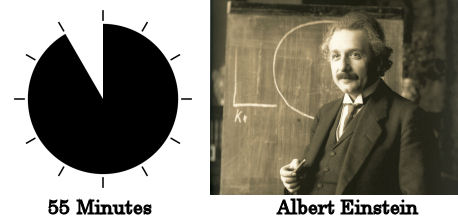
Question for Quote Investigator: The importance of laying the proper groundwork before attempting to solve a problem is emphasized in a popular statement that is usually attributed to the scientific luminary Albert Einstein. Here are three versions:
If I had only one hour to save the world, I would spend fifty-five minutes defining the problem, and only five minutes finding the solution.
If I had an hour to solve a problem I’d spend 55 minutes thinking about the problem and 5 minutes thinking about solutions.
Given one hour to save the planet, I would spend 59 minutes understanding the problem and one minute resolving it.
Because there are so many different variations I do not have much confidence that this was actually said by the acclaimed genius. Would you please explore this expression?
Reply from Quote Investigator: There is no substantive evidence that Einstein ever made a remark of this type. It is not listed in the comprehensive collection “The Ultimate Quotable Einstein” from Princeton University Press.1 Einstein died in 1955, and the first attribution to Einstein known to QI appeared in 1973. The citation is presented further below.
The earliest match known to QI appeared in leaflet published in 1945 titled “Get It Right the First Time” by Professor of Education George E. Carrothers of the University of Michigan, Ann Arbor. Carrothers credited the saying to a mathematician. Boldface added to excerpts by QI:2
Once upon a time Professor Robert J. Aley, head of the Department of Mathematics in Indiana University, said that if he had just one hour in which to work a problem, after which he would be hanged if he did not have the correct answer, he would spend the first fifty minutes reading and studying the problem, and would not begin to make any marks or figures during that time.
We students in his class were not at all sure but that he might become a bit nervous about the 48th or 49th minute, but that was beside the point; he wanted to impress upon us the importance of thinking about problems before attempting solutions or trial and error answers
The citation above was obtained via Google Books snippet view and has not yet been verified with hardcopy.
Here are additional selected citations in chronological order.
In 1966 the saying appeared within a collection of articles about manufacturing. An employee of the Stainless Processing Company named William H. Markle wrote a piece titled “The Manufacturing Manager’s Skills” which included a strong match. However, the words were credited to an unnamed professor at Yale University and not to Einstein. Also, the hour was split into 40 vs. 20 minutes instead of 55 vs. 5 minutes:3
Some years ago the head of the Industrial Engineering Department of Yale University said, “If I had only one hour to solve a problem, I would spend up to two-thirds of that hour in attempting to define what the problem is.”
In 1973 a version of the saying was assigned to Albert Einstein in an article in the journal “Invention Intelligence” based in New Delhi, India. Interestingly, the hour was split into three parts instead of two. No supporting data for the attribution was given:4
Often the problem as given is misleading, and you have to work through a mass of data to define the real problem. Often this step consumes more time than deriving the solution. Einstein said: “If I were given an hour in which to do a problem upon which my life depended, I would spend 40 minutes studying it, 15 minutes reviewing it and 5 minutes solving it.”
In 1986 an instance of the saying was attributed to Einstein in a paper published in the conference proceedings of the International Association of Quality Circles. The hour was split into two parts. The phrase “Einstein is reported to have said” suggested that the author did not have much confidence in the ascription:5
Einstein is reported to have said that if he only had one hour to solve a problem he would spend 55 minutes defining the problem and the remaining 5 minutes solving it routinely.
In 1989 “The Practical Guide to Joint Ventures and Corporate Alliances” was published, and the author presented an instance attributed to Einstein. This version once again split the hour into three parts:6
Albert Einstein was once asked how he would spend his time if he was given a problem upon which his life depended and he had only one hour to solve it. He responded by saying he would spend 30 minutes analyzing the problem, 20 minutes planning the solution, and ten minutes executing the solution. For those overly prone to jumping into action, a bit more planning would be worthwhile.
Skilled researchers Jesse Mazer and Barry Popik have also examined this saying and some of their findings have been incorporated in the next section.7 8
In 1995 the book “Creative Problem Solving and Opportunity Finding” printed an instance of the expression in which Einstein was called upon to save the world:9
Dewey believed that a problem well stated was half solved. Albert Einstein was even more emphatic about the importance of the definition of the problem. He was once asked: “If you have one hour to save the world, how would you spend that hour?” He replied, “I would spend 55 minutes defining the problem and then five minutes solving it.”
In March 1995 “The Orange County Register” newspaper of California printed the remarks of a management professor at McMasters University in Ontario who credited Einstein with an instance of the saying:10
While brainstorming and problem solving are important, it’s equally critical to pinpoint the exact problem, Basadur said. “When Einstein was asked how he would save the world in one hour, he said he’d spend 55 minutes defining the problem and five minutes solving it,” Basadur said.
A 2012 book about the talents needed by workers in the robotic age presented a dramatic scenario for the time limit and suggested that Einstein delivered his remarks during an interview:11
In another interview he said that if he knew a fiery comet was certain to destroy the earth in an hour, and it was his job to head it off, he would spend the first fifty-five minutes defining the problem and the last five minutes solving it.
An interesting analogous statement has been spuriously attributed to another eminent person. The following remark about preparing to perform a task is usually assigned to Abraham Lincoln. An examination of its provenance is available by following this link:
Give me six hours to chop down a tree and I will spend the first four sharpening the axe.
In conclusion, currently there is no known substantive support for the claim that Albert Einstein made one of these remarks. The earliest evidence points to mathematician Robert J. Aley of Indiana University. The popular expression has been evolving for decades leading to a creative efflorescence of inaccuracies.
Image Notes: Albert Einstein during a lecture in Vienna in 1921 via Wikimedia Commons. Clock face showing 55 minutes from OpenClips on Pixabay.
Acknowledgement: Myriad thanks to John McChesney-Young for obtaining scans of the important 1973 citation. Great thanks to Don MacDonald and the librarians of the Harvard Business School for obtaining scans of the key 1986 citation. Many thanks to Barry Popik whose previous research and query led QI to formulate this question and perform this exploration. Special thanks to Jesse Mazer for his valuable work tracing Einstein attributions at Wikiquote. Many thanks to Ilya Ilba who told QI about the important 1945 citation.
Update History: On June 20, 2014 the 1973 citation was moved from the appendix into the main body of the article. This movement occurred after the citation had been verified with scans. On September 12, 2024 the format of the bibliographical notes was updated. On March 28, 2026 the 1945 citation was added to the article.
- 2010, The Ultimate Quotable Einstein, Edited by Alice Calaprice, Princeton University Press, Princeton, New Jersey. (Examined on paper) ↩︎
- Date: 1945 December, Observations – Leaflet Number 27, Bureau of Cooperation with Educational Institutions, University of Michigan, Title: Get It Right the First Time, Author: George E. Carrothers (Professor of Education at the University of Michigan, Ann Arbor), Quote Page 23, Note: Not yet verified; this information was extracted from Google Books; this information may be inaccurate and it must be verified with hardcopy. link link ↩︎
- 1966, The Manufacturing Man and His Job by Robert E. Finley and Henry R. Ziobro, “The Manufacturing Manager’s Skills” by William H. Markle (Vice President, Stainless Processing Company, Chicago, Illinois), Start Page 15, Quote Page 18, Published by American Management Association, Inc., New York. (Verified on paper) ↩︎
- 1973 August, Invention Intelligence, Volume 8, Number 8, Can I Learn to Invent? by A. M. Elijah (Director, Institute of Creative Development, Poona-1), Start Page 294, Quote Page 297, Issued by the National Research Development Corporation of India in New Delhi, India. (Verified with scans; thanks to John McChesney-Young and the University of California, Berkeley library system) ↩︎
- 1986, Educational Transactions of the 8th Annual IAQC Spring Conference, “Creatively Managing Your Mind” by Robert J. Greene (IBM Corporation), Start Page 62, Quote Page 68, Published by International Association of Quality Circles. (Verified with scans; thanks to Don MacDonald and the Harvard Business School, Baker Library) ↩︎
- 1989, The Practical Guide to Joint Ventures and Corporate alliances by Robert Porter Lynch, Chapter 13: Problems and Pitfalls in Strategy and Structure, Quote Page 225 and 226, John Wiley & Sons, New York. (Verified on paper) ↩︎
- Website: Wikiquote: Discussion Page, Webpage Title: Talk: Albert Einstein, Discussion topic: If I had only one hour to save the world, I would spend fifty-five minutes defining the problem, and only five minutes finding the solution, Date of modification: January 10, 2012, Handle of person adding note: Hypnosifl, Website description: All about Quotations. (Accessed wikiquote.org on May 22, 2014) ↩︎
- Website: The Big Apple, Article title: “If I had an hour to solve a problem, I would spend 55 minutes thinking about the problem”, Date on website: May 06, 2014, Website description: Etymological dictionary with more than 10,000 entries. (Accessed barrypopik.com on May 21, 2014) ↩︎
- 1995, Creative Problem Solving and Opportunity Finding by J. Daniel Couger, Chapter 6, Quote Page 178, Boyd & Fraser Publishing Company, Danvers, Massachusetts, A division of International Thomson Publishing. (Verified with scans) ↩︎
- 1995 March 19, The Orange County Register, Section: Business, “BUSINESS FIND A NEW TOOL: CREATIVITY – STRATEGIES: More companies are encouraging creative thinking in order to remain competitive” by Edward Iwata, Page: k01, Santa Ana, California. (NewsBank Access World News) ↩︎
- 2012, Metaskills: Five Talents for the Robotic Age by Marty Neumeier, Unnumbered page, Published by New Riders, an imprint of Peachpit, a division of Pearson Education. (Google Books Preview) ↩︎