Samuel Butler? Eliza Mary Ann Savage? Ogden Nash? Mandell Creighton? Charles Bowen? George Ferguson Bowen? William Burns? Anonymous?
Question for Quote Investigator: A well-known bible verse, Matthew 5:45, discusses God and the weather:1
Your Father who is in heaven, who maketh his sun to rise upon the good and the evil, and raineth upon the just and the unjust.
This Biblical verse has attracted humorous commentary. Here is one version of a joke that has been circulating for more than one-hundred years:
It raineth by th’ eternal laws
Upon the just and unjust fella;
But mostly on the just, because
The unjust steals the just’s umbrella.
This jest has been attributed to the prominent English novelist Samuel Butler, the popular U.S. poet Ogden Nash, the English judge Charles Bowen, the British administrator George Ferguson Bowen, and others. Would you please explore the provenance of this comical analysis?
Reply from Quote Investigator: This joke is difficult to trace because it can be expressed in many ways. A partial match occurred within the 1853 book “Life in New York, in Doors and Out of Doors” illustrated by William Burns. Boldface added to excerpts by QI:2
Heaven makes the rain to fall on the just and the unjust; the just and the unjust resort to umbrellas for protection from too much of the blessing—the former buying them honestly, the latter stealing them dishonestly—and so comes that large class of workers—the umbrella makers.
The above passage did contain the core elements of the joke, but it did not state that the “just” people encountered more raindrops. The omission of this punchline rendered this instance incomplete.
The earliest full match located by QI appeared in October 1879 within the “Bucks County Gazette” of Bristol, Pennsylvania. The newspaper printed a set of miscellaneous quips under the title “Odds and Ends” which included this item:3
It rains alike on the just and the unjust—on the just mainly because the unjust have borrowed their umbrellas.
The creator of the joke was anonymous. The attributions to Samuel Butler, Ogden Nash, Charles Bowen, and George Ferguson Bowen all occurred later, and QI has not yet found substantive support for these attributions.
Below are additional selected citations in chronological order.
In October 1879 the joke above appeared without attribution in several other newspapers such as the “Burlington Free Press” of Vermont4 and “The Minneapolis Tribune” of Minnesota.5
In December 1879 the joke appeared in the “Young Ireland” newspaper of Dublin, Ireland.6
In 1880 “The Referee” newspaper of London, England published a slightly different instance using the word “generally”:7
“It rains alike on the just and the unjust, because,” says an American humourist, “the unjust have generally stolen the just’s umbrella.”
In 1881 Eliza Mary Ann Savage wrote a letter to her friend Samuel Butler. Savage described a conversation during which she employed the punchline of the joke which was already in circulation:8
Mrs. A. hears from her friend of the good fortune of some bad people (dissenters probably) and exclaims ‘Dear, dear, to think now of their having such good luck’. Her friend says ‘Well, well, it rains alike on the just as well as the unjust’. I smarting with a sense of wrong say from the other end of the room, ‘it rains more on the just, for the unjust take the umbrellas’. I hope you will laugh at my little joke. They didn’t.
Butler replied with praise for the quip, and Butler suggested that he might use it in his writing:9
I liked your plum about the umbrellas. I must try and get it in somewhere.
Henry Festing Jones described this exchange in his biography of Samuel Butler. Jones mentioned the book that Butler was writing in 1881, and Jones stated that the joke was not included in Butler’s book:10
He was writing Alps and Sanctuaries at the time, and meant that he must put her remark into the book; he used to say that one can get anything in anywhere if one sets to work; but I have not found this particular plum in the book.
In 1882 a version of the jest appeared in “The Vassar Miscellany” which was published by the students of Vassar College in Poughkeepsie, New York:11
“The rain falls on the just and the unjust,” remarked the Sophomore editor as he left the sanctum with the editorial umbrella. “Upon the just, principally,” commented the chief, “because the unjust have gone off with the umbrella.” —College Olio.
In 1884 “The Speaker’s Garland and Literary Bouquet” included a pertinent entry in a section titled “Witticisms and Funny Sayings”:12
It rains alike on the just and the unjust—and on the just mainly because the unjust have borrowed their umbrellas.
In 1890 “The Detroit Free Press” of Michigan printed a filler item titled “Heard in Conversation”:13
“Rain falls on the unjust and just,” declared he,
“Alike.” Then said some other fellow,
“Oh, no, that’s not true, for the unjust, you see,
Have borrowed the just’s umbrella.”
In 1892 “The National Tribune” of Washington, D.C. printed this version:14
The Reverend Mr. Harps—You know, my friend, that it rains alike on the just and on the unjust.
Old Flint—I don’t know about that, Parson. It strikes me that it rains on the just, largely; the unjust usually have the just’s umbrellas.
In June 1897 the popular New York humor magazine “Judge” printed an instance:15
The rain it falls upon the just
And, too, upon the unjust fellows,
But more upon the just because
The unjust have the just’s umbrellas.
In November 1897 “The Manchester Guardian” of Manchester, England reported that Mrs. Humphry Ward employed an instance while delivering an address:16
It reminds me of the little American rhyme—
“The rain it raineth every day,
Both on the just and unjust fellers;
But more upon the just, because
The unjust have the just’s umbrellas!”
(Laughter and applause.)
In 1898 “The Tammany Times” of New York printed the following instance:17
It looks very much as if New York had a rainy season, for it raineth every day. The rain falls equally on the just and the unjust, but it has been noticed that, as a general thing, only the just get wet, as the unjust swim off, so to speak, with the umbrellas of the just.
In 1899 “The Pall Mall Magazine” of London printed this instance:18
“The rain it raineth every day upon the just and unjust fellows, But chiefly on the just, because the unjust take the justs’ umbrellas.”
In 1903 “T.P.’s Weekly” of London credited an instance to Anglican Bishop Mandell Creighton using the word “steal”:19
Apropos of bishops, repartees, and rain, here is a ready epigram of the late Bishop of London’s, extemporised upon the complaint of a clergyman that his umbrella had been stolen from him at his Lordship’s visitation of the clergy:
It raineth by th’ eternal laws
Upon the just and unjust fella;
But mostly on the just, because
The unjust steals the just’s umbrella.
In 1923 English writer Walter Sichel published a memoir titled “The Sands of Time: Recollections and Reflections”. Sichel attributed an instance to Lord Bowen (Charles Bowen):20
It was he again who penned the familiar anacreontic on the vanishing umbrellas at the Athenaeum Club:
The rain, it raineth on the just
And also on the unjust fella.
But chiefly on the just, because
The unjust steals the just’s umbrella.
The citation above was the earliest known to QI which attributed to joke to Charles Bowen who died in 1894. This long delay reduced the credibility of the attribution. It is possible that Charles Bowen employed the joke, but QI believes he did not craft it.
In 1932 the “Queries and Answers” section of “The New York Times Book Review” examined the topic of joke authorship.21 The first correspondent pointed to Walter Sichel’s 1923 book “The Sands of Time” and highlighted the attribution to Lord Bowen.
The second correspondent pointed to a book that was published forty years earlier in 1892 titled “The Satires of Cynicus” by the pseudonymous Cynicus. But QI has examined both “The Satires of Cynicus”22 and “The Humours of Cynicus”.23 Neither contained the joke under examination. Also, 1892 is a late date for this joke.
The third correspondent suggested that the creator might be Anglo-Irish satirist Jonathan Swift who died in 1745. But QI has found no support for that conjecture.
In 1935 “The Home Book of Quotations Classical and Modern” compiled by researcher Burton Stevenson contained the following entry:24
The rain it raineth on the just
And also on the unjust fella;
But chiefly on the just, because
The unjust steals the just’s umbrella.Sir George Ferguson Bowen. (Sichel, Sands of Time, p. 82.) Also attributed to “Cynicus,” said to have been a Mr. Robertson, of Fifeshire, Scotland, and to Dean Swift.
Stevenson largely repeated the information from “The New York Times Book Review”. Stevenson was usually a careful researcher, but in this case, he misread Sichel’s book which attributed the joke to Charles Bowen and not George Ferguson Bowen.
In 1945 “The Pocket Book of Humorous Verse” edited by David McCord credited the four-line instance above to Lord Bowen.25
In 1960 “The Penguin Dictionary of Quotations” compiled by J. M. Cohen and M. J. Cohen credited the four-line instance above to Lord Bowen.26
In 1974 Lord Clark delivered a speech in the House of Lords of the United Kingdom Parliament. He attributed an instance to Samuel Butler:27
I expect that Samuel Butler’s immortal verses have often been quoted in your Lordships’ House:
“The rain it falleth every day upon the just and unjust fella,”
“But chiefly on the just, because the unjust’s got the just’s umbrella.”
In 2005 a columnist in the “Tucson Citizen” newspaper of Arizona attributed an instance to the poet Ogden Nash:28
Szeto’s perpetual plight calls to mind that rhythmic rumination by Ogden Nash: “The rain, it raineth on the just and also on the unjust fella; But mostly on the just, because the unjust steals the just’s umbrella.”
In conclusion, the earliest full instance found by QI appeared in 1879. The original creator remains unknown. Eliza Mary Ann Savage mentioned the joke in an 1881 letter to Samuel Butler, but it was already in circulation. Lord Bowen (Charles Bowen) received credit in 1923, but that was a very late date; hence, the evidence was not substantive.
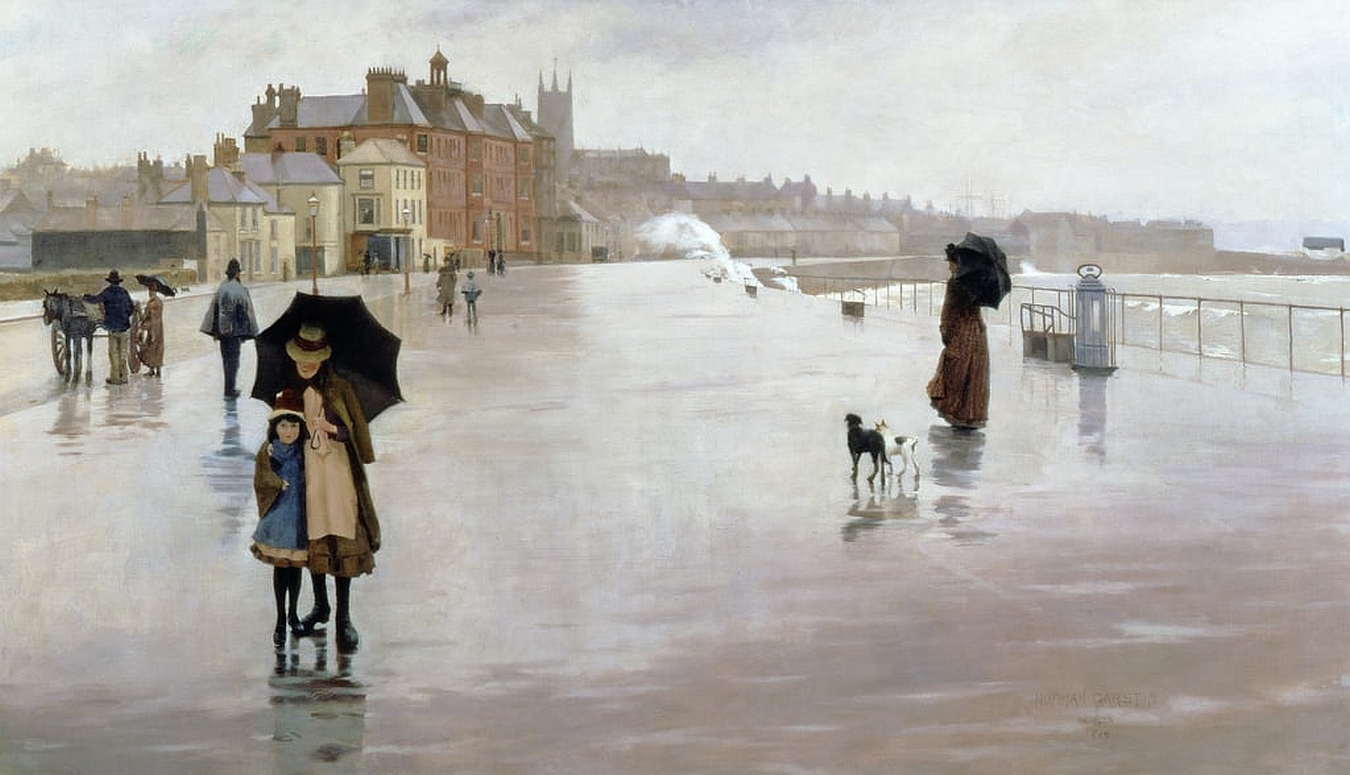
Image Notes: Artist Norman Garstin’s 1889 painting titled “The Rain It Raineth Every Day”. The image has been resized.
Acknowledgement: Great thanks to Lizard whose inquiry led QI to formulate this question and perform this exploration. Lizard mentioned the attributions to Ogden Nash and Lord Bowen.
- Website: BibleHub, Gospel of Matthew, Chapter 5, Verse 45, Translation: Wycliffe’s Bible, Website description: Online Bible Study Suite; Bible Hub is a production of the Online Parallel Bible Project. (Accessed BibleHub.com on February 4, 2026) link ↩︎
- 1853, Life in New York, in Doors and Out of Doors, Illustrated by the Late William Burns, Chapter: The Umbrella Maker, Unnumbered Quote Page, Bunce & Brother, New York. (Google Books Full View) link ↩︎
- 1879 October 16, Bucks County Gazette, Odds and Ends, Quote Page 1, Column 7, Bristol, Pennsylvania. (Newspapers_com) ↩︎
- 1879 October 16, Burlington Free Press & Times, Notes and Motes, Quote Page 2, Column 2, Burlington, Vermont. (Newspapers_com) ↩︎
- 1879 October 18, The Minneapolis Tribune, Tea-Table Gossip, Quote Page 2, Column 9, Minneapolis, Minnesota. (Newspapers_com) ↩︎
- 1879 December 20, Young Ireland, Gas-Jets, Quote Page 819 (23), Column 1, Dublin, Ireland. (British Newspaper Archive) ↩︎
- 1880 July 4, The Referee, Edited by Pendragon, Untitled item, Quote Page 7, Column 4, London, England. (British Newspaper Archive) ↩︎
- 1935, Letters Between Samuel Butler and Miss E. M. A. Savage, 1871-1885, Letter number 195, Letter date: Probably August 13, 1881, Letter from: Eliza Mary Ann Savage, Letter to: Samuel Butler, Quote Page 257 and 258, Jonathan Cape, London. (Verified with scans) ↩︎
- 1935, Letters Between Samuel Butler and Miss E. M. A. Savage, 1871-1885, Letter number 197, Letter date: September 4, 1881, Letter from: Samuel Butler, Letter to: Eliza Mary Ann Savage, Quote Page 259, Jonathan Cape, London. (Verified with scans) ↩︎
- 1919, Samuel Butler, Author of Erewhon (1835-1902): A Memoir by Henry Festing Jones, Volume 2 of 2, Chapter 43: 1902-1916: On Lips of Other Men, Quote Page 423, Macmillan and Company, London. (Google Books Full View) link ↩︎
- 1882 February, The Vassar Miscellany, Volume 11, Number 5, Clippings from Exchanges, Quote Page 253, Published by the Student’s Association of Vassar College, Poughkeepsie, New York. (Google Books Full View) link ↩︎
- 1884, The Speaker’s Garland and Literary Bouquet, Volume 2, Supplement to One Hundred Choice Selections No. 7, Witticisms and Funny Sayings, Quote Page 187, P. Garrett & Company, Philadelphia, Pennsylvania. (Google Books Full View) link ↩︎
- 1890 May 4, The Detroit Free Press, Heard in Conversation, Quote Page 10, Column 5, Detroit, Michigan. (Newspapers_com) ↩︎
- 1892 December 15, The National Tribune, Tribunets: The Way It Works, Quote Page 6, Column 5, Washington, D.C. (Newspapers_com) ↩︎
- 1897 June 26, Judge, Volume 32, Number 819, ‘Twas Ever Thus, Quote Page 432, The Judge Publishing Company, New York. (Verified with scans) link ↩︎
- 1897 November 4, The Manchester Guardian, The Unitarian Bazaar in St. James’s Hall, Address by Mrs. Humphry Ward, Quote Page 5, Column 5, Manchester, England. (Newspapers_com) ↩︎
- 1898 August 1, The Tammany Times, Untitled filler item, Quote Page 8, Column 1, The Tammany Times Company, New York. (Google Books Full View) link ↩︎
- 1899 July, The Pall Mall Magazine, Volume 18, Number 75, From a London Attic by G. S. Street, Quote Page 428, Column 2, Office of Pall Mall Magazine, London. (Google Books Full View) link ↩︎
- 1903 July 3, T.P.’s Weekly, T.P In His Anecdotage: Bishop Creighton and the stolen umbrella, Quote Page 99, Column 2, T.P.’s Weekly, London. (Google Books Full View) link ↩︎
- 1923, The Sands of Time: Recollections and Reflections by Walter Sichel, Chapter 4: Harrow, Quote Page 82, Hutchinson & Company, London. (Google Books Full View) link ↩︎
- 1932 July 31, The New York Times, Section: The New York Times Book Review, Queries and Answers, “The Just and Unjust”, Quote Page 19, Column 2, New York. (Verified with scans) ↩︎
- 1892, The Satires of Cynicus by Cynicus, (The target quotation is absent), The Cynicus Publishing Company, London. (Google Books Full View) link ↩︎
- 1892, The Humours of Cynicus by Cynicus, (The target quotation is absent), The Cynicus Publishing Company, London. (Google Books Full View) link ↩︎
- 1935, The Home Book of Quotations Classical and Modern, Selected and Arranged by Burton Stevenson, Entry: Umbrella, Quote Page 2065, Column 2, Dodd, Mead & Company, New York. (Verified with scans) ↩︎
- 1946 (1945 Copyright), The Pocket Book of Humorous Verse, Gathered and Edited by David McCord, Part One, Shirtsleeve Philosophy, Quote Page 325, Pocket Books, New York. (Verified with scans) ↩︎
- 1960, The Penguin Dictionary of Quotations, Edited by J. M. Cohen and M. J. Cohen, Entry: Lord Bowen, Quote Page 64, Column 2, Penguin Books, London. (Verified with scans) ↩︎
- UK Parliament Hansard, Date: June 26, 1974, Lords Chamber, Topic: Wealth Tax Proposal and Historic Houses, Speaking: Lord Clark. (Accessed Hansard of UK Parliament hansard.parliament.uk on Feb 4, 2026) link ↩︎
- 2005 February 3, Tucson Citizen, Section: Calendar, ‘Butterfly’ a seductive work of beauty by Chuck Graham, Quote Page 9, Column 4, Tucson, Arizona. (Newspapers_com) ↩︎