Voltaire? Henry Wadsworth Longfellow? Apocryphal?
Question for Quote Investigator: The philosopher and historian Voltaire (penname of François-Marie Arouet) wrote about metaphorically dying twice. One dies when one can no longer form a bond of love. One dies again when the physical body expires. I do not know the precise phrases Voltaire used to express this idea. Would you please help me to find a citation?
Reply from Quote Investigator: In 1745 the sixth volume of a large collection of works by Voltaire appeared. The following verse was included. Boldface added to excerpts by QI:1
On meurt deux fois, je le vois bien :
Cesser d’aimer & d’être aimable,
C’est une mort insupportable :
Cesser de vivre, ce n’est rien.
Here is one possible translation into English:
One dies twice, I see it clearly:
To cease to love and to be lovable,
It’s an unbearable death:
To cease to live is nothing.
The verse was inspired by Voltaire’s complicated intellectual and romantic relationship with mathematician and physicist Émilie du Châtelet. Below are additional selected citations in chronological order.
In 1743 a slightly different version of the verse appeared in the Paris journal “Mercure de France”:2
On meurt deux fois, je le vois bien ;
Cesser de plaire & d’être aimable,
C’est une mort insupportable ;
Cesser de vivre ce n’est rien.
Here is one possible translation into English:
One dies twice, I see it well;
To cease to please and to be lovable,
It’s an unbearable death;
To cease to live is nothing.
In 1870 a rhyming version of the verse in English appeared in the collection “The Poets and Poetry of Europe” edited by Henry Wadsworth Longfellow:3
Yes, one dies twice, I see it plain;
Ceasing to love or love to kindle
Is the worst death on Clotho’s spindle;
Ceasing to live is little pain.
In 1880 the collection “A Thousand Flashes of French Wit, Wisdom, and Wickedness” included another version of the quotation in English:4
One dies twice: to cease to live is nothing, but to cease to love and to be loved is an insupportable death.
Voltaire.
In 1920 “The Wasp: The Pacific Coast Weekly” of San Francisco, California printed an instance:5
One dies twice: to cease to live is nothing, but to cease to love and to be loved is an insupportable death. —Voltaire.
In 2021 the important reference work “The Quotable Voltaire” edited by Garry Apgar and Edward M. Langille included the quotation together with another English translation. The reference stated that the couplet dated from 1741 during Voltaire’s relationship with Émilie du Châtelet:6
On meurt deux fois, je le vois bien:
Cesser d’aimer & d’être aimable,
C’est une insupportable mort ;
Cesser de vivre ce n’est rien.We die twice o’er, I do believe;
Once we stop loving and being loved,
That is the harshest death by far;
T’is really nothing to cease to live.
In conclusion, Voltaire deserves credit for the French verse which appeared in the 1745 collection of his works. Several different translations into English appeared during subsequent decades.
Acknowledgements: Great thanks to Joseph Rice, Michael DeBusk, Gil Whalen whose inquiries led QI to formulate this question and perform this exploration. The inquiries were about different phrases which referred to “two deaths” and “die twice”. This article focuses on the Voltaire quotation.
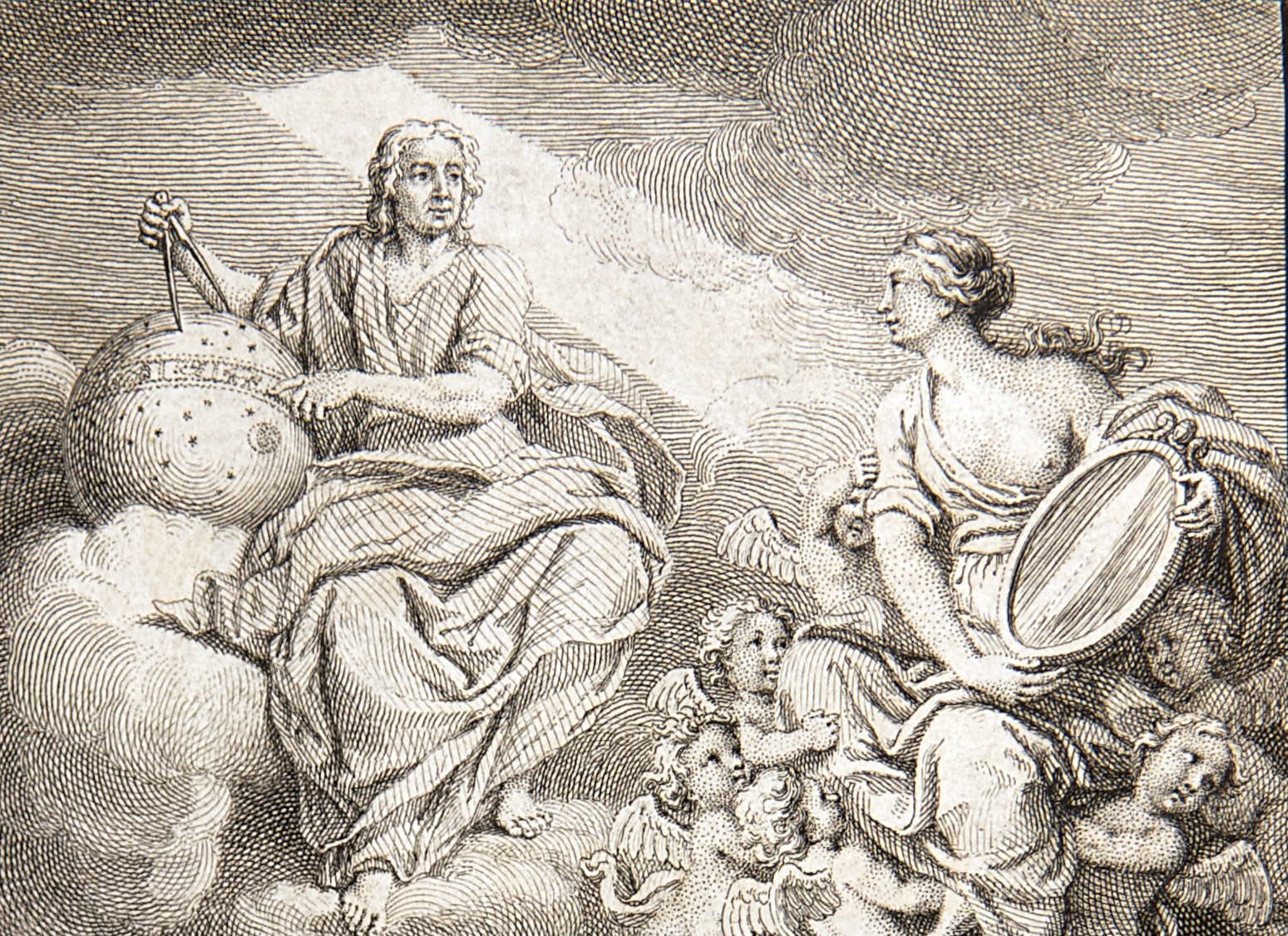
Image Notes: Detail from the frontispiece to Voltaire’s book on Newton’s philosophy. The image depicts Voltaire with Émilie du Châtelet as his muse. She is reflecting heavenly insights. The image is from the public domain.
- 1745, Œuvres De Mr. De Voltaire, Tome Sixième (Volume Six), Stances, Start Page 349, Quote Page 350, Chez Arckstee & Merkus, A. Amsterdam & A. Leipzig. (Google Books Full View) link ↩︎
- 1743 Décembre, Mercure de France, Quatrains, Start Page 2598, Quote Page 2598 and 2799, Paris, France. (Google Books Full View) link ↩︎
- 1870, The Poets and Poetry of Europe, Edited by Henry Wadsworth Longfellow, New Edition Revised and Enlarged, Section: Supplement French, To Madame Du Chatelet by Voltaire, Quote Page 841, Houghton, Mifflin and Company, Boston, Massachusetts. (Internet Archive) link ↩︎
- 1880, A Thousand Flashes of French Wit, Wisdom, and Wickedness, Collected and Translated by J. De. Finod, Quote Page 113, D. Appleton and Company, New York. (Internet Archive) link ↩︎
- 1920 February 28, The Wasp: The Pacific Coast Weekly, Volume 4, Number 8, Flashes of French Wit and Wisdom, Quote Page 3, Column 3, The Wasp Publishing Company, San Francisco, California. (Internet Archive) link ↩︎
- 2021, The Quotable Voltaire, Edited by Garry Apgar and Edward M. Langille, Section: Quotations by Voltaire, Topic: Love, Quote Page 177, Bucknell University Press, Lewisburg, Pennsylvania. (Verified with hardcopy) ↩︎