Mulla Nasreddin? Khodshah? Khoja Nasr ed-Dîn Effendi? Harry Charles Lukach? Anonymous?
Question for Quote Investigator: In the past you have examined a family of humorous anecdotes about credulousness. The punchline of these tales was:
Who you gonna believe, me or your lying eyes?
There is another anecdote of this type which seems to be older: A neighbor wished to borrow a donkey from a person who was reluctant to loan the animal. The person indicated that the donkey was located elsewhere and unavailable. A moment later the donkey began to bray in the nearby stable. The neighbor exclaimed “Do I not hear the donkey’s braying?” The person responded angrily:
“You fool! Would you believe me or the donkey?”
This punchline has been credited to the international folklore character Nasreddin (or Nasruddin). Would you please explore the provenance of this tale?
Reply from Quote Investigator: The earliest match in English found by QI appeared in 1885 within a Buffalo, New York newspaper which acknowledged a newspaper in Vienna, Austria. Boldface added to excerpts by QI:1
A Turkish joke—One day a man came to Khodshah and said: “I need a donkey to-day; won’t you lend me yours?” “I no longer own a donkey,” was the answer. At the same moment the donkey began to bray in stable. “Oh,” exclaimed the man, “do I not hear the donkey’s braying?” “What?” retorted Khodshah angrily, “would you sooner believe a donkey than me?” — Wiener Fremdenblatt.
QI conjectures that earlier instances exist in the Turkish language. This folklore tale circulates in many countries including Türkiye and Iran. The Nasruddin character is usually dated to the 13th century, but the chronology of the many associated anecdotes is highly variable.
Below are additional selected citations in chronological order.
In 1886 the anecdote was reprinted in the journal “Cottage Hearth” of Boston, Massachusetts.2
In 1890 the anecdote was reprinted in the “St. James Parish Mirror” of Milwaukee, Wisconsin.3
In 1913 British administrator Harry Charles Lukach published “The Fringe of the East: A Journey Through Past and Present Provinces of Turkey” which contained the following version of the tale:4
One day a man went to the Khoja, and asked for the loan of his donkey. The Khoja replied that the donkey was not there, but at that moment the beast brayed and so betrayed its presence.
“Ah, so the donkey is here after all?” said the man.
“O Fool, begone! Would’st thou believe my donkey before me?”
Lukach’s book presented the following description of Khoja Nasr ed-Dîn Effendi:5
Some five hundred years ago there lived in Asia Minor, in the little town of Aqshehir, which lies between Afiun Karahissar and the ancient Seljuq capital of Konia, the Khoja Nasr ed-Dîn Effendi of happy and genial memory. At Aqshehir he died and was buried; and his tomb may be seen to-day by the traveller on the Baghdad Railway, surmounted by the gigantic green turban which he affected. The Khoja was a village Imâm, a sort of country parson …
In June 1913 “T. P.’s Weekly” of London discussed Lukach’s book and reprinted the donkey anecdote.6
In 1924 the anecdote titled “The Loan of a Donkey” appeared in the book “The Khoja: Tales of Nasr-ed-Din”. These stories were translated from the Turkish by Henry D. Barnham:7
One day a neighbour asked the Khoja for the loan of his donkey. “It is not here,” said he. Just at that moment the donkey began to bray.
“Hullo!” said the man, “you say it is not here, and there it is braying!”
The Khoja shook his head at him. “You are a strange fellow. You believe my donkey, but don’t believe me, in spite of my grey beard!”
A thematically similar joke appeared in the 1933 Marx Brothers movie “Duck Soup”. Chico Marx delivered the punchline:
Well, who ya gonna believe me or your own eyes?
This family of jokes was based on discounting visual evidence instead of auditory evidence. A separate QI article about this joke is available here.
In 1960 U.S. salesman Elmer Wheeler published “Around the World with Elmer … Backwards or How to Haggle in 17 Countries”, and he included the following version of the anecdote:8
The great humorist of Turkey is Nasreddin Hodja. Everyone has a Hodja story to tell. …
Hodja was asked once for the loan of his donkey, but, knowing the asker mistreated donkeys, he said the donkey was no longer there. Suddenly the donkey brayed. “You say the donkey is no longer around, but I can hear him,” said the donkey-beater and would-be borrower. Hodja replied, “Would you believe me or the donkey?”
In 1961 the periodical “Iran Review” presented a version ascribed to Persian folklore:9
A friend came to borrow Mulla’s donkey for a day, and Mulla said the donkey was out. At that very minute the donkey began to bray from the stable.
“Hey! There is the donkey!” exclaimed his friend.
Mulla said, “Do you believe me or the donkey?”
In 1964 “The Sufis” by Idries Shah included the following instance of the tale:10
A neighbor went to Nasrudin, asking to borrow his donkey. “It is out on loan,” said the Mulla. At that moment the donkey was heard to bray, somewhere inside the stable.
“But I can hear it bray, over there.”
“Whom do you believe,” said Nasrudin; “me or a donkey?”
In 1968 “Psychiatry East and West: An Account of Four International Conferences” contained a version of the tale told by Dr. George Vassiliou who was the Director of the Athenian Institute of Anthropos, Athens, Greece:11
There is a Turkish-Greek joke where a man was asked by another man to lend him his donkey. And he said, “I left the donkey in the mountains.” At that moment, the donkey brayed, so the first man said, “Mister, you are lying,” whereupon the second man asked, “Do you believe me or the donkey?”
In conclusion, this tale is associated with the humorous folklore character Khoja Nasr ed-Dîn Effendi (or Nasreddin Hodja) who appears in thousands of stories. The character is commonly placed in the 13th century. An English version of the anecdote was circulating by 1885, but earlier instances are likely to exist in Turkish.
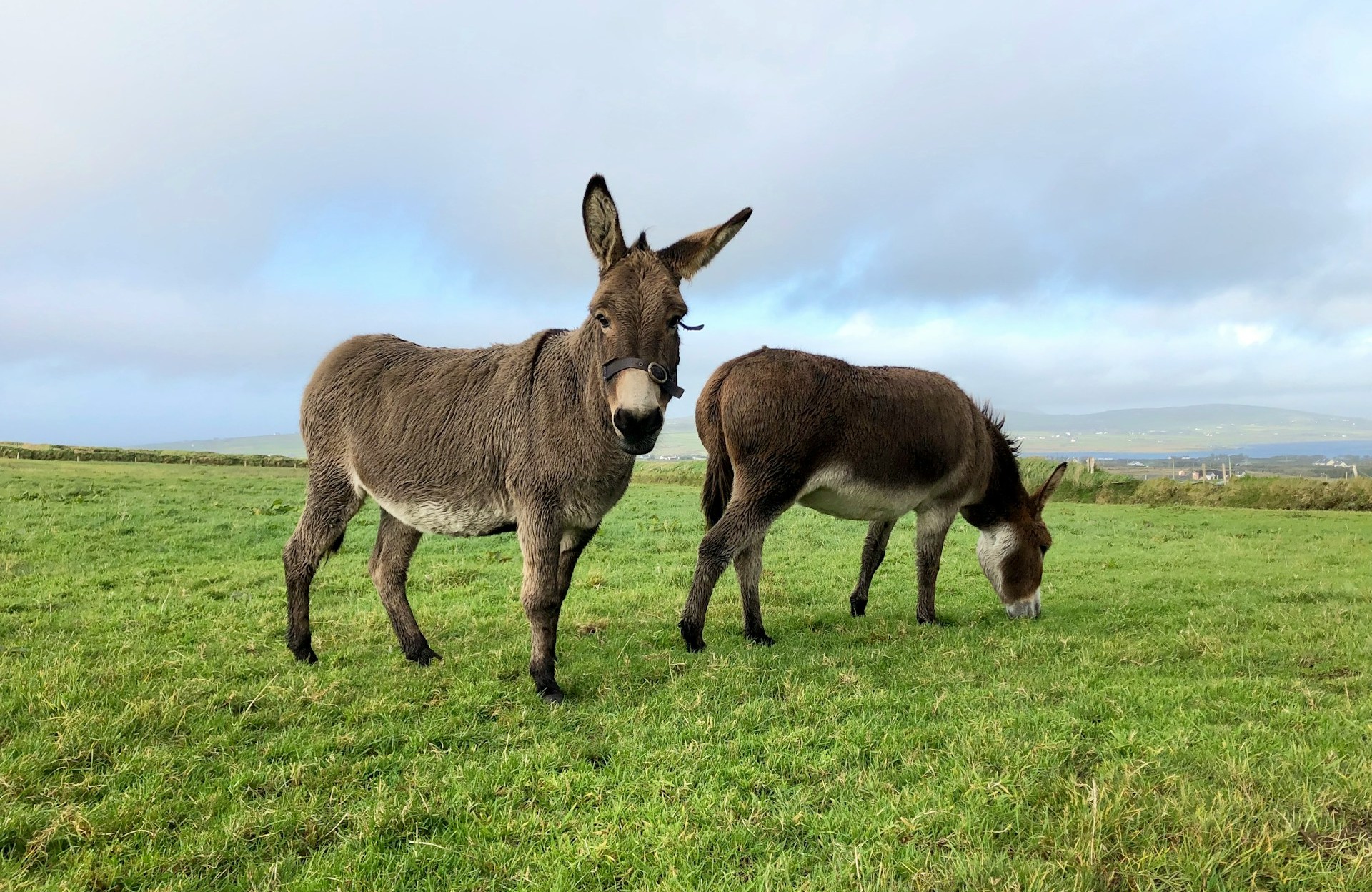
Image Notes: Picture of grazing donkeys in Doora, Ireland from Christian Hess Araya at Unsplash. The image has been cropped and resized.
Acknowledgement: Great thanks to Matt Wachsman whose email led QI to formulate this question and perform this exploration. Wachsman saw the QI article about the joke in the 1933 Marx Brothers movie “Duck Soup”, and Wachsman told QI about the earlier family of thematically similar jokes featuring the Nasruddin character.
- 1885 November 5, The Buffalo Daily Courier, All Sorts, Quote Page 3, Column 3, Buffalo, New York. (Newspapers_com) ↩︎
- 1886 June, Cottage Hearth, Volume 12, Number 6, Wit and Humor, Quote Page, Column 2, Boston, Massachusetts. (Google Books Full View) link ↩︎
- 1890 July, St. James Parish Mirror, Volume 2, Number 22, A Turkish Joke, Quote Page 11, Column 1, Milwaukee, Wisconsin. (Google Books Full View) link ↩︎
- 1913, The Fringe of the East: A Journey Through Past and Present Provinces of Turkey by Harry Charles Lukach, Chapter: Introduction, Quote Page 2, Macmillan and Company, London. (Google Books Full View) link ↩︎
- 1913, The Fringe of the East: A Journey Through Past and Present Provinces of Turkey by Harry Charles Lukach, Chapter: Introduction, Quote Page 1, Macmillan and Company, London. (Google Books Full View) link ↩︎
- 1913 June 6, T. P.’s Weekly, Tales From Far and Near: Charpentier—Khoja Stories—Behind the Scenes, Which Speaks the Truth?, Quote Page 708, Column 2, The Magazine and Publication Syndicate Ltd., London. (Google Books Full View) link ↩︎
- 1924 Copyright, The Khoja: Tales of Nasr-ed-Din, Translated from the Turkish by Henry D. Barnham, The Loan of a Donkey, Quote Page 200, D. Appleton and Company, New York. (Google Books Full View) link ↩︎
- 1960, Around the World with Elmer … Backwards or How to Haggle in 17 Countries by Elmer Wheeler, Chapter 40: Turkish Towels, Yes — But Turkish Coffee, No!, Quote Page 265, Fleet Publishing Corporation, New York. (Verified with scans) ↩︎
- 1961 Autumn, Iran Review, Volume 6, Number 4, Invitation to a Persian Dinner R.S.V.P. by D. Zal, Start Page 6, Quote Page 9, Column 2, Published by Office of Press & Information, Imperial Embassy of Iran, Washington, DC. (Google Books Preview) ↩︎
- 1964, The Sufis by Idries Shah, Chapter: The Subtleties of Mulla Nasrudin, Quote Page 78 and 79, Doubleday & Company, Garden City, New York. (Verified with scans) ↩︎
- 1968 Copyright, Psychiatry East and West: An Account of Four International Conferences, Edited by Jules H. Masserman M.D. (Professor Department of Neurology and Psychiatry, Northwestern University), Part 4: Seminar on Family Therapy, Abstracts of Panel Discussion, Quote Page 149, Grune & Stratton, New York. (Verified with scans) ↩︎