Mel Brooks? Carl Reiner? Betty Brainerd? Joey Bishop? Kenneth Tynan? S. Sylvan Simon? Anonymous?
Question for Quote Investigator: What makes something funny? Why do so many people find pratfalls humorous? The difference between comedy and tragedy has been described in a comically cynical remark with a tincture of cruelty:
Tragedy is when I get a paper cut; Comedy is when you fall down a manhole and die.
This statement has been attributed to comedians such as Mel Brooks and Joey Bishop. Would you please help me to find a citation?
Reply from Quote Investigator: In 1962 Carl Reiner and Mel Brooks recorded an album during the Cannes Film Festival which was released in early 1963. During one sketch Mel Brooks played a character called the 2000-Year-Old Man, and Carl Reiner acted as an interviewer. The 2000-Year-Old Man described a person being eaten by a tiger while indicating that observers found this event funny. The interviewer was shocked. Boldface added to excerpts by QI:1
Interviewer (Carl Reiner): I would consider that in the realm of tragedy rather than comedy. How do you differentiate between tragedy and comedy?
2000-Year-Old Man (Mel Brooks): To me, tragedy is if I’ll cut my finger. That’s tragedy. It bleeds, and I’ll cry, and I’ll run around, and I’ll go into Mount Sinai for a day and a half. I’m very nervous about it. And to me, comedy is if you walk into an open sewer and die. What do I care? That’s comedy. My finger is important.
This dialogue includes a pun based on “Mount Sinai” which is a biblical location and a prominent hospital in Manhattan.
The sketch presented above contained the earliest close match located by QI. Mel Brooks deserves credit for this compelling formulation. The general idea is older. Below is an outline showing precursors and variants with dates:
1904: Life is a comedy when you’re well. A tragedy when you’re sick.
1913: Comedy — When he deceives her; Tragedy — When she deceives him.
1917: HAPPY THOUGHT: It’s always funny when somebody else falls down.
1934: COMEDY is when you see a fat man take a tumble. TRAGEDY is when you feel your own feet start to stumble! (Attributed to Betty Brainerd)
1950: If you fall down it hurts; if somebody else falls down, it’s funny. (S. Sylvan Simon)
1962: Tragedy is if I’ll cut my finger … comedy is if you walk into an open sewer and die. (Mel Brooks as the 2000-Year-Old Man)
1963: Tragedy is if I’ll cut my finger—comedy is if you’ll walk into an open sewer and die. (Attributed to Mel Brooks by Kenneth Tynan)
1964: If I hurt my finger it’s a tragedy, but if you fall down a manhole, it’s funny. (Attributed to Joey Bishop)
1977: If you fall down a manhole that’s funny. If I cut my finger that is tragedy. (Mel Brooks)
1988: Comedy is when a man slips on a banana peel and tragedy is when you, yourself, take the fall (Old saw)
1989: Comedy is when somebody else falls and breaks his neck, while tragedy is when I stub my toe. (Attributed to Mel Brooks)
1990: If you would be walking on the street in a tuxedo and slip on a banana peel and fall down a manhole and break your head that would be comedy. If I would get a paper cut on my finger that would be tragedy. (Attributed to Mel Brooks)
1993: Tragedy is when I get a paper cut; comedy is when you fall into an open manhole and die. (Attributed to Mel Brooks)
1995: Tragedy is when I cut my finger; comedy is when you fall down a well and die. (Joe Fiorito)
2000: If I fall and stub my toe, that’s tragedy, if you fall and stub your toe, that’s comedy. (Attributed to anonymous by Peter Boyle)
Below are additional citation details.
In 1904 “The Los Angeles Times” published an advertisement for Palatial Baths Cure which included the following statement contrasting comedy and tragedy. This precursor referred to only one person instead of two:2
LIFE IS A COMEDY WHEN YOU’RE WELL. A TRAGEDY WHEN YOU’RE SICK.
In 1913 a newspaper in Windsor, Ontario, Canada printed the following definition of comedy and tragedy from the man’s perspective:3
Comedy — When he deceives her;
Tragedy — When she deceives him.
In 1917 a newspaper in Wilmington, Ohio printed the following which presented one-half of the notion under examination:4
HAPPY THOUGHT: It’s always funny when somebody else falls down.
In 1934 the “San Francisco Examiner” of California printed a verse ascribed to journalist Betty Brainerd which expressed the full idea under examination:5
It Depends —
COMEDY is when you see
A fat man take a tumble.
TRAGEDY is when you feel
Your own feet start to stumble!
In 1950 U.S. film producer S. Sylvan Simon received credit for a precursor statement:6
In his recent Washington visit he related that his view of comedy was based on the premise that if you fall down it hurts; if somebody else falls down, it’s funny.
In 1962 a comedy album titled “Carl Reiner & Mel Brooks at the Cannes Film Festival” was recorded. Capitol Records released it in 1963. Mel Brooks delivered the following line while playing the 2000-Year-Old Man character:7
To me, tragedy is if I’ll cut my finger. That’s tragedy … And to me, comedy is if you walk into an open sewer and die. What do I care? That’s comedy.
In May 1963 “Playboy” magazine reviewed the album by Reiner and Brooks and reprinted some of the gags:8
As the character who launched him on a performing career — the 2000-year-old man — Brooks claims that garlic is responsible for his longevity. Every night before he goes to bed, the 2000-year-old man eats a pound and a half of garlic; then, when the Angel of Death hovers nearby he gets a whiff, goes “Whooey” and leaves. When asked to define the difference between comedy and tragedy, Brooks comments “Tragedy is if I cut my finger; comedy is if you walk into an open sewer and die.”
Also, in May 1963, London-based theatre critic Kenneth Tynan mentioned the joke:9
I thought of Mel Brooks, the reigning master of American ad-lib wit, and of a definition be recently coined on the floor of a Florida night-club: “Tragedy is if I’ll cut my finger—comedy is if you’ll walk into an open sewer and die.”
In July 1963, trade journal “Billboard” printed an altered version which used the pronoun “I” twice:10
Comic Mel Brooks (on what is funny): “Tragedy is if I cut my finger—comedy is if I fall in an open sewer and die.”
In 1964 a newspaper in Memphis, Tennessee linked the quotation to comedian Joey Bishop:11
Joey Bishop quoted somebody once, that if I hurt my finger it’s a tragedy, but if you fall down a manhole, it’s funny.
In 1970 a columnist in San Francisco, California credited Mel Brooks:12
But humor as the 2000-year-old man, Mel Brooks, has pointed out, is relative. Tragedy, according to Brooks, is when he cuts his finger, it bleeds and he goes into Mt. Sinai. Comedy is when you fall down a manhole and get killed. “What do I care?” questions Brooks.
In 1977 talk show host Larry King published a conversation that he had with Mel Brooks:13
Q: Is it possible to explain what makes something funny or why people laugh?
A: Of course. If you fall down a manhole that’s funny. If I cut my finger that is tragedy. Seriously, it’s a very difficult subject to approach.
In 1988 journalist Renee Kaplan mentioned a version of the saying within theatre review:14
Despite the old saw that comedy is when a man slips on a banana peel and tragedy is when you, yourself, take the fall, one is hard put to see the humor in the never-ending suffering visited on this play’s title character.
In 1989 a Canadian movie reviewer credited Mel Brooks with the following instance using the phrase “stub my toe”:15
But as Mel Brooks used to say: Comedy is when somebody else falls and breaks his neck, while tragedy is when I stub my toe
In 1990 “Newsday” newspaper of Long Island, New York printed a lengthy instance that used the word “paper cut”:16
… one of my favorite Mel Brooks stories (I quote from memory): “If you would be walking on the street in a tuxedo and slip on a banana peel and fall down a manhole and break your head,” he said, “that would be comedy.”
“If I would get a paper cut on my finger,” he continued, “that would be tragedy.”
In 1993 “The Herald” of Everett, Washington printed the following:17
Mel Brooks once said that the difference between tragedy and comedy was this “Tragedy is when I get a paper cut; comedy is when you fall into an open manhole and die.”
In 1995 Canadian journalist Joe Fiorito employed a version with the phrase “fall down a well” while writing in “The Gazette” of Montreal, Canada:18
Tragedy is when I cut my finger; comedy is when you fall down a well and die.
In 2000 U.S. actor Peter Boyle mentioned a version with an anonymous attribution during an interview published in “Newsday” of Long Island:19
Somebody once said the difference between comedy and tragedy was, if I fall and stub my toe, that’s tragedy, if you fall and stub your toe, that’s comedy.
In conclusion, Mel Brooks deserves credit for this saying based on the album “Carl Reiner & Mel Brooks at the Cannes Film Festival” released in 1963. Brooks also delivered a concise instance in 1977. Journalist Betty Brainerd received credit for an intriguing precursor in 1934.
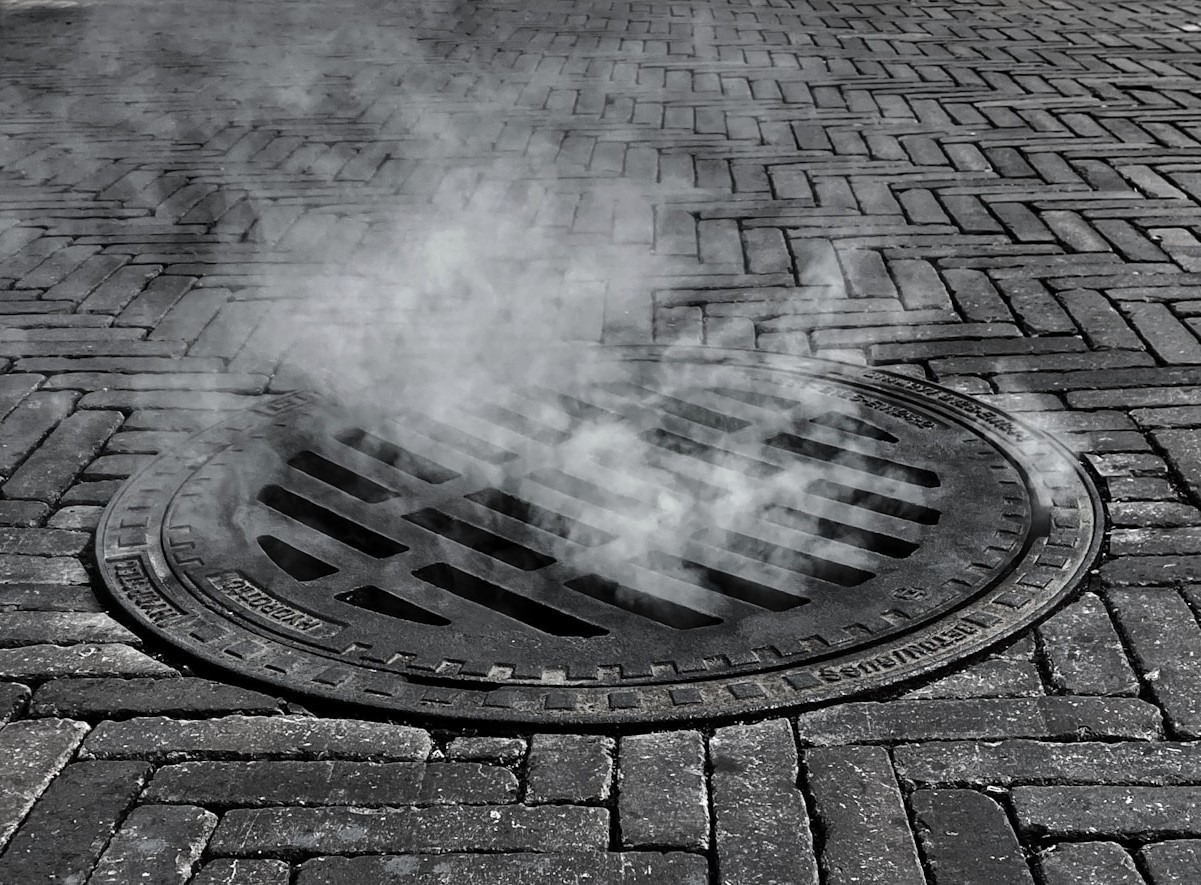
Image Notes: Picture of a manhole cover with rising steam from Kéoma Oran at Unsplash. The image has been cropped and resized.
Acknowledgement: Great thanks to Lizard whose inquiry led QI to formulate this question and perform this exploration. Thanks also to Tim Triche, Jr. who told QI about an instance using the phrase “stub my toe” and “fall down a well”.
Update History: On January 24, 2026, citations dated May 20, 1989; July 22, 1995; and July 9, 2000 were added to the article.
- 1962 Copyright, Record title: Carl Reiner & Mel Brooks at the Cannes Film Festival, Note: Recorded in 1962; released in 1963, Track 3: 2,000 And Two Year Old Man, Location: 2 minutes 53 seconds of 9 minutes 41 seconds, Publisher: Capitol Records. (Verified with audio digital copy) ↩︎
- 1904 March 20, The Los Angeles Times, (Advertisement for Palatial Baths Cure), Section 4, Quote Page 9, Column 2, Los Angeles, California. (Newspapers_com) ↩︎
- 1913 August 18, The Evening Record, Definitions, Quote Page 4, Column 3, Windsor, Ontario, Canada. (Newspapers_com) ↩︎
- 1917 December 7, Wilmington Daily News, (Filler item), Quote Page 2, Column 1, Wilmington, Ohio. (Newspapers_com) ↩︎
- 1934 July 31, San Francisco Examiner, It Depends (Filler item), Quote Page 15, Column 1, San Francisco, California. (Newspapers_com) ↩︎
- 1950 June 24, The Washington Daily News, Carson Comedy: ‘Good Humor Man’ Guarantees a Good Humor for Film Fans by Oscar Davis, Quote Page 12, Column 1, Washington, District of Columbia. (Newspapers_com) ↩︎
- 1962 Copyright, Record title: Carl Reiner & Mel Brooks at the Cannes Film Festival, Note: Recorded in 1962; released in 1963, Track 3: 2,000 And Two Year Old Man, Location: 2 minutes 53 seconds of 9 minutes 41 seconds, Publisher: Capitol Records. (Verified with audio digital copy) ↩︎
- 1963 May, Playboy, Volume 10, Number 5, Playboy After Hours, Review of the recording: Carl Reiner & Mel Brooks at the Cannes Film Festival (Capitol Records), Quote Page 41, Column 1, HMH Publishing Company, Chicago, Illinois. (Verified with scans) ↩︎
- 1963 May 5, The Observer, Theatre: An uncertain laugh by Kenneth Tynan, Quote Page 29, Column 1, London, Greater London, England. (Newspapers_com) ↩︎
- 1963 July 13, Billboard, Unquote, Quote Page 8, Column 3, The Billboard Publishing Company, Cincinnati, Ohio. (Google Books Full View) ↩︎
- 1964 January 5, The Commercial Appeal, ‘That Was The Week’ Bows On Channel 5 On Friday by Henry Mitchell, Section 4, Quote Page 9, Column 2, Memphis, Tennessee. (Newspapers_com) ↩︎
- 1970 February 13, San Francisco Chronicle, The Symbolic Task: Clyde Lee’s Cycle Reaches an End by Art Spander, Quote Page 54, Column 2, San Francisco, California. (Newspapers_com) ↩︎
- 1977 May 31, The Miami News, The Larry King interview: What’s so funny? Here’s what top comics have to say by Larry King, Quote Page 9A, Column 2, Miami, Florida. (Newspapers_com) ↩︎
- 1988 August 31, Newsday (Suffolk Edition), Theater Review: Neil Simon’s Modern Story of Job by Renee Kaplan, (Review of God’s Favorite (Comedy) by Neil Simon), Section 2, Quote Page 11, Column 1, Melville, New York. (Newspapers_com) ↩︎
- 1989 May 20, The Standard, Wilder, Prior aren’t Shaw, but they can draw laughs by Maurice Yacowar, Quote Page 18, Column 1, St. Catharines, Ontario, Canada. (Newspapers_com) ↩︎
- 1990 September 11, Newsday, Mindlessness: The Sequel by Marvin Kitman, Section 2, Start Page 7, Quote Page 13, Column 1, New York, New York. (Newspapers_com) ↩︎
- 1993 February 15, The Herald, Honesty, accountability are best policies by James McCusker, Quote Page C1, Column 1, Everett, Washington. (Newspapers_com) ↩︎
- 1995 July 22, The Gazette from Montreal, But seriously, folks: Thoughts on comedy, art and a boozing kangaroo by Joe Fiorito, Quote Page C5, Column 1, Montreal, Quebec, Canada. (Newspapers_com) ↩︎
- 2000 July 9, Newsday (Suffolk Edition), Peter Boyle by Kayla Mattes, Amalia Sirica, and Brooke Suddell (Kidsday Staff Reporters), Section: Kidsday, Unnumbered Page, Column 2, Melville, New York. (Newspapers_com) ↩︎