Samuel Goldwyn? Louella Parsons? Sylvia Porter? Leonard Hall? Apocryphal?
Question for Quote Investigator: A famous producer from the Golden Age of Hollywood once complained to his scriptwriters that their stories were uninspired. The producer made an inadvertently comical request:
Let’s have some new cliches.
This saying has been attributed to Samuel Goldwyn, but I am skeptical. Would you please explore this topic?
Reply from Quote Investigator: The earliest ascription to Samuel Goldwyn found by QI appeared in an article by prominent gossip columnist Louella Parsons published in the September 1948 issue of “Cosmopolitan” magazine. Parsons used the initials S. G. when referring to Goldwyn. Boldface added to excerpts by QI:1
I wouldn’t, naturally, want to mention any names. But one of Hollywood’s most alert producers, whose initials are S. G. and who, a little more than a year ago, got an Oscar for a particularly fine picture, has lately been belaboring his writers “to come up with some new cliches.”
The notion of “new cliches” began to appear many years earlier, but usually the intention was not humorous. For example, in 1913 the book “Harry the Cockney” by Edwin Pugh discussed the influence of working-class Londoners:2
Every day he is enriching the English tongue with new forms of speech, new cliches, new slang, new catchwords.
In 1921 “The State” newspaper of South Carolina printed the following:3
The American position in regard to Hungarian affairs is said to be one of “interested observation.” This deserves to rank alongside “view with alarm,” and “point with pride.” Some brand-new cliches, to use a paradox, are getting themselves made every day.
In 1927, theater critic Harold E. Clurman wrote about the emergence of “new cliches” in plays, but this usage was also not intended to be humorous:4
So today many “unconventional” plays dealing with various types of Americans: the puritan, the repressed, the straitlaced, and hard-headed, the emancipated and the simple, are more or less conventional hokum cut after the latest pattern—the new cliches. So too, for example, the majority of plays, however intelligently maneuvered, dramatizing a “sex problem” on a psychoanalytic basis or plays about plain people with very plain speech.
The notion of deliberately creating and employing “new cliches” was discussed by journalist Leonard Hall in 1936:5
… we are busily trying to age some new cliches to fit these matters.
Below are additional selected citations in chronological order.
In 1938 the “Daily Express” in London printed an article about the news coverage of the famous U.K. horse race called the Epsom Derby:6
A touching sight, I thought, was a book lying on a Press table: a brand-new copy of Roget’s Thesaurus. Someone at least was making a praiseworthy effort to find some new clichés for this most cliché-ridden English prose genre.
In 1946 financial journalist Sylvia Porter of the “New York Post” published the following remark:7
Poor men. They’ll have to find some new cliches.
In 1947 journalist Robert J. Casey published the book “More Interesting People” which included the following:8
“And of course you remember how Mr. Makaroff put it: “The boss says he’s getting tired of old clichés. . . . We gotta get a lotta new clichés. . . .”
In 1948 syndicated gossip columnist Erskine Johnson published a piece with the following title:9
Maybe Movies Need Some New Cliches?
In September 1948 Louella Parsons of “Cosmopolitan” magazine attributed the quip under examination to Samuel Goldwyn as mentioned previously:10
… one of Hollywood’s most alert producers, whose initials are S. G. … has lately been belaboring his writers “to come up with some new cliches.”
Also, in September 1948 the “Brooklyn Eagle” of New York printed a column by Al Salerno containing the following:11
Add Goldwynisms: “I’m getting tired of old cliches. We gotta get new cliches.”
In October 1948 the “Evening Standard” of London printed the following:12
They’re blaming this one on Sam Goldwyn. He called in his writers, banged the table and said, “Your scripts are full of clichés. I’m sick and tired of these old clichés. Let’s have some new clichés,” Louis Sobol, New York Journal American.
Also, in October 1948 “The Observer” of London printed the following in its collection titled “Sayings of the Week”:13
Let’s have some new clichés. — Mr. Samuel Goldwyn.
In 1950 “The Hollywood Reporter” published a piece by columnist Irving Hoffman which referred to the remark about “old cliches” as an “ancient gag”:14
The ancient gag of the B-picture director who announced, “The boss says, don’t use any more old cliches, so we gotta think up some new cliches,” reminds me of some wornout mystery cliches I’d like to see abolished. The hardboiled private eye, for example, who starts out broke and invariably gets a beautiful blonde client who pays off in hundred-dollar bills.
In 1953 the “Chicago Daily Tribune” printed the following:15
As an old editor of our dim past, who was noted rather more for energy than for literacy, was given to remark, “What we need is some new cliches.”
In 1977 “The Globe and Mail” of Toronto, Canada tentatively attributed the remark to Goldwyn:16
As someone (was it Samuel Goldwyn?) is supposed to have said, “what we need are some new cliches!”
In conclusion, the saying under examination was credited to Samuel Goldwyn in September 1948 by gossip columnist Louella Parsons. During this period, it was common to ascribe malapropisms to Goldwyn, so it is unclear whether this Goldwynism was genuine. The humorous notion of deliberately creating “new cliches” was already in circulation.
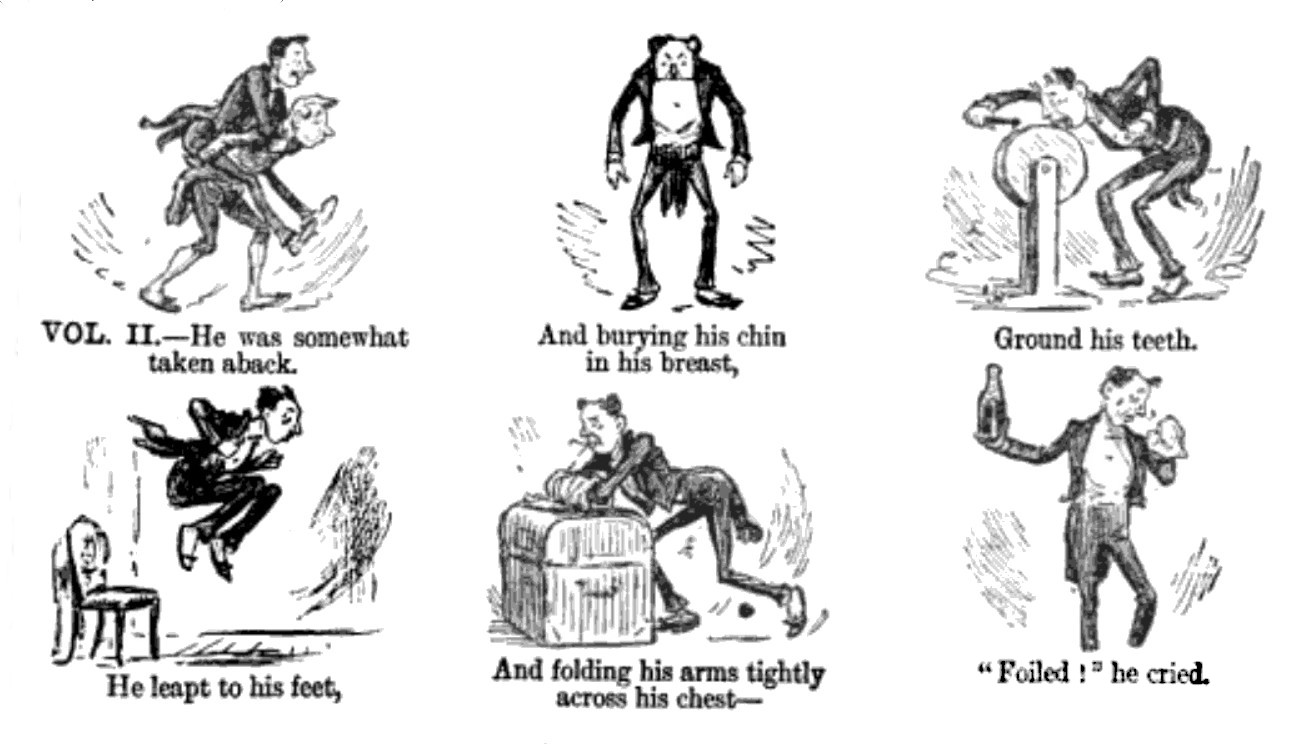
Image Notes: Illustrations of cliches by cartoonist J. Priestman Atkinson from the 1900 book “An Evening with Punch: Being a selection from the First Fifty Years of Punch”.
Acknowledgement: Great thanks to the anonymous person whose inquiry led QI to formulate this question and perform this exploration. Also, thanks to Stephen Goranson who accessed the 1948 citation in “The Observer”. In addition, thanks to Vance Maverick who told QI about the 1913 and 1927 citation. Further thanks to Peter Morris who found helpful citations for the phrase “new cliches”.
Update History: On April 5, 2026, the 1913 citation and the October 31, 1921 citation were added to the article.
- 1948 September, Cosmopolitan, Volume 125, Issue 3, Cosmopolitan’s Movie Citations by Louella O. Parsons (Motion Picture Editor, International News Service), Start Page 12, Quote Page 159, Column 1, New York. (ProQuest) ↩︎
- 1913, Harry the Cockney by Edwin Pugh, Quote Page 2, T. Werner Laurie Ltd., London. (HathiTrust Full View) link ↩︎
- 1921 October 31, The State, The State’s Survey, Quote Page 4, Column 1, Columbia, South Carolina. (Newspapers_com) ↩︎
- 1927 July 9, The Billboard: The Theatrical Digest and Show World Review, Conventionality in the Theater by Harold E. Clurman, Start Page 41, Quote Page 41, Column 3 and 4, The Billboard Publishing Company, Cincinnati, Ohio. (Google Books Full View) link ↩︎
- 1936 September 6, The El Paso Times, Section: The Sunday Home Magazine, Love Is a Nifty … Marriage Just a Gag by Leonard Hall, Unnumbered Page, Column 4, El Paso, Texas. (ProQuest) ↩︎
- 1938 June 2, Daily Express, These names make news: Wet Day Out, Quote Page 6, Column 4, London, England. (British Newspaper Archive) ↩︎
- 1946 April 12, New York Post, Republicans Lose a Song by Sylvia F. Porter, Quote Page 26, Column 5, New York, New York. (Old Fulton History at fultonhistory.com) ↩︎
- 1947, More Interesting People by Robert J. Casey (Robert Joseph Casey), Chapter 5: The Rise of the Asterisk, Quote Page 51, The Bobbs-Merrill Company, Indianapolis, Indiana. (Verified with scans) ↩︎
- 1948 February 26, The Marshfield News-Herald, Maybe Movies Need Some New Cliches? by Erskine Johnson, Quote Page 16, Column 4, Marshfield, Wisconsin. (ProQuest) ↩︎
- 1948 September, Cosmopolitan, Volume 125, Issue 3, Cosmopolitan’s Movie Citations by Louella O. Parsons (Motion Picture Editor, International News Service), Start Page 12, Quote Page 159, Column 1, New York. (ProQuest) ↩︎
- 1948 September 3, Brooklyn Eagle, Brooklyn and Broadway: Night Life by Al Salerno, Quote Page 6, Column 3, Brooklyn, New York. (Newspapers_com) ↩︎
- 1948 October 14, Evening Standard, The Londoner’s Diary, Incidental intelligence, Quote Page 2, Column 6, London, England. (ProQuest) ↩︎
- 1948 October 24, The Observer, Sayings of the Week, Quote Page 2, Column 3, London, England. (ProQuest) ↩︎
- 1950 October 5, The Hollywood Reporter, Tales of Hoffman: Writing Academy by Irving Hoffman, Quote Page 3, Column 4, Los Angeles, California. (ProQuest) ↩︎
- 1953 November 7, Chicago Daily Tribune, “Some New Cliches”, Quote Page 14, Column 3, Chicago, Illinois. (ProQuest) ↩︎
- 1977 July 19, The Globe and Mail, Taking a very serious view of the laughter business by Blaik Kirby, Quote Page 13, Column 3, Toronto, Ontario, Canada. (Newspapers_com) ↩︎