Life Magazine? Milton College? Joan Kochanowski? Norman Brinkmeier? Anonymous?
Question for Quote Investigator: There is a family of wordplay jokes in which a customer asks a waiter about the availability of seafood. Here are three examples:
“Waiter, do you serve shrimps here?” “Sure. We don’t care how tall you are. Sit down.”
“Do you serve crabs?” “Yes, we treat all customers alike.”
“Do you serve lobsters here? ” “Oh, yes sir, we serve anyone. Sit right down.”
In each of these jokes, the seafood term is not interpreted as a menu item; instead, the term is applied to the customer. Would you please trace the history of this family of jokes?
Reply from Quote Investigator: The earliest match located by QI appeared in “The Scioto Gazette” of Chillicothe, Ohio in March 1901. Boldface added to excerpts by QI:1
“Do you serve lobsters here?” asked the new arrival.
“Well,” replied the waiter, “we ’as our instructions to discriminate as much as possible among them as comes in to eat.”
This joke can be understood as an absurdist misunderstanding. Further, circa 1901 there were several different slang interpretations for “lobster”. Here are five senses listed in “Green’s Dictionary of Slang”:2
1. (a) a soldier, a marine (who also wears scarlet).
1. (b) (also blue lobster) a policeman.
2. (a) (US) a slow-witted, awkward, or gullible person; a general term of abuse; esp. of a socially inept or foolish person.
2. (b) an older man who gives a younger woman presents and/or money in return for sexual favours.
3 (US) in the context of obtaining money, one who is a waste of effort.
The joke above appeared in several newspapers in 1901 including “The Omaha Daily News” in Nebraska,3 “The Washington Reporter” in Pennsylvania,4 and “The Wilsonton Journal” in Kansas.5
Below are additional selected citations in chronological order.
A reversal of the wordplay appeared in “The Chicago Sunday Tribune” in February 1901. The pun was based on the slang sense of “lobster” meaning “policeman”:6
“What is your order?” asked the waiter girl.
“Anything you please, dear,” replied the burly policeman. “I’m hungry enough to do the cannibal act today.”
“We don’t serve lobsters here, sir,” she said, with offended dignity.
In December 1901 the religious periodical “Friends’ Intelligencer and Journal” of Philadelphia, Pennsylvania printed the following:7
A man went into a St. Louis restaurant and shouted, “Where’s the head waiter?” That dignitary came forward. “Say,” bawled the man, “do you serve lobsters here?” “Yes,” replied the waiter, urbanely, “what will you have?”
In February 1902 “Life” magazine of New York printed the following one-panel cartoon:8
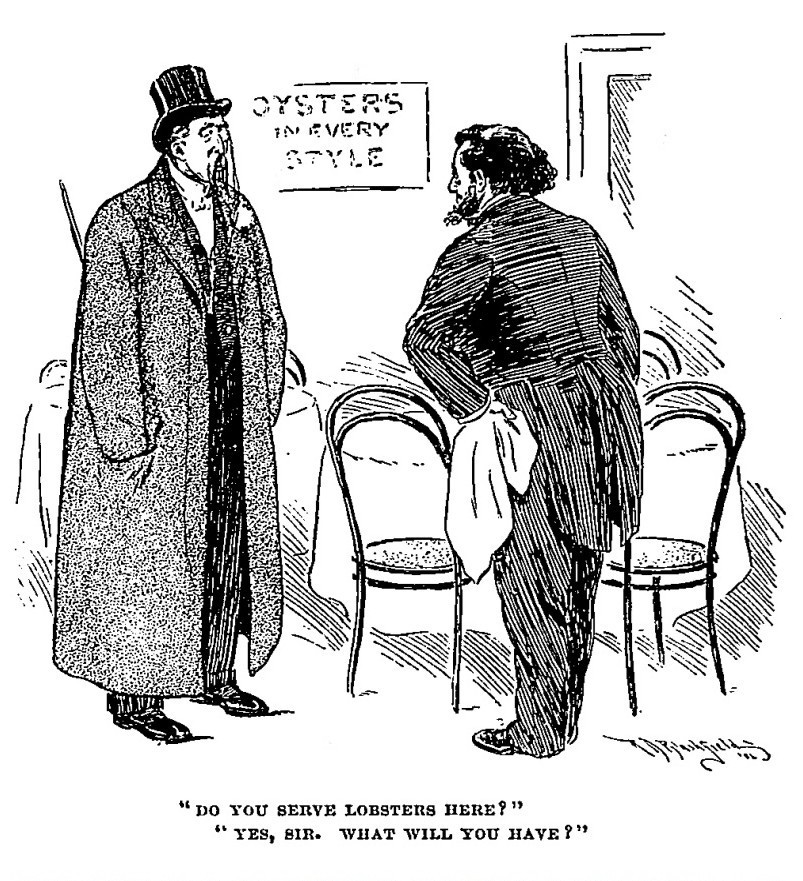
“DO YOU SERVE LOBSTERS HERE?”
“YES, SIR. WHAT WILL YOU HAVE?”
In November 1902 a periodical published by the students of Milton College in Milton, Wisconsin published the following:9
Blanchard (to waiter)—Do you serve lobsters here?
Waiter—Oh, yes sir, we serve anyone. Sit right down. —Ex.
In 1914 the periodical “High School Life” Chicago, Illinois printed an instance with “crabs”:10
M. — “Do you serve crabs?”
Moutsatson —“Oh yes, we treat all customers alike.”
“Green’s Dictionary of Slang” helpfully notes that a “crab” corresponds to “a nag, a complainer”.11
In 1916 “The Marshall Messenger” in Texas printed an instance with “shrimps”:12
Diner (in cafe) — “Do you serve shrimps in here?”
Waiter — “Yes, sir; we serve everybody.” — Ex.
“Green’s Dictionary of Slang” helpfully notes that a “shrimp” corresponds to “a small, weak, insignificant person”.13
In 1919 “The Lakeland Evening Telegram” in Florida published a different instance with “shrimp”:14
In a flippant manner he asked: “Do you serve shrimp at this hour?” and quick as a flash the girl came back with—“We certainly do if we have what you wish!”
In 1952 “Saskatoon Star-Phoenix” in Saskatchewan, Canada printed another version with “shrimp” from young correspondent Norman Brinkmeier:15
A small boy went to a restaurant and asked, “Do you serve shrimps?”
Waiter: “We don’t care how big they are as long as they have money.”
In 1963 “The Leavenworth Times” of Kansas printed a joke submitted by Joan Kochanowski:16
Man: Do you serve crabs here?
New waiter: Sure. We don’t care how cross you are. Sit right down.
These types of jokes have continued to circulate for decades. In 1995 “The Guinness Dictionary of Jokes,” compiled by Nigel Rees listed the following gags:17
Waiter, do you serve shrimps here?
Sure. We don’t care how tall you are. Sit down.
Another version: ‘Do you serve crabs here?’ — ‘We serve anyone, sir.’
In conclusion, this family of jokes entered citation by 1901. The first version was based on “lobsters”. The creator was anonymous. By 1914 a version based on “crabs” was circulating, and by 1916 a version based on “shrimps” was circulating.
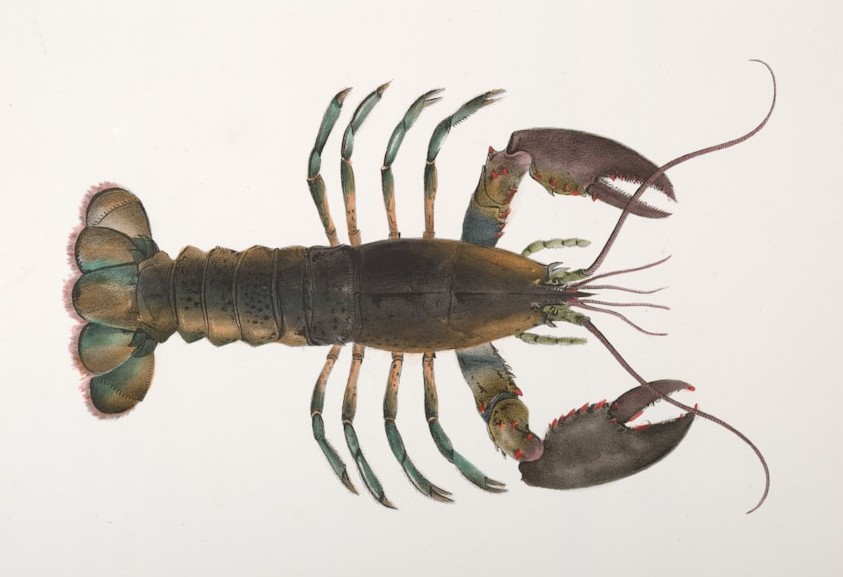
Image Notes: Illustration of lobster (Homarus americanus) from the New York Public Library at Unsplash. The image has been cropped and resized.
Acknowledgement: Great thanks to Nigel Rees whose “Quote … Unquote” Newsletter of April 2026 discussed this family of jokes together with the larger class of “waiter” jokes. Rees mentioned the variants based on “shrimps”, “crabs”, and “lobsters”. Rees cited a pertinent cartoon in the humor magazine “Punch” in 1933. Rees’s discussion inspired QI to formulate this question and perform this exploration. Also, thanks to Peter Morris who told QI about the reverse wordplay with “lobster” and “policeman”.
Update History: On April 24, 2026, the February 10, 1901 citation was added to the article.
- 1901 March 7, The Scioto Gazette, (Filler item), Quote Page 5, Column 3, Chillicothe, Ohio. (ProQuest) ↩︎
- Website: Green’s Dictionary of Slang, Website editor: Jonathon Green, Entry title: lobster n.2, Entry title: lobster n.3, Website description: “largest historical dictionary of English slang. Written by Jonathon Green over 17 years from 1993”. (Accessed greensdictofslang.com on April 20, 2026) link link ↩︎
- 1901 March 12, The Omaha Daily News, Just as the Pipe Went Out, Quote Page 4, Column 3, Omaha, Nebraska, (Newspapers_com) link ↩︎
- 1901 March 19, The Washington Reporter, Can’t Always Tell, Quote Page 7, Column 5, Washington, Pennsylvania. (GenealogyBank) ↩︎
- 1901 March 30, The Wilsonton Journal, Can’t Always Tell, Quote Page 6, Column 4, Wilsonton, Kansas. (Newspapers_com) link ↩︎
- 1901 February 10, The Chicago Sunday Tribune, In a Minor Key: Prompt Punishment, Quote Page 38, Column 5, Chicago, Illinois. (Newspapers_com) link ↩︎
- 1901 December (Twelfth Month) 28, Friends’ Intelligencer and Journal, (Untitled short item), Quote Page iii, Column 1, Friends’ Intelligencer Association, Philadelphia, Pennsylvania. (Google Books Full View) link ↩︎
- 1902 February 27, Life, Volume 39, Number 1009, (Caption of one-panel cartoon), Quote Page 166, Column 2, New York, New York. (Google Books Full View) link ↩︎
- 1902 November, The Milton College Review, Volume 4, Number 2, Exchange, Quote Page 14, Published by the Students of Milton College in Milton, Wisconsin. (Google Books Full View) link ↩︎
- 1914 February, High School Life, Volume 14, Number 5, Ye Olde Joke Inn, Quote Page 343, Marcus Berstein, Chicago, Illinois. (Google Books Full View) link ↩︎
- Website: Green’s Dictionary of Slang, Website editor: Jonathon Green, Entry title: crab n.2, Website description: “largest historical dictionary of English slang. Written by Jonathon Green over 17 years from 1993”. (Accessed greensdictofslang.com on April 20, 2026) link ↩︎
- 1916 June 23, The Marshall Messenger, Smile a Bit, Quote Page 4, Column 4, Marshall, Texas. (Newspapers_com) link ↩︎
- Website: Green’s Dictionary of Slang, Website editor: Jonathon Green, Entry title: shrimp n., Website description: “largest historical dictionary of English slang. Written by Jonathon Green over 17 years from 1993”. (Accessed greensdictofslang.com on April 20, 2026) link ↩︎
- 1919 February 12, The Lakeland Evening Telegram, Answer Was Time (Thorn in Palm Beach Post), Quote Page 6, Column 2, Lakeland, Florida. (Newspapers_com) ↩︎
- 1952 November 8, Saskatoon Star-Phoenix, Section: The Prairie Pals, A Joke by Norman Brinkmeier, Quote Page 3, Column 1, Saskatoon, Saskatchewan, Canada. (Newspapers_com) ↩︎
- 1963 July 14, The Leavenworth Times, Section: The Junior Times, Jokes: Hollywood Theater Prize, Quote Page 13, Column 7, Leavenworth, Kansas. (Newspapers_com) link ↩︎
- 1995, The Guinness Dictionary of Jokes, Compiled by Nigel Rees, Topic: Waiter Jokes, Quote Page 266, Guinness Publishing, Enfield, Middlesex. (Verified with scans) ↩︎