Mandell Creighton? James Payn? Helen Ricker Beebe? William Ralph Inge? Jack Hulbert? Anonymous?
Question for Quote Investigator: Oxford and Cambridge rank among Europe’s oldest and most prestigious centers of higher learning. An oft-repeated comical statement contrasts the attitudes of the students of the two schools:
Oxford people think they own the world. Cambridge people do not care who owns the world.
This ambiguous saying has divergent interpretations. One explication highlights student stereotypes. The Oxford person is a confident, natural, and entitled leader. The Cambridge person is a detached academic individual who is unconcerned with managing world affairs. Would you please explore the provenance of this saying?
Reply from Quote Investigator: QI conjectures that this saying evolved from remarks made by English editor James Payn in “Chambers’s Journal” in 1862. Payn described the annual Oxford and Cambridge Boat Race held on a stretch of the Thames in West London. Interestingly, the two groups Payn contrasted differed from the modern saying.
The first group was the young gentlemen of London who looked as though they were the “proprietors of the universe”. The second group was the combined students of Oxford and Cambridge, i.e., the “dark and light blue” based on each school’s traditional colors. This combined student group looked as though they did not care to whom the universe belonged.
In the following excerpt, “the town” referred to London, and the pronoun “them” referred to the students of both Oxford and Cambridge. Boldface added to excerpts by QI:1
There is also a charming independence about them, contrasting curiously with the assumed indifference of the young gentlemen of the town. The latter present the appearance, more or less complete, of being the proprietors of the universe; but ‘this pride is yet no match for theirs’ of the Dark and Light Blue, who look as though they did not care to whom it belonged.
They do not as yet perceive the necessity of assuming a superior position with respect to others; the world is a solid pudding to them (with plenty of plums in it), and mere wafer-biscuits and trifle-froth have no attractions for them. They do not understand that to look weary and ill-tempered is to convey the idea of fashionable beings worn out with the attentions of the aristocracy; and that to take an interest in anything is bad taste. On the contrary, Dark and Light Blue take very great interest in everything, and about this University Boat-race they do more—they are wild enthusiasts.
The piece in “Chambers’s Journal” did not have a byline identifying the author. But the article was reprinted in 1867 within the collection “Lights and Shadows of London Life” authored by James Payn.2
A close match for the modern version of the saying appeared in a speech delivered at Oxford by Reverend Mandell Creighton on June 17, 1896. Creighton was the Bishop of Peterborough who later became the Bishop of London. Creighton disclaimed authorship and implied that the saying was a preexisting epigram:3
That great question—the difference between an Oxford man and a Cambridge man—was once solved by the epigram: ‘An Oxford man looks as if the world belongs to him: a Cambridge man looks as if he did not care to whom the world belongs.’
I am not concerned with the truth of that saying in itself, but it undoubtedly describes two temperaments, which differ and annoy one another by a sense of difference. I think, however, that we must admit that the man who does not care to whom the world belongs is extremely annoying to the man who maintains that the world belongs to him.
Below is an overview with dates and attributions:
1862: Young gentlemen of London: Appearance of being the proprietors of the universe. Oxford and Cambridge students: Look as though they did not care to whom it belonged
(James Payn)
1896 Jun 17: An Oxford man looks as if the world belongs to him: a Cambridge man looks as if he did not care to whom the world belongs
(Anonymous attribution from Mandell Creighton)
1896 Jun 18: An Oxford man looks as if the world belonged to him; a Cambridge man looks as if he did not care to whom the world belonged
(Anonymous attribution from Mandell Creighton)
1899: The Oxford man who looks as if the world belongs to him, the Cambridge man who looks as if he did not care to whom the world belongs
(Mandell Creighton)
1917: The Oxford man acts as if all the world belongs to him; the Cambridge man as if he belonged to all the world
(Anonymous attribution from George Edwin Maclean)
1922: The Oxford man — He looks as if the world belonged to him. The Cambridge man — He looks as if he did not care to whom the world belonged
(William Ralph Inge)
1929: Oxford man wears a gown as if it belonged to him, and a Cambridge man wears it as if he didn’t care who it belonged to
(Jack Hulbert)
1936: An Oxford man goes about looking as though the world belongs to him — a Cambridge man as though he doesn’t care to whom it belongs
(Alfred Walter Frank Blunt)
1940: An Oxford man walks as though he owned the earth; and a Cambridge man walks as though he didn’t care who owned it
(Anonymous attribution from Helen Ricker Beebe)
1970: An Oxford man acts as if he owns the place; a Cambridge man doesn’t care who owns it and acts accordingly
(Anonymous attribution from Ralph Bossence)
1972: Oxford men think they rule the world and Cambridge men don’t care a cent who does
(Attributed to Mandell Creighton)
1984: Oxford men think the world belongs to them. Cambridge men don’t care who it belongs to
(Anonymous attribution from Stephen Toulmin)
Below are details for selected citations in chronological order.
On June 18, 1896, the day after Mandell Creighton’s lecture, “The Evening Chronicle” of Newcastle-upon-Tyne printed a slightly different version of the saying using “belonged” instead of “belongs”:4
The lecturer incidentally remarked that the great question the difference between an Oxford man and a Cambridge man was once solved by the epigram: — “An Oxford man looks as if the world belonged to him; a Cambridge man looks as if he did not care to whom the world belonged.” On whatever side they approached English history they found Englishman animated by a stubborn determination to manage their own affairs in their own ways, according to their own minds.
In 1899 “The Times” of London reported on a speech delivered by Mandell Creighton in Liverpool which included an instance of the saying:5
“The Oxford man who looks as if the world belongs to him, the Cambridge man who looks as if he did not care to whom the world belongs,” must be surrounded by men who have learned for themselves the secret of England’s greatness.
In 1917 U.S. college administrator George Edwin Maclean published an article titled “Studies in Higher Education in England and Scotland” which contained a variant saying:6
The universities are hit off by many facetious remarks, such as, “The Oxford man acts as if all the world belongs to him; the Cambridge man as if he belonged to all the world.”
In 1922 “The Western Gazette” of Yeovil, England reported on a speech delivered by the popular commentator William Ralph Inge who employed an instance of the saying:7
The Oxford man — He looks as if the world belonged to him. The Cambridge man — He looks as if he did not care to whom the world belonged.
These were two of Dean Inge’s epigrams in a weekend lecture he gave on “England and the English” at the Working Men’s Club, King’s Cross.
In 1929 the book “Round About ‘The Mitre’ at Oxford” included a chapter by Jack Hulbert which contained a variant saying about clothes:8
“I feel that the main difference between an Oxford man and a Cambridge man is that the Oxford man wears a gown as if it belonged to him, and a Cambridge man wears it as if he didn’t care who it belonged to.
In 1936 the “Sunday Dispatch” of London published a short piece about the Bishop of Bradford Alfred Walter Frank Blunt which included an instance:9
He is an Oxford man and proud of it. He detests snobbery and “uppishness” and says that an Oxford man goes about looking as though the world belongs to him — a Cambridge man as though he doesn’t care to whom it belongs.
In 1940 U.S. romance novelist Helen Ricker Beebe (under the pseudonym Elswyth Thane) published “England Was an Island Once” which contained the following instance:10
Of all the legends concerning the long rivalry between Oxford and Cambridge I like best the brief statement to the effect that: An Oxford man walks as though he owned the earth; and a Cambridge man walks as though he didn’t care who owned it.
In 1970 the Northern Irish journalist Ralph Bossence published the following in the “News Letter” of Belfast:11
… a means of distinguishing the two sets of undergraduates which I heard many years ago. An Oxford man, I was told, acts as if he owns the place; a Cambridge man doesn’t care who owns it and acts accordingly.
In 1972 the “Manchester Evening News” of England attributed the following instance to Creighton:12
Oxford men think they rule the world and Cambridge men don’t care a cent who does. —Bishop Creighton
In 1984 British philosopher Stephen Toulmin published a piece in “The New York Review of Books” which contained the following:13
… Cambridge tends to be a bit out of touch with worldly things. (“Oxford men think the world belongs to them,” the saying was, “Cambridge men don’t care who it belongs to.”)
In conclusion, James Payn employed a version of this saying in 1862 which contrasted young London men versus students of both Oxford and Cambridge. The saying evolved, and in 1896 Mandell Creighton used a version which contrasted Oxford students versus Cambridge students. Creighton indicated that this version was already in circulation.
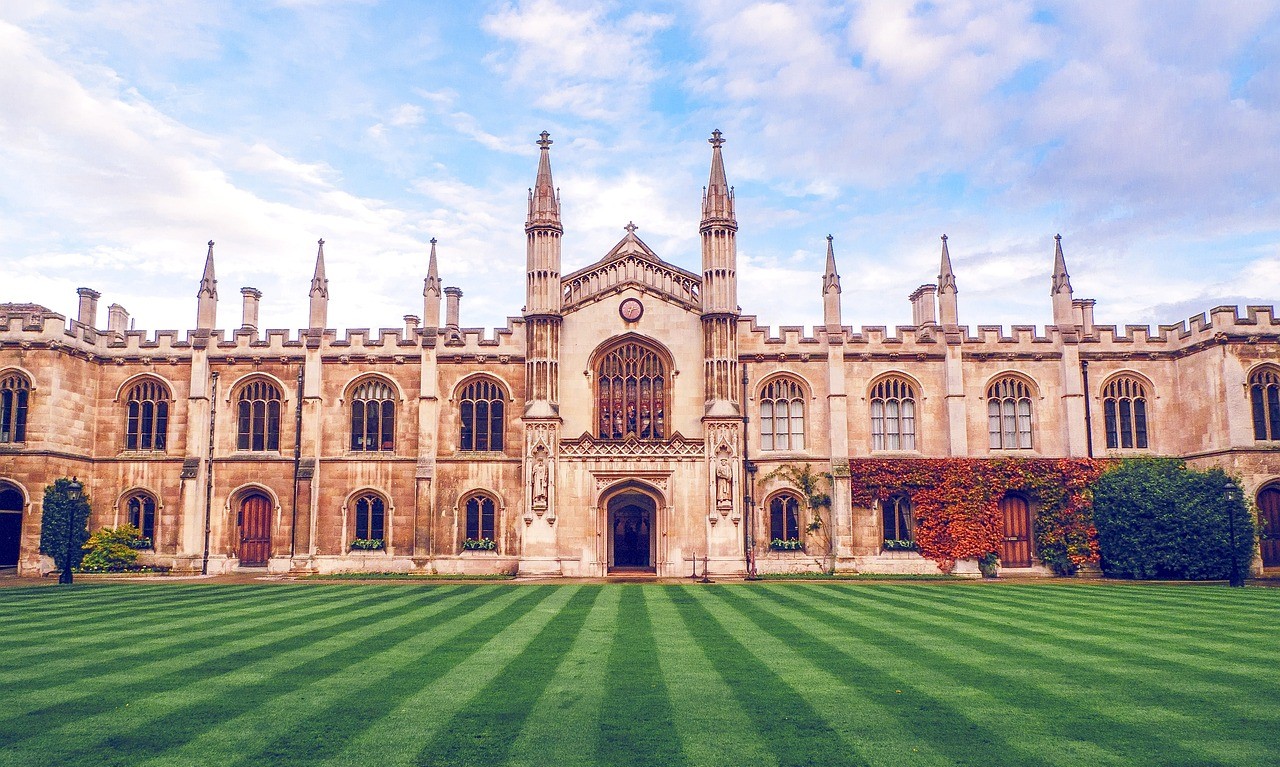
Image Notes: Gothic style building at Corpus Christi College, University of Cambridge from blizniak at Pixabay. The image has been cropped and resized.
Acknowledgement: Great thanks to BruvverEccles whose inquiry led QI to formulate this question and perform this exploration.
- 1862 May 17, Chambers’s Journal of Popular Literature, Science, and Arts, Conducted by William and Robert Chambers, Volume 17, Number 437, The ‘Derby’ of the River (by James Payn), Start Page 305, Quote Page 305 and 306, W. & R. Chambers, London. (Google Books Full View) link ↩︎
- 1867, Lights and Shadows of London Life (by James Payn), Volume 1 of 2, Chapter 4: The “Derby” of the River, Quote Page 305 and 306, Hurst and Blackett Publishers, London. (Google Books Full View) link ↩︎
- 1896, The Romanes Lecture 1896: The English National Character by the Right Reverend Mandell Creighton (Lord Bishop of Peterborough), (Lecture delivered in the Sheldonian Theatre on June 17, 1896) Quote Page 17, Henry Frowde, London. (Google Books Full View) link ↩︎
- 1896 June 18, The Evening Chronicle, The English National Character: Interesting Lecture by Bishop Creighton, Quote Page 4, Column 2, Newcastle-upon-Tyne, Northumberland, England. (British Newspaper Archive) ↩︎
- 1899 January 19, The Times, The Secret of Personal Force: An Important Suggestion by the Bishop of London, Quote Page 13, Column 1, London, England. (The Times Digital Archive, Gale Primary Sources) ↩︎
- 1917, Studies in Higher Education in England and Scotland by George Edwin Maclean (Formerly President of the State University of Iowa), Bulletin Number 16, Chapter 1: First group of universities—Oxford, Cambridge, Durham, Quote Page 34, Government Printing Office, Washington D.C. (Google Books Full View) link ↩︎
- 1922 December 1, The Western Gazette, Dean Inge on England, Quote Page 12, Column 6, Yeovil, Somerset, England. (British Newspaper Archive) ↩︎
- 1929, Round About ‘The Mitre’ at Oxford (Episodes of the University, City and Hotel), Compiled by R. A. H. Spiers, Second Edition, Chapter: Jack Hulbert, His Page (From “The Isis” of December 6, 1922), Quote Page 151, Published at “The Mitre” Hotel, Oxford, England. (Google Books Full View) link ↩︎
- 1936 December 6, Sunday Dispatch, Most Outspoken Bishop by a Special Correspondent, Quote Page 7, Column 3, London, England. (British Newspaper Archive) ↩︎
- 1940, England Was an Island Once by Elswyth Thane (pseudonym of Helen Ricker Beebe), Chapter 3: Waiting, Quote Page 90, Harcourt, Brace and Company, New York. (Verified with scans) ↩︎
- 1970 February 17, News Letter, Ringing the Changes with a Blue Belle by Ralph Bossence, Quote Page 3, Column 2, Belfast, Antrim, Northern Ireland. (British Newspaper Archive) ↩︎
- 1972 February 10, Manchester Evening News, (Filler item), Quote Page 3, Column 4, Manchester, Lancashire, England. (British Newspaper Archive) ↩︎
- 1984 January 19, The New York Review of Books, Fall of a Genius by Stephen Toulmin (Book review of “Alan Turing: The Enigma” by Andrew Hodges), Quote Page 3, Column 1, Publisher A. Whitney Ellsworth: The New York Review of Books, New York. (Verified with scans; also accessed via nybooks.com on October 22, 2026) link ↩︎