Oscar Wilde? Gian Vincenzo Gravina? John D. MacDonald? Roger Ebert? Paul Gibson? Marcel Proust? Anonymous?
Question for Quote Investigator: A clever person constructed the following definition:
A bore is a person who deprives you of solitude without providing you with company.
This remark has been attributed to Irish wit Oscar Wilde, Italian man of letters Gian Vincenzo Gravina, U.S. thriller writer John D. MacDonald, and movie critic Roger Ebert. I have never seen a solid citation. Would you please explore this topic?
Reply from Quote Investigator: The earliest match found by QI appeared in the periodical “Reader’s Digest” in March 1949 within a section of miscellaneous sayings called “Quotable Quotes”. Boldface added to excerpts by QI:1
Gian Vincenzo Gravina, contemporary Italian author: A bore is a man who deprives you of solitude without providing you with company.
The entries printed on the “Quotable Quotes” page were sent to “Reader’s Digest” by readers who were compensated. The quotations were not verified by the magazine; hence, misquotations sometimes appeared.
Gian (Giovanni) Vincenzo Gravina was the name of a prominent Italian jurist and author who died in 1718. Thus, the claim that Gravina was a “contemporary Italian author” was odd. Perhaps, Giovanni Vincenzo Gravina was a pseudonym used by a contemporary author.
Oscar Wilde died in 1900. He implausibly received credit in 2008. John D. MacDonald used the expression in a 1974 novel, but he credited Gravina. Roger Ebert used the saying in 1976, but he credited John D. MacDonald.
Below are additional selected citations in chronological order.
A thematic match appeared in the 1923 novel “La Prisonnière” (“The Captive”) by Marcel Proust which was part of the famous series “À la recherche du temps perdu” (“Remembrance of things past”). An English translation by C. K. Scott Moncrieff was published in 1929. In the following passage, a luncheon inspired boredom. The English text2 is followed by the French text3 below:
Mamma would write to me: “Mme. Sazerat gave us one of those little luncheons of which she possesses the secret and which, as your poor grandmother would have said, quoting Mme. de Sévigné, deprive us of solitude without affording us company.”
Maman m’écrivait : « Mme Sazerat nous a donné un de ces petits déjeuners dont elle a le secret et qui, comme eût dit ta pauvre grand’mère, en citant Mme de Sévigné, nous enlèvent à la solitude sans nous apporter la société. »
On March 4, 1949 “The Jackson Sun” of Tennessee printed the statement without an attribution:4
A bore is a man who deprives you of solitude without providing you with company.
In May 1949 “The Pensacola News-Journal” printed the statement as a “Quote of the Day”. No attribution was specified.5
In November 1949 “Quote: The Weekly Digest” published the statement and repeated the attribution listed in the “Reader’s Digest”:6
A bore is a man who deprives you of solitude without providing you company. — GIAN VINCENZO GRAVINA, contemporary Italian writer.
In 1952 Arthur Duxbury published the compilation “Duxbury’s Notebook for Speaker’s” containing the following entry. Gravina was labeled an eighteenth-century figure instead of a contemporary figure:7
A bore is a man who deprives you of solitude without providing you with company. — Gian Vincenzo Gravina, 18th-century Italian author.
In 1953 a newspaper in Singleton, Australia printed an instance which employed a different phrasing. The word “person” replaced “man”:8
DEFT DEFINITION
BORE: A person who deprives you of solitude without providing you with company.
In 1960 “Esar’s Comic Dictionary” compiled by Evan Esar presented several humorous definitions for the word “bore”:9
bore. 1. The person who tells everything. 2. One whose shortcoming is his long staying. 3. A person who says a thousand things but never says good-bye. 4. A man who deprives you of solitude without providing you with company. 5. One who never goes without saying.
In 1962 Larry Wolters printed the saying in his syndicated column called “Gag Bag” which he assembled from remarks broadcast on radio and television:10
Paul Gibson: “A bore is a man who deprives you of solitude without providing you company.”
In 1974 John D. MacDonald published “The Turquoise Lament” which contained the following dialog between Travis McGee and his friend Dr. Meyer:11
“I like that Spanish definition of yours better.”
“Gian Gravina? ‘A bore is a person who deprives you of solitude without providing you with company.'”
In 1976 Roger Ebert published a piece in the “Chicago Reader”. Ebert discussed the characters Travis McGee and Dr. Meyer. Ebert attempted to reconstruct a conversation between the two based on his imperfect memory:12
Travis mentions the name of another boat owner a few slips down at the marina. Meyer nods judiciously. “A bore,” he says. “Do you know what a bore is, Travis?” Travis does not. “A bore, Travis, is someone who deprives you of solitude without providing you with companionship.” They sip their gin. …
I’m not sure in which of John D. MacDonald’s books that particular conversation takes place (although I know Meyer’s lines by heart). I do remember, though, reading the book on an airplane, which is the best place to read MacDonald.
In 1977 a newspaper in Manchester, England printed the following filler item:13
BORES are people who deprive you of solitude without providing you with company. — CARRUTHERS.
In 2008 a participant at the Goodreads website attributed the expression to Oscar Wilde. No supporting citation was listed:14
“A bore is someone who deprives you of solitude without providing you with company.”
― Oscar Wilde
In conclusion, this article presents a snapshot of current research. The earliest match appeared in “Reader’s Digest” in 1949. The quotation was attributed to “Gian Vincenzo Gravina, contemporary Italian author”. This was surprising because “Gian (Giovanni) Vincenzo Gravina” was a prominent 18th century Italian author. QI conjectures that the name was used as a pseudonym for a modern author, or the person who sent the quotation to “Reader’s Digest” specified a misattribution.
The ascription to Oscar Wilde occurred many decades after his death and has no probative value.
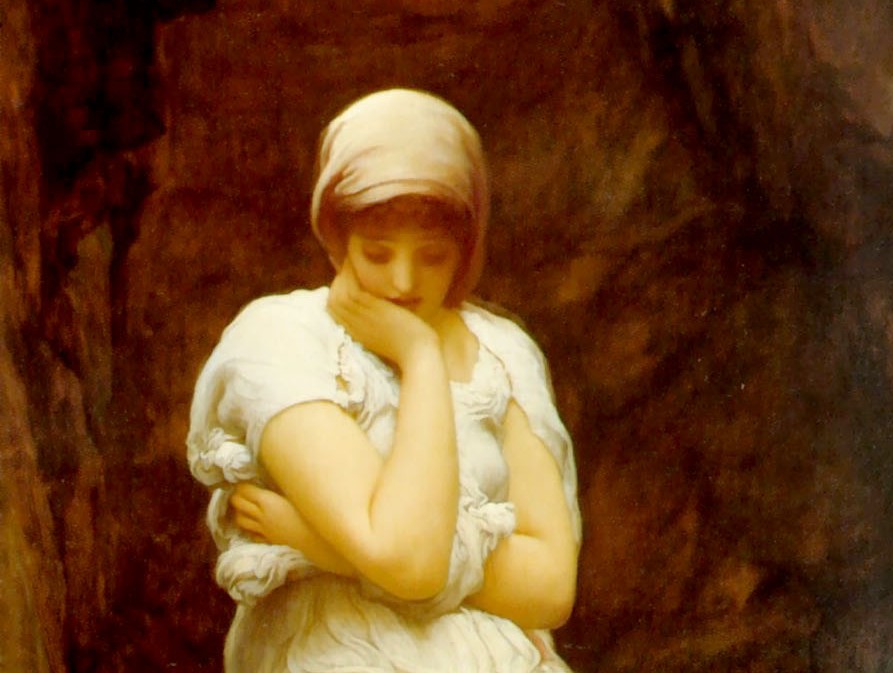
Image Notes: Painting titled “Solitude” by Frederic Leighton circa 1890. The image has been cropped and resized.
Acknowledgement: Great thanks to Dave Hill whose inquiry led QI to formulate this question and perform this exploration. Hill noted that the expression had been attributed to Oscar Wilde, Gian Vincenzo Gravina, and others. Hill also noted that John D. MacDonald used the expression in “The Turquoise Lament”, and Roger Ebert credited MacDonald. Many thanks to Peter Morris who found the intriguing citation in the novel by Marcel Proust.
Update History: On August 5, 2025 the Marcel Proust citations were added to the article.
- 1949 March, Reader’s Digest, Volume 54, Number 323, Quotable Quotes, Quote Page 18, The Reader’s Digest Association, Pleasantville, New York. (Verified with hardcopy) ↩︎
- 1929, The Captive by Marcel Proust, Series: Remembrance of things past, Volume 6, Translated by C. K. Scott Moncrieff, Chapter 1: Life with Albertine, Quote Page 11 and 12, Albert & Charles Boni, New York. (Google Books Full View) link ↩︎
- 1923, La Prisonnière (Sodome et Gomorrhe III) by Marcel Proust, Series: A la recherche du temps perdu, Tome VI, Chapitre Premier, Quote Page 19 and 20, Publisher : Éditions de la Nouvelle Revue Française (NRF), Paris. (Google Books Full View) link ↩︎
- 1949 March 4, The Jackson Sun, (Filler item), Quote Page 4, Column 1, Jackson, Tennessee. (Newspapers_com) ↩︎
- 1949 May 1, The Pensacola News-Journal, Section: Of and for Women, (Filler item), Quote Page 5, Column 3, Pensacola, Florida. (Newspapers_com) ↩︎
- 1949 November 27, Quote: The Weekly Digest, Volume 18, Number 22, Topic: Boredom, Quote Page 2, Column 1, Droke House, Indianapolis, Indiana. (Verified with scans) ↩︎
- 1952 Copyright, Duxbury’s Notebook for Speaker’s, Compiled by Arthur Duxbury, Topic: Bores, Quote Page 35, University of London Press, London. (Verified with scans) ↩︎
- 1953 May 22, The Singleton Argus, Deft Definition, Quote Page 3, Column 2, Singleton, New South Wales, Australia. (Newspapers_com) ↩︎
- 1960 Copyright, Esar’s Comic Dictionary, Compiled by Evan Esar, Completely Revised and Enlarged Edition, Entry: bore, Quote Page 43, Bramhall House, New York. (Verified on paper) ↩︎
- 1962 March 11, Chicago Sunday Tribune, Section: Chicago Tribune Magazine, Radio TV Gag Bag by Larry Wolters, Quote Page 41, Column 4, Chicago, Illinois. (Verified with scans) ↩︎
- 1974 (1973 Copyright), The Turquoise Lament by John D. MacDonald, Series: A Travis McGee Novel, Chapter 12, Quote Page 158, A Fawcett Gold Medal Book: Ballantine Books, New York. (Verified with scans) ↩︎
- 1976 November 26, Chicago Reader: Chicago’s Free Weekly, Once More, With Freeling by Roger Ebert, Quote Page 19, Column 1, Chicago Reader Inc., Chicago, Illinois. (Verified with scans) ↩︎
- 1977 August 25, Manchester Evening News, Dave and Co bravely step into a new world, Quote Page 10, Column 3, Manchester, Greater Manchester, England. (Newspapers_com) ↩︎
- Website: Goodreads, Article title: Oscar Wilde > Quotes > Quotable Quote, Date of first comment on this quotation: July 29, 2008, Website description: Social cataloging website listing books and quotations. (Accessed goodreads.com on August 2, 2025) link ↩︎