Friedrich Nietzsche? Claudia Crawford? Walter Kaufmann? Karl Jaspers? Roland Barthes? Apocryphal?
Question for Quote Investigator: In Greek mythology, the Cretan princess Ariadne helped the hero Theseus slay the Minotaur and escape from the labyrinth. Ariadne gave Daedalus a ball of thread so he could successfully navigate through the deadly maze. While contemplating this myth, the famous German philosopher Friedrich Nietzsche reportedly wrote the following:
A labyrinthine man never seeks the truth, but only his Ariadne— whatever he may tell us.
I have never seen a solid citation for this remark; hence, I have become skeptical of this attribution. Would you please help me to trace this statement?
Reply from Quote Investigator: Friedrich Nietzsche recorded some of his ideas and impressions in a group of notebooks which were not published while he was alive. The Musarion edition of the “Gesammelte Werke” (“Collected Works”) of Nietzsche included material from these notebooks. The fourteenth volume included a pertinent remark written by Nietzsche while he was working on the important opus “Also sprach Zarathustra” (“Thus Spoke Zarathustra”). This note did not appear directly in “Also sprach Zarathustra”. It was published posthumously. Boldface added to excerpts by QI:1
Ein labyrinthischer Mensch sucht niemals die Wahrheit, sondern immer nur seine Ariadne, — was er uns auch sagen möge.
Here is one possible translation into English:
A labyrinthine person never seeks the truth, but always only his Ariadne – whatever he may tell us.
Below are additional selected citations in chronological order.
Cosima Wagner was the wife of German composer Richard Wagner. The relationship between the couple and Nietzsche was complicated and fraught shifting from admiration to condemnation. In 1930 “The Living Age” journal of New York printed a piece about Nietzsche which included the following:2
His feeling for Cosima Wagner appears in a number of cryptic notes written after he had lost his mind. In Zarathustra he had said, ‘A labyrinthine man never seeks the truth but only and always his Ariadne.’ This statement provides the key to such later confessions as: ‘Everything that remains is for Frau Cosima … Ariadne’; and the object of his affection herself received a scribbled note from his asylum reading: ‘Ariadne, I love you. Dionysus.’
The passage above incorrectly asserted that the statement under review appeared within “Also sprach Zarathustra”. This error has caused confusion in later years.
In 1948 Psychology Professor H. A. Reyburn published a biography of Nietzsche which included the following analysis:3
In the plot of a drama, Empedocles, drawn up in 1870 or 1871, Nietzsche introduced Theseus and Ariadne in the third act, and at the end of the fifth act, after the tragedy, he asked: “Does Dionysus flee before Ariadne?” It is only a question, but it shows a preoccupation with the legend and a readiness to tamper with it.
The development of the story, however, took place at first on reasonably orthodox lines. Wagner, we have seen, was the Minotaur; Nietzsche, his conqueror, must therefore be Theseus, although he boasts that he requires no thread of an Ariadne. But this detachment did not last. The figure of Ariadne grew on him, leading him to assert in a note written during the time of Zarathustra, “A labyrinthine man never seeks the truth, but always only his Ariadne. . . .”
In 1950 philosopher and translator Walter Kaufmann published a biography of Nietzsche which discussed the symbolic meaning of the figure of Ariadne:4
Thus Ariadne meant more to him than just the flesh and blood Cosima Wagner whom he does not seem to have in mind when he writes: “A labyrinthian man never seeks the truth but always only his Ariadne—whatever he may tell us.” His sister is not entirely wrong when she claims that he is speaking of the human soul, though today we have perhaps a somewhat more accurate term in C. G. Jung’s conception of the Anima: originally dependent on a “mother image,” it grows into the ideal which a man pursues through his adult life.
Existentialist philosopher Albert Camus kept a set of private notebooks. An entry from 1951 recorded a version of the Nietzsche’s saying with the name “Ariane” instead of “Ariadne”:5
“A labyrinthine man never seeks the truth, but always and only Ariane.”
In 1965 R. J. Hollingdale published “Nietzsche: The Man and His Philosophy” which discussed Nietzsche’s attitude toward women:6
Women are the ‘delight of every strong [male] soul’, he adds, and at one time or another he personifies Life, Wisdom and Truth as a woman. During the years in which he was personifying the ‘life-affirmation of the superman’ as Dionysus, he gave Dionysus a companion in Ariadne, and wrote: ‘The labyrinthine man never seeks the truth but always and only his Ariadne.’ Certainly he had some unkind things to say about women (‘Are you visiting women? Do not forget your whip!’ an old woman advises Zarathustra—by far the best known sentence in his works, among women at least), but the total impression is very far from the dislike and fear of them with which he is popularly credited.
Psychiatrist Karl Jaspers published a book about Nietzsche’s ideas which was translated into English and released under the title “Nietzsche: An Introduction to the Understanding of His Philosophical Activity” in 1965. Jaspers discussed the symbolic meaning of the labyrinth:7
“We have a peculiar curiosity about the Labyrinth, and we are taking pains to make the acquaintance of Mr. Minotaur.” The philosopher sits “in his cave, year in and year out, day and night, alone with his soul, in intimate dispute and dialogue. It can be a labyrinth, but it can also be a goldmine.”
Such is the truth; it leads us into the Labyrinth and into the power of the Minotaur. Consequently the knower has still another entirely different goal: “Whatever he may tell us, a labyrinthine man never seeks the truth but always only his Ariadne.” The search for the truth leads on to something other than the truth — something that resembles it but is not among those truths that can be grasped as truths. Nietzsche has never told us what Ariadne is; perhaps he could not.
French literary theorist Roland Barthes published “La Chambre Claire” which was translated into English and released under the title “Camera Lucida: Reflections on Photography” in 1981. Barthes wrote about an idealized image artifact called the Winter Garden Photograph:8
All the world’s photographs formed a Labyrinth. I knew that at the center of this Labyrinth I would find nothing but this sole picture, fulfilling Nietzsche’s prophecy: “A labyrinthine man never seeks the truth, but only his Ariadne.” The Winter Garden Photograph was my Ariadne, not because it would help me discover a secret thing (monster or treasure), but because it would tell me what constituted that thread which drew me toward Photography.
In 1995 Claudia Crawford published “To Nietzsche: Dionysus, I love you! Ariadne”. Crawford presented an alternative title page with the following two interlocked statements:9
“A labyrinthian man never seeks for truth, rather always only his Ariadne—no matter what he says.” Nietzsche
“A labyrinthian woman never seeks for truth, rather always only her Dionysus—no matter what she says.” Ariadne
In conclusion, Friedrich Nietzsche deserves credit for the statement under examination which he wrote in German in a private notebook. The statement was published posthumously. Commentators have linked Ariadne to Cosima Wagner although this interpretation is overly simplistic.
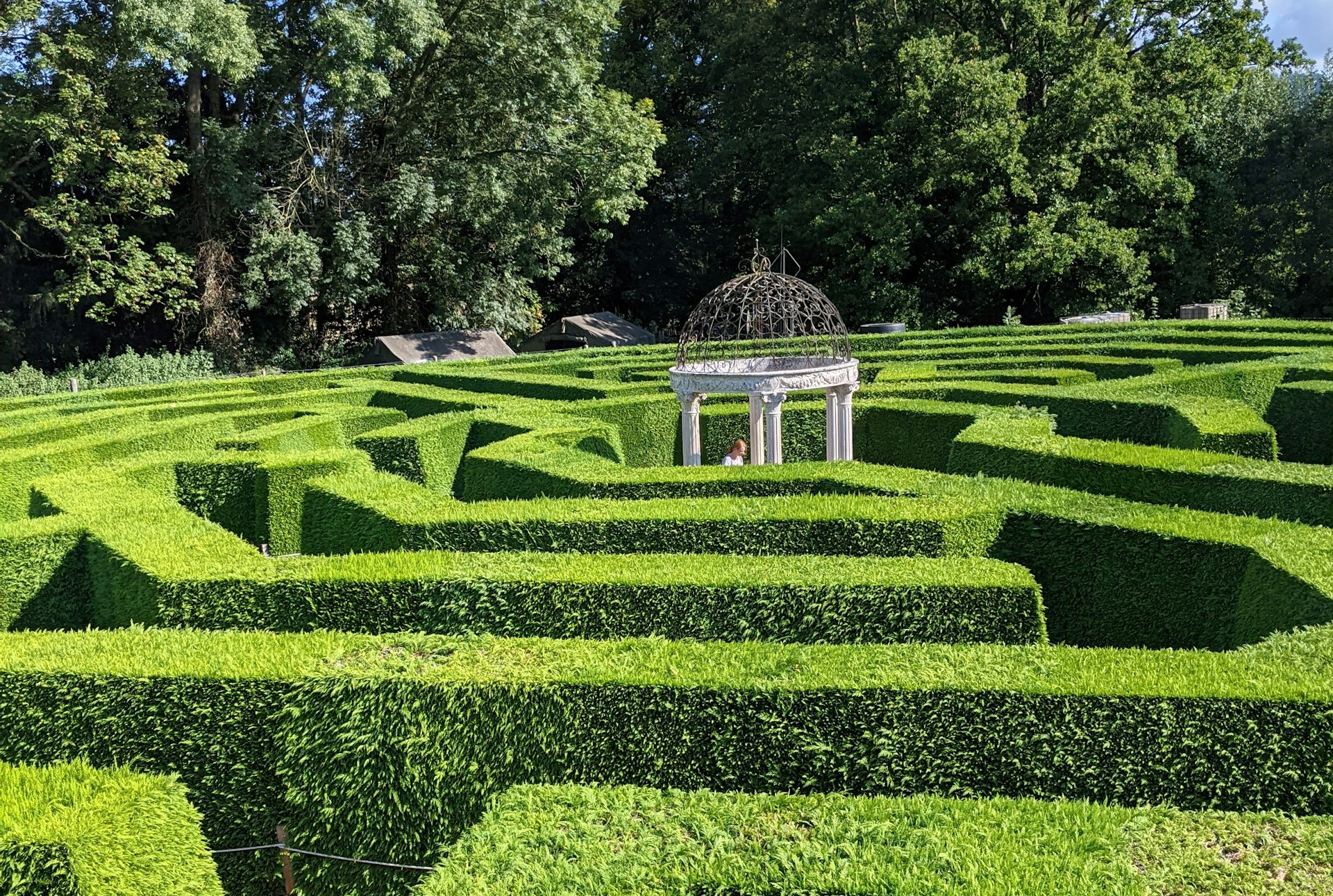
Image Notes: Picture of a maze with a gazebo from Field Cottage at Unsplash. The image has been cropped and resized.
Acknowledgement: Great thanks to Dave E. Lee whose inquiry led QI to formulate this question and perform this exploration.
- 1925, Gesammelte Werke (Collected Works) by Friedrich Nietzsche, Musarionausgabe (Musarion edition), Vierzehnter Band (Fourteenth Volume), Aus der Zeit des Zarathustra (From the time of Zarathustra) 1882-1886, Section: Einzelbemerkungen (Individual remarks) 1881-1884, Quote Page 22, Musarion Verlag München. (Verified with scans) link ↩︎
- 1930 April 15, The Living Age, Volume 338, Number 4360, Letters and the Arts, New Light on Nietzsche, Start Page 221, Quote Page 221, The Living Age Company, New York. (Google Books Full View) link ↩︎
- 1948, Nietzsche: The Story of a Human Philosopher by H. A. Reyburn (Professor of Psychology at the University of Cape Town) in collaboration with H. E. Hinderks and J. G. Taylor, Chapter 31: Ecce Homo, Quote Page 477, Macmillan & Company, London. (Verified with scans) ↩︎
- 1950, Nietzsche: Philosopher, Psychologist, Antichrist by Walter A. Kaufmann, Chapter 1: Nietzsche’s Life as Background of His Thought, Quote Page 30, Princeton University Press, Princeton, New Jersey. (Verified with scans) ↩︎
- 2008, Notebooks 1951-1959 by Albert Camus, Translated from the French by Ryan Bloom, Notebook 7, December 1951, Quote Page 27, Ivan R. Dee Inc., Chicago, Illinois. (Verified with scans) ↩︎
- 1965, Nietzsche: The Man and His Philosophy by R. J. Hollingdale, Chapter 12: The Solitary, Quote Page 210 and 211, Louisiana State University Press, Baton Rouge, Louisiana. (Verified with scans) ↩︎
- 1966 (1965 Copyright), Nietzsche: An Introduction to the Understanding of His Philosophical Activity by Karl Jaspers, Translated by Charles F. Wallraff and Frederick J. Schmitz, Book 2: The Basic Thoughts of Nietzsche, Chapter Two: Truth, Section: A Transcending Breakthrough to the Truth, Quote Page 226, The University of Arizona Press, Tucson, Arizona. (Verified with scans) ↩︎
- 1981 Copyright, Camera Lucida: Reflections on Photography by Roland Barthes, Translated by Richard Howard, (Originally published in French as La Chambre Claire in 1980), Chapter 30: Ariadne, Quote Page 73, Hill and Wang, New York. (Verified with scans) ↩︎
- 1995, To Nietzsche: Dionysus, I love you! Ariadne by Claudia Crawford, Section: Alternative title page, Quote Page vii, State University of New York Press, Albany, New York. (Verified with scans) ↩︎