Thomas Edison? Julia Marlowe? Samuel Smiles? Anonymous?
Question for Quote Investigator: A famous entrepreneur once spoke about the ingredients needed for success. Here are two versions:
(1) I tell you genius is hard work, stick-to-it-iveness, and common sense.
(2) The three great essentials to achieve anything worthwhile are, first, hard work; second, stick-to-itiveness; third, common sense.
These statements have been attributed to inventor and businessman Thomas Edison, but I have not seen solid citations. Would you please help?
Reply from Quote Investigator: In 1910 Frank Lewis Dyer and Thomas Commerford Martin published the two-volume authorized biography “Edison: His Life and Inventions” which included the following remarks about genius. Boldface added to excerpts by QI:1
The idea of attributing great successes to “genius” has always been repudiated by Edison, as evidenced by his historic remark that “Genius is 1 per cent. inspiration and 99 per cent. perspiration.” Again, in a conversation many years ago at the laboratory between Edison, Batchelor, and E. H. Johnson, the latter made allusion to Edison’s genius as evidenced by some of his achievements, when Edison replied:
“Stuff! I tell you genius is hard work, stick-to-it-iveness, and common sense.”
“Yes,” said Johnson, “I admit there is all that to it, but there’s still more. Batch and I have those qualifications, but although we knew quite a lot about telephones, and worked hard, we couldn’t invent a brand-new non-infringing telephone receiver as you did when Gouraud cabled for one.”
The biography author Dyer was the general counsel of the Edison Laboratory and Martin was the former president of the American Institute of Electrical Engineers. Both authors were friends of Edison, and Edison participated in the creation of the book as discussed within an article printed in “The New York Times” in 1910:2
Not only has he read every word of it, testing the statements in it by original documents and a memory of stupendous retentiveness, but he has furnished to it several hundred pages of autobiography, nearly all of which is quoted in his own nervous and forceful language.
The crucial conversation containing the quotation was between Edison, Batchelor, and Johnson. QI does not know who described the conversation to the authors of the biography. In any case, Edison reviewed the text, and he endorsed the quotation; hence, QI believes that the quotation should be ascribed to Edison.
The variant statement containing the phrase “three great essentials” was attributed to Edison in 1917. The citation appears further below.
Here are additional selected citations in chronological order.
The connection between genius and common sense has a long history. For example, in 1859 British author Samuel Smiles published “Self-Help; with Illustrations of Character and Conduct” which contained the following:3
The very greatest men have been among the least believers in the power of genius, and as worldly wise and persevering as successful men of the commoner sort. Some have even defined genius to be only common sense intensified.
The connection between genius and perseverance also has a long history. In 1879 T. H. Ingham delivered a speech at the Skipton Grammar School in Skipton, England. Ingham credited the French naturalist and mathematician Georges-Louis Leclerc, Comte de Buffon with a three-fold statement about genius:4
It is often said that a boy has a genius. Now some of our great philosophers give a definition of genius much more encouraging to pupils. Buffon, the great naturalist, says—Genius is simply hard work, perseverance, patience.
In 1898 the trade publication “Dental Brief” of Philadelphia, Pennsylvania printed a poem ascribed to Henry Austin. The following were the first four lines:5
PERSEVERANCE CONQUERS ALL.
Genius, that power which dazzles mortal eyes,
Is oft but perseverance in disguise.
Continuous effort, of itself, implies,
In spite of countless falls, the power to rise.
In March 1909 “The Roanoke Times” of Virginia printed an article titled “Casual Remarks That Have Helped to Make History” which included the following item:6
“Genius is hard work,” said Thomas A. Edison.
In 1910 the authorized biography “Edison: His Life and Inventions” appeared as mentioned at the beginning of this article. The book included the following remarks about genius:7
… in a conversation many years ago at the laboratory between Edison, Batchelor, and E. H. Johnson, the latter made allusion to Edison’s genius as evidenced by some of his achievements, when Edison replied:
“Stuff! I tell you genius is hard work, stick-to-it-iveness, and common sense.”
In November 1910 a book review of the Edison biography appeared in “The Indianapolis News” in Indiana. The reviewer paraphrased the quotation attributed to Edison:8
His remarkable genius has found vent in many ways, although Edison scornfully says that genius is simply hard work, “stick-to-it-iveness” and common sense.
In 1911 William H. Meadowcroft published a biography titled “The Boy’s Life of Edison” which contained the quotation:9
… Edison replied: “Stuff! I tell you genius is hard work, stick-to-it-iveness, and common sense.”
In 1915 the “Semi-Weekly News” of Monroe City, Missouri credited a popular actress with a statement about genius:10
Julia Marlowe — Genius is simply hard work with no let-up.
In 1917 journalist B. C. Forbes published “Men Who Are Making America” which included a chapter about Edison that began with the following paragraphs:11
You and I think of inventors as geniuses who suddenly are hit by a brilliant idea from out the air and forthwith patent it in workable form. We picture them as eccentric fellows who for the most part sit around waiting for a stroke of inspiration.
Edison is not of that type. He angrily resents being called a genius or a wizard or a magician. “Genius is one per cent. inspiration and 99 per cent. perspiration,” he declares. “The three great essentials to achieve anything worth while are, first, hard work; second, stick-to-itiveness; third, common sense.”
B. C. Forbes also published his piece about Edison in “Leslie’s Illustrated Weekly Newspaper” in 1917. Thus, the quotation attributed to Edison about “three great essentials” achieved further distribution.12
In 1920 a version of the quotation appeared in “The Fort Myers Press” in Florida:13
Definition of Genius.
Edison some time ago said: “What is genius? Why, genius is simply hard work, stick-to-it-iveness and common sense.”
In 1926 Dale Carnegie published “Public Speaking: A Practical Course for Business Men” which included the following item:14
“I never allow myself to become discouraged under any circumstances … The three great essentials to achieve anything worth while are, first, hard work; second, stick-to-itiveness, third, common sense.” — Thomas A. Edison
In 1937 John Edward Bentley published “Superior Children: Their Physiological, Psychological and Social Development” which included an instance of the quotation:15
His great slogan: “Millions for progress but not one cent for stupid waste,” is a clarion call to truth and power. His genius, which he declared to be negligible, was due to hard work. “Stuff! I tell you genius is hard work, stick-to-it-iveness and common sense.”
In 2011 the collection “The Quotable Edison” included the following entry which cited the Florida newspaper mentioned previously:16
What is genius? Why, genius is simply hard work, stick-to-it-iveness and common sense.
July 10, 1920, Fort Myers (Fla.) Press
In 2020 Matt Ridley published “How Innovation Works and Why It Flourishes in Freedom” which included the following instance of the quotation:17
As he told several interviewers, genius is 1 per cent inspiration and 99 per cent perspiration (he sometimes said 2 per cent and 98 per cent). ‘I tell you genius is hard work’, he added, ‘stick-to-it-iveness, and common sense.’ I repeat that Edison tested 6,000 plant materials till he found the right kind of bamboo for the filament of a light bulb.
In conclusion, Thomas Edison deserves credit for the quotation about genius which appeared in the authorized 1910 biography titled “Edison: His Life and Inventions”. Edison carefully examined the biography, and he approved the text.
The quotation containing the phrase “three great essentials” was attributed to Edison by prominent journalist B. C. Forbes in the 1917 book “Men Who Are Making America”. QI does not know whether Forbes heard this statement directly from Edison.
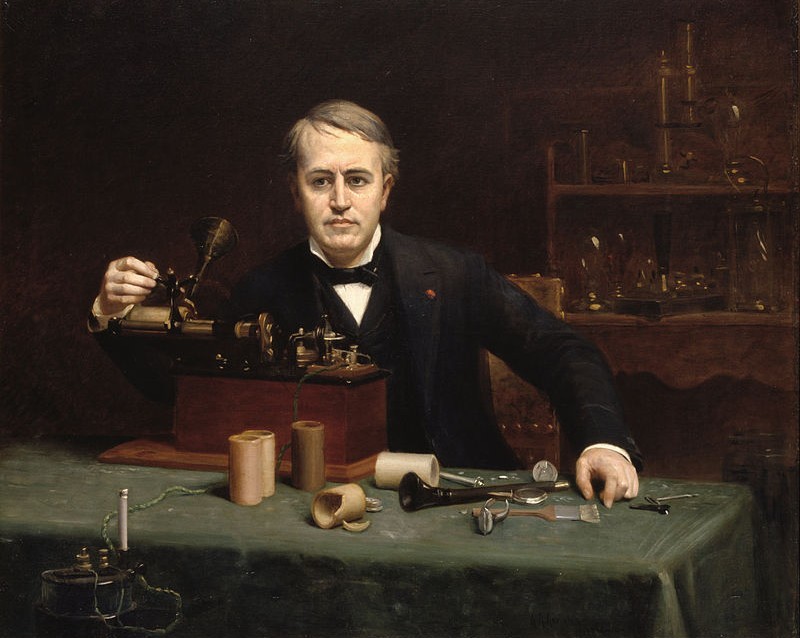
Image Notes: Portrait from 1890 of Thomas Edison by Abraham Archibald Anderson. The image has been cropped and resized.
Acknowledgement: Great thanks to Alexandra Hairston whose inquiry led QI to formulate this question and perform this exploration.
- 1910, Edison: His Life and Inventions by Frank Lewis Dyer and Thomas Commerford Martin, Volume 2 of 2, Chapter 24: Edison’s Method in Inventing, Quote Page 607, Harper & Brothers Publishers, New York. (Google Books Full View) link ↩︎
- 1910 December 31, The New York Times, Section: Saturday Review of Books, Edison and His Inventions: An Authorized Biography by Two Enthusiastic Friends Who Understand Electricity, Quote Page BR2, Column 1, New York. (ProQuest) ↩︎
- 1859, Self-Help; with Illustrations of Character and Conduct by Samuel Smiles, Chapter 3: Application and Perseverance, Quote Page 47, John Murray, London. (Internet Archive at archive.org) link ↩︎
- 1879 August 2, The Craven Pioneer, Skipton Grammar School: Speech Day and Prize Distribution, Quote Page 3, Column 4, Skipton, North Yorkshire, England. (Newspapers_com) ↩︎
- 1898 November, Dental Brief, Volume 3, Number 4, Section: For Our Patients, Perseverance Conquers All by Henry Austin, Quote Page 245, L. D. Caulk, Philadelphia, Pennsylvania. (Google Books Full View) link ↩︎
- 1909 March 14, The Roanoke Times, Casual Remarks That Have Helped to Make History, Quote Page 6, Column 5, Roanoke, Virginia. (Newspapers_com) ↩︎
- 1910, Edison: His Life and Inventions by Frank Lewis Dyer and Thomas Commerford Martin, Volume 2 of 2, Chapter 24: Edison’s Method in Inventing, Quote Page 607, Harper & Brothers Publishers, New York. (Google Books Full View) link ↩︎
- 1910 November 26, The Indianapolis News, Life and Work of Edison (Review of “Edison: His Life and Inventions”), Quote Page 16, Column 4, Indianapolis, Indiana. (Newspapers_com) ↩︎
- 1911, The Boy’s Life of Edison by William H. Meadowcroft, Chapter 23: Edison’s Method in Inventing, Quote Page 299, Harper & Brothers Publishers, New York. (Google Books Full View) link ↩︎
- 1915 September 24, Semi-Weekly News, Remarkable Remarks, Quote Page 4, Column 5, Monroe City, Missouri. (Newspapers_com) ↩︎
- 1917 Copyright, Men Who Are Making America by B. C. Forbes (Bertie Charles Forbes), Chapter: Thomas A. Edison, Quote Page 93, B. C. Forbes Publishing Company, New York. (Google Books Full View) link ↩︎
- 1917 May 17, Leslie’s Illustrated Weekly Newspaper, Men Who are Making America by B. C. Forbes, Start Page 627, Quote Page 627, Column 1, Leslie-Judge Company, New York. (Google Books Full View) link ↩︎
- 1920 July 10, The Fort Myers Press, Experimenting Wins Success Says Edison Who Worked One Year To Reproduce A Word by Roy T. Burke, Quote Page 3, Column 2, Fort Myers, Florida. (Newspapers_com) ↩︎
- 1926 Copyright, Public Speaking: A Practical Course for Business Men by Dale Carnegie, Chapter 6: Essential Elements in Successful Speaking, Quote Page 166, American Institute of Banking, New York. (Google Books Full View) link ↩︎
- 1937, Superior Children: Their Physiological, Psychological and Social Development by John Edward Bentley, Chapter: A Great Inventor: Thomas Alva Edison (1847-1931), Quote Page 246, W. W. Norton & Company, New York. (Verified with scans) ↩︎
- 2011, The Quotable Edison by Thomas A. Edison, Edited by Michele Wehrwein Albion, Chapter 5: On Work and Business, Quote Page 84, University Press of Florida, Gainesville, Florida. (Verified with scans) ↩︎
- 2020, How Innovation Works and Why It Flourishes in Freedom by Matt Ridley, Chapter 12: An Innovation Famine, Quote Page 372, Harper: An Imprint of HarperCollins Publishers, New York. (Verified with scans) ↩︎