George Washington? Augustus Bedford? Peleg D. Harrison? Jane A. Stewart? Apocryphal?
Question for Quote Investigator: U.S. flags are displayed on holidays such as Flag Day, Memorial Day, and Independence Day. One of the founding fathers has received credit for the following symbolism explanation:
We take the stars from heaven, the red from our mother country, separating it by white stripes, thus showing that we have separated from her, and the white stripes shall go down to posterity, representing our liberty.
These words have been attributed to George Washington, but I am skeptical because I have never seen a solid citation, and the phrasing sounds too modern, i.e., nineteenth or twentieth century. Would you please explore this topic?
Reply from Quote Investigator: The U.S. National Archives operates the “Founders Online” website which provides a comprehensive searchable database containing correspondence and other writings from seven Founding Fathers including George Washington who died in 1799.1 QI was unable to find any matching documents in this database for the quotation under examination.
Hence, QI performed a broader search. The earliest match appeared in “The American Almanac, Year-Book, Cyclopedia and Atlas of 1903”. The copyright date of this book was 1902 because it was assembled in 1902 for the succeeding year. The almanac was published by the New York American and Journal, Hearst’s Chicago American, and the San Francisco Examiner. The quotation occurred within an article titled “Flag of the United States; Its 125th Anniversary” by Augustus Bedford. Boldface added to excerpts by QI:2
It has often been said in orations that the red meant valor, the white purity, and the blue loyalty, but Washington gave us a sentiment that is even grander. Gazing upon it, he said:
“We take the star from Heaven, the red from our mother country, separating it by white stripes, thus showing that we have separated from her, and the white stripes shall go down to posterity representing liberty.”
QI does not know where Augustus Bedford obtained this quotation. Bedford did not provide a supporting citation. The lengthy period between the death of George Washington and the emergence of this quotation undercuts the attribution to Washington. Thus, the identity of the creator remains anonymous. QI hopes that future researchers will discover illuminating citations.
Below are additional selected citations in chronological order.
In May 1903 the “Portland Evening Express” of Portland, Maine printed an article about Flag Day which included an instance of the quotation:3
It has often been said in fervid Fourth of July orations that the red in our nation’s flag meant valor, the white purity, and the blue loyalty, but Washington gave a sentiment that was even grander. Gazing upon it, he said:
“We take the star from heaven, the red from our mother country, separating it by white stripes, thus showing that we have separated from her, and the white stripes shall go down to posterity representing liberty.”
Other newspapers in Maine such as the “Daily Kennebec Journal” of Augusta, Maine printed comparable articles containing the same quotation in May 1903.4
In 1906 Peleg D. Harrison published “The Stars and Stripes and Other American Flags”. This book was reviewed by “The Literary Digest” of New York in February 1907. The quotation occurred in the book, and it was reprinted in the review:5
The American flag is a growth rather than a creation. It has been held by some that the stars and stripes were derived from the Washington coat-of-arms. This, however, is refuted by Washington himself, who gave this explanation of his country’s flag:
“We take the stars from heaven, the red from our mother country, separating it by white stripes, thus showing that we have separated from her, and the white stripes shall go down to posterity representing liberty.”
Mr. Harrison has interwoven many interesting incidents of history with his story of the national flag.
In June 1907 “Watson’s Jeffersonian Magazine” of Atlanta, Georgia printed a piece titled “The Day of Old Glory” by Loretta Lide Jolly which contained the following:6
Referring to the flag, Washington said of it: “We take the star from heaven, the red from our mother country, separating it by white stripes, thus showing that we have separated from her, and the white stripes shall go down to posterity representing Liberty.”
In May 1908 the “Journal of Education” published a short play titled “The Making of the Flag: A Dialogue for Flag Day” by Jane A. Stewart. The cast included characters representing the historical figures Betsey Ross, George Washington, George Ross, and Robert Morris. The dialogue was fictionalized. The quotation was spoken by the Washington character:7
Morris—We now have a flag of our own, a beautiful symbolic banner. I cannot recall having seen anywhere the flag of any nation that compares with this in attractiveness of design and coloring.
Ross—Not alone in design, but in its symbolism, this lovely ensign is destined to be leader among all the flags of the earth.
Washington—We take the star from heaven, the red from our mother country, separating it by white stripes, thus showing that we have separated from her, and the white stripes shall go down to posterity representing liberty!
It is possible that Jane A. Stewart learned of the quotation and decided to incorporate it into the dialogue of her play. Yet, it is also possible that Stewart or the author of a similar dramatization constructed the line for the George Washington character sometime before 1902. QI has not yet located a citation early enough to support this hypothesis.
Peleg D. Harrison’s book “The Stars and Stripes and Other American Flags” appeared in 1906, but QI has not yet found scans of a first edition. QI has accessed scans of the third edition published in 19088 and the fifth edition published in 1914. Here is an excerpt:9
That neither the stars nor stripes were derived from the Washington coat of arms is shown by Washington himself, in a grand sentiment on our national flag, which he gave in these words:
“We take the star from Heaven, the red from our mother country, separating it by white stripes, thus showing that we have separated from her, and the white stripes shall go down to posterity representing liberty.”
The quotation has repeatedly appeared in the U.S. Congressional Record. For example, in 1932, Oklahoma Senator Elmer Thomas placed into the Congressional Record a radio address by Robert M. Tolson which contained the following:10
The symbolism of the flag was thus interpreted by Washington: “We take the stars from heaven, the red from our mother country, separating it by white stripes, thus showing that we have separated from her, and the wh1te stripes shall go down to posterity representing liberty.”
In 1959 Representative James E. Van Zandt of Pennsylvania added the following remarks to the Congressional Record:11
It is interesting to recall that when the Star-Spangled Banner was first flown at the head of the Continental Army, Gen. George Washington described its symbolism as follows:
“We take the stars from heaven, the red from our mother country, separating it by white stripes, thus showing that we separated from her and the white stripes shall go down to posterity representing liberty.”
In conclusion, this quotation was attributed to George Washington in an almanac compiled in 1902. However, Washington died in 1799. The length of this delay indicated that Washington probably did not craft the quotation. Also, the quotation does not appear in the “Founders Online” database which includes the writings of Washington. The true creator remains anonymous.
The quotation may have originated in a fictionalized drama or story. It appeared in Jane A. Stewart’s short 1908 work, “The Making of the Flag: A Dialogue for Flag Day,” but that drama appeared after the quotation was already in circulation. QI hopes future researchers will find relevant citations.
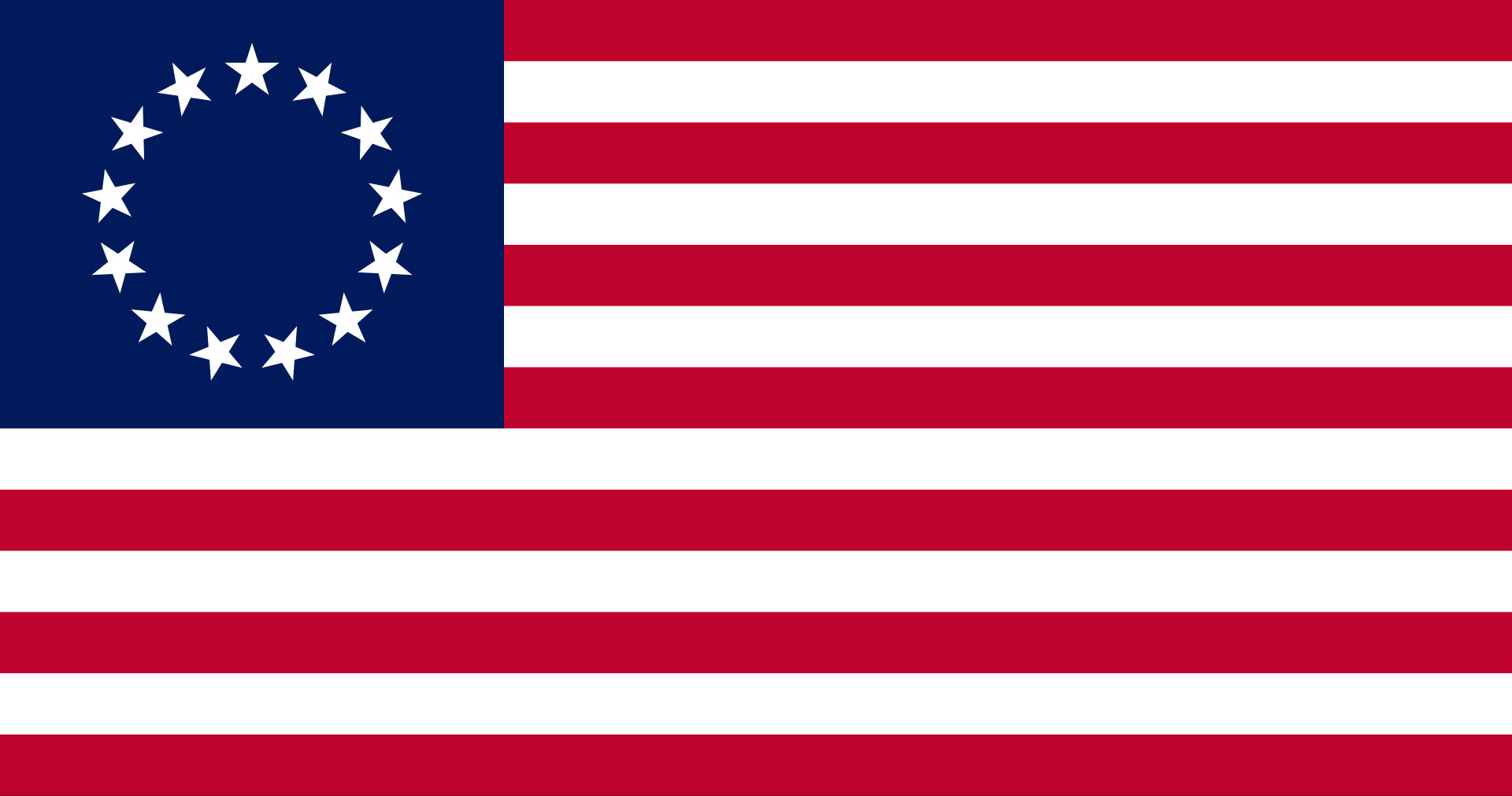
Image Notes: Illustration of the 13-star Betsy Ross variant U.S. flag. Image created by jacobolus using Adobe Illustrator and released into the public domain.
Acknowledgement: Great thanks to the participants in a discussion thread on Bluesky including The Fake History Hunter @fakehistoryhunter.net; Craig Good @clgood.bsky.social; John T @jrtonca.bsky.social; Richard Bartholomew @Barthsnotes. This thread (containing a request) inspired QI to formulate this question and perform this exploration.
- Website: Founders Online, Website description: Database operated by the U.S. National Archives containing correspondence of seven major shapers of the U.S. including George Washington. (Accessed founders.archives.gov on June 15, 2026) link ↩︎
- 1902 Copyright, 1903 The American Almanac, Year-Book, Cyclopedia and Atlas, Second Edition, Flag of the United States; Its 125th Anniversary by Augustus Bedford, Start Page 297, Quote Page 299, Published by New York American and Journal, Hearst’s Chicago American, and San Francisco Examiner. (Google Books Full View) link ↩︎
- 1903 May 27, Portland Evening Express, Flag Day, Quote Page 3, Column 3, Portland, Maine. (Newspapers_com) link ↩︎
- 1903 May 27, Daily Kennebec Journal, State House: Flag Day to Be Celebrated on June 14, Quote Page 5, Column 2, Augusta, Maine. (Newspapers_com) link ↩︎
- 1907 February 2, The Literary Digest, Volume 34, Number 5, A Guide to the New Books, (Book review of Peleg D. Harrison’s “The Stars and Stripes and Other American Flags”), Quote Page 177, Column 3, Funk & Wagnalls Company, New York. (Google Books Full View) link ↩︎
- 1907 June, Watson’s Jeffersonian Magazine, Volume 1, Number 6, The Day of Old Glory by Loretta Lide Jolly, Start Page 606, Quote Page 607, Thomas E. Watson, Atlanta, Georgia. (HathiTrust Full View) link ↩︎
- 1908 May 7, Journal of Education, Volume 67, Number 19, The Making of the Flag: A Dialogue for Flag Day by Jane A. Stewart, Scene 2, (Spoken by George Washington character), Start Page 523, Quote Page 524 and 525, Boston, Massachusetts. (Internet Archive Full View) link ↩︎
- 1908 (1906 Copyright), The Stars and Stripes and Other American Flags by Peleg D. Harrison, Third Edition, Chapter: The Stars and Stripes, Quote Page 59, Little, Brown, and Company, Boston, Massachusetts. (Google Books Full View) link ↩︎
- 1914 (1906 Copyright), The Stars and Stripes and Other American Flags by Peleg D. Harrison, Fifth Edition, Chapter: The Stars and Stripes, Quote Page 58 and 59, Little, Brown, and Company, Boston, Massachusetts. (Google Books Full View) link ↩︎
- 1932, Congressional Record, Senate, Date: June 25, 1932, Radio Address by Robert M. Tolson on Flag Day, Recorded in the Congressional Record at the request of Mr. Thomas (Elmer Thomas) of Oklahoma, Quote Page 13940, Column 1, Government Printing Office, Washington D.C. Accessed congress.gov on June 15, 2026) link ↩︎
- 1959, Congressional Record, House, Extensions of Remarks, Date: June 16, 1959, Topic: Annual Flag Day Luncheon, of the Col. John Proctor Chapter, Daughters of the American Revolution, June 13, 1959, Penn-Alto Hotel, Altoona, Pa. Speaker: Hon. James E. Van Zandt of Pennsylvania, Quote Page 10999, Government Printing Office, Washington D.C. Accessed congress.gov on June 15, 2026) link ↩︎