Thomas J. Watson Sr.? Thomas J. Watson Jr.? Howard H. Aiken? Harold Bergstein? J. Presper Eckert? John Mauchly? Chris Morgan? David Langford? Apocryphal?
Question for Quote Investigator: Collections of boneheaded predictions are popular with people who enjoy laughter combined with commiseration or superiority.
Computers were extraordinarily expensive in the 1950s. First-generation machines used vacuum tubes which were fragile and unreliable. The leader of IBM supposedly said:
I think there is a world market for about five computers.
I have been unable to find a solid citation for this attribution. Would you please explore his topic?
Reply from Quote Investigator: The notion that the market for early computers would be strictly capped has been linked to several pioneers in the development and commercialization of computers.
Thomas J. Watson Sr. was the President of IBM in 1924. He remained the leader until a transition period began in 1952 when Thomas J. Watson Jr. became the President of IBM. In 1956 Watson Sr. died and Watson Jr. became CEO. Watson Jr. continued as the leader up to 1971. He died in 1993.
Researchers have been unable to find substantive evidence supporting the attribution to either man. IBM corporation received many inquiries about this topic and performed a search in corporate documents.
IBM determined that Thomas J. Watson Jr. discussed a forthcoming computer model called the 701 Electronic Data Processing Machine during an annual meeting in 1953. A team of salespeople and Watson Jr. visited potential customers, and Watson Jr. stated, “… we expected to get orders for five machines, we came home with orders for 18”.
The German magazine “Der Spiegel” published a piece about computers in 1965. While discussing Thomas J. Watson Jr. and the demand for these massive machines the magazine wrote, “Watson estimated the US economy’s need at no more than five.”
Howard H. Aiken was the main designer of IBM’s Harvard Mark I, one of the earliest general-purpose electromechanical computers. The Mark I began operating in 1945. There is evidence that Aiken believed that very few computers were needed based on the 1944 citation given further below.
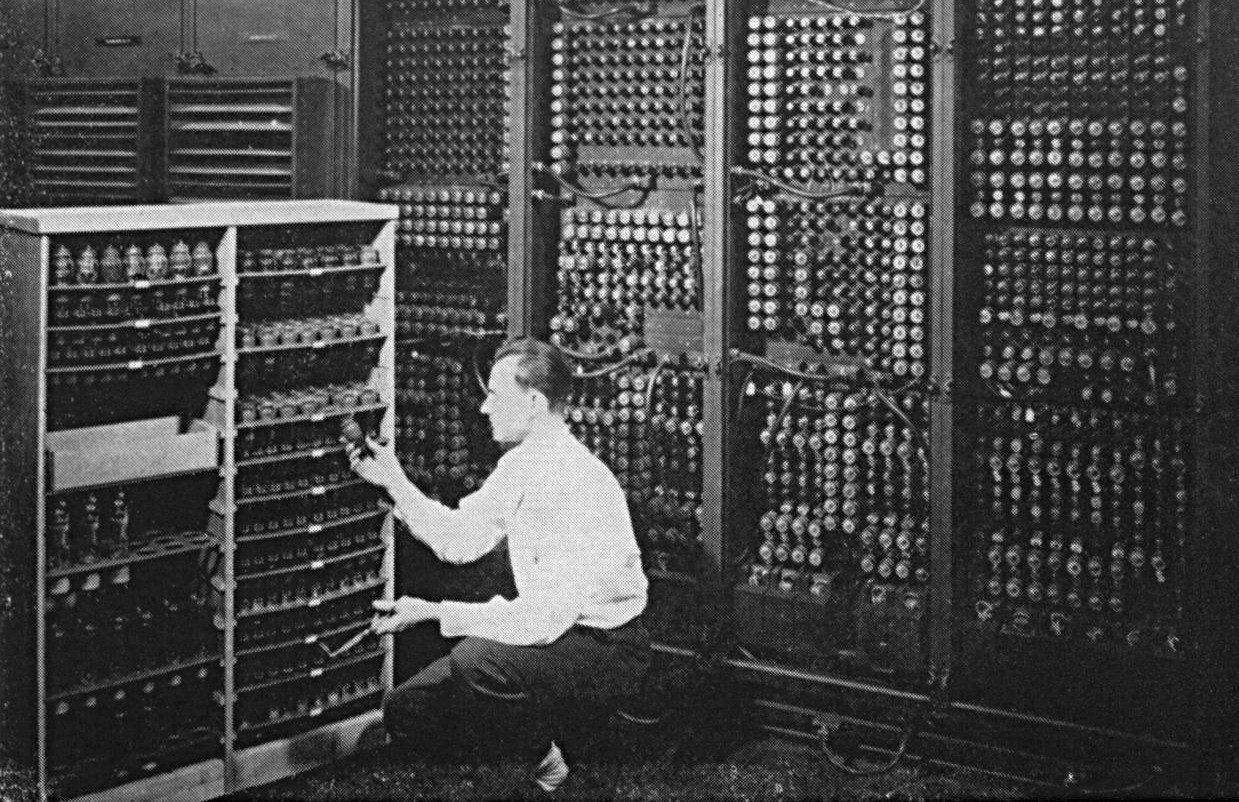
J. Presper Eckert and John Mauchly designed ENIAC, the first general-purpose electronic digital computer which was completed in 1945. The duo discussed the saying during a 1962 interview in the magazine “Datamation” which is covered further below.
Here is an overview displaying dates, excerpts, and attributions.
1944 Oct: Eight years ago, when Aiken began work on mathematical plans for this machine, he supposed that only one such capacious calculator would ever be built. He could not conceive of there being enough work for more than one such giant (Claim about Howard H. Aiken in “Popular Science Monthly”)
1953 Apr 28: As a result of our trip, on which we expected to get orders for five machines, we came home with orders for 18 (Remark by Thomas J. Watson Jr. about the model 701 Electronic Data Processing Machine at IBM’s annual stockholders meeting)
1960 Mar 29: Using electric machines to tabulate census … five electronic computers capable of doing the job of 2,000 card punch operators (Journalist Julia Spiegelman in “The Christian Science Monitor”)
1962 Apr: Who made the now classic prediction that the total requirement for computing power in the U. S. would be six machines? (Question posed by “Datamation” editor Harold Bergstein to computer pioneers J. Presper Eckert and John Mauchly)
1962 Apr: Let’s get orders for six machines to get us enough backlog to make it worthwhile to go ahead with the ENIAC project. (Attributed to John Mauchly by J. Presper Eckert in “Datamation”)
1962 Apr: If six machines were built … we’d never be able to train enough people to program enough problems for these machines. (Attributed to Howard H. Aiken by J. Presper Eckert in “Datamation”)
1965 May 25: IBM CEO Thomas Watson initially wanted nothing to do with the new machines … Watson estimated the US economy’s need at no more than five (Prediction attributed to Thomas J. Watson Jr. in “Der Spiegel” magazine; translated from German to English)
1967 Jan 09: In the late nineteen-forties an authority predicted that only six machines would be needed to serve the nation (Claim by “New York Times” journalist William D. Smith)
1974 Jul 25: In another development at Sperry, the computer was invented which was to have a limited market of perhaps five machines (U.S. Senate testimony by security analyst Marilyn Walter-Carlson)
1981: I think there is a world market for about five computers (Attributed to Thomas J. Watson in “Facts and Fallacies”)
1981 Feb 15: He predicted that the world would need only six such machines. (Prediction attributed to Howard H. Aiken in an article by journalist Bill Kent of the “Courier-Post” in Camden, New Jersey. The machine was the ENIAC)
1983: I think there is a world market for about five computers (Attributed to Thomas J. Watson circa 1958 in “303 of the World’s Worst Predictions”)
1984: I think there is a world market for about five computers (Attributed to Thomas J. Watson circa 1943 in “The Experts Speak”)
1993: Thomas J. Watson … estimated that the total demand for them would not exceed twenty five machines (Attributed to Thomas J. Watson Sr. in “Stan Veit’s History of the Personal Computer”)
2003: No evidence exists that Watson made the remark about five computers (Remark in “The Maverick and His Machine: Thomas Watson Sr. and the Making of IBM” by Kevin Maney)
Below are details for selected citations in chronological order.
In 1944 “Popular Science Monthly” published an article about IBM’s Harvard Mark I. The main designer, Howard H. Aiken, initially underestimated the demand for such machines. Boldface added to excerpts by QI:1
Eight years ago, when Aiken began work on mathematical plans for this machine, he supposed that only one such capacious calculator would ever be built. He could not conceive of there being enough work for more than one such giant. He holds no patent rights and expects no profit. But Harvard faculty members predict now that at least 50 enormous machines like this will soon be needed.
The IBM corporation created a document for their website at ibm.com which presented answers to frequently asked questions (FAQ).2 The FAQ document was dated 2002, but it described remarks3 made by Thomas J. Watson Jr. in 1953:4
Q1. Did Thomas Watson say in the 1950s that he foresaw a market potential for only five electronic computers?
A1. We believe the statement that you attribute to Thomas Watson is a misunderstanding of remarks he made at IBM’s annual stockholders meeting on April 28, 1953. In referring specifically and only to the IBM 701 Electronic Data Processing Machine — which had been introduced the year before as the company’s first production computer designed for scientific calculations — Thomas Watson, Jr., told stockholders that “IBM had developed a paper plan for such a machine and took this paper plan across the country to some 20 concerns that we thought could use such a machine. I would like to tell you that the machine rents for between $12,000 and $18,000 a month, so it was not the type of thing that could be sold from place to place. But, as a result of our trip, on which we expected to get orders for five machines, we came home with orders for 18.”
In 1960 “The Christian Science Monitor” of Boston, Massachusetts printed a piece about the U.S. census which stated that five computers were used to perform the tabulation:5
Using electric machines to tabulate census data in 1890 was the first step in a process culminating this year in the use of five electronic computers capable of doing the job of 2,000 card punch operators.
In 1962 “Datamation” magazine of New York published an interview conducted by editor Harold Bergstein of computer pioneers J. Presper Eckert and John Mauchly. In the following except, a question was posed by Bergstein and Eckert replied. The name “John” corresponded to John Mauchly:6
Q: Who made the now classic prediction that the total requirement for computing power in the U. S. would be six machines?
E: There’s some confusion here. John said, ‘Let’s get orders for six machines to get us enough backlog to make it worthwhile to go ahead with the ENIAC project.’ And then, Howard Aiken made a remark that if six machines were built (and I don’t know whether he was referring to the six machines we were building or whether he was referring to some other source), we’d never be able to train enough people to program enough problems for these machines.
In 1965 the German weekly newsmagazine “Der Spiegel” (“The Mirror”) published an article titled “Sieg der Mikrosekunde” (“Victory of the microsecond”). The article included a picture of Thomas J. Watson Jr. together with the IBM System/360. Below is an excerpt in German followed by an English translation:7
IBM-Chef Thomas Watson hatte zunächst von den neuen Geräten nichts wissen wollen. Als in den frühen fünfziger Jahren die ersten Rechenungetüme für kommerzielle Nutzung auftauchten, die mit ihren Tausenden von Röhren ganze Zimmerfluchten füllten und unerträgliche Hitze entwickelten, schätzte Watson den Bedarf der US-Wirtschaft auf höchstens fünf Stück.
IBM CEO Thomas Watson initially wanted nothing to do with the new machines. When the first behemoths of computers for commercial use appeared in the early 1950s, filling entire rooms with their thousands of vacuum tubes and generating unbearable heat, Watson estimated the US economy’s need at no more than five.
In 1967 “The New York Times” published an article by William D. Smith which contained an instance of the saying with an anonymous attribution:8
A subtle device, the computer has caused the “experts” both to underrate and overrate it
In the late nineteen-forties an authority predicted that only six machines would be needed to serve the nation. By 1950 there were 15 in use, and last year, 40,000. The figure may reach 100,000 by 1970.
In 1974 security analyst Marilyn Walter-Carlson presented testimony to a U.S. Senate subcommittee. She discussed the history of the electronics industry and stated that Sperry Corporation designed a computer with a very small projected demand of five machines:9
In another development at Sperry, the computer was invented which was to have a limited market of perhaps five machines.
The 1981 book “Facts and Fallacies: A Book of Definitive Mistakes and Misguided Predictions” compiled by Chris Morgan and David Langford contained a pertinent entry. Unfortunately, the authors did not distinguish between Thomas J. Watson Sr. and Thomas J. Watson Jr. Also, the authors did not provide a precise citation:10
I think there is a world market for about five computers.
Thomas J. Watson of IBM
In February 1981 the “Courier-Post” of Camden, New Jersey published an article by journalist Bill Kent about J. Presper Eckert who attributed a version of the remark under examination to Aiken:11
Dr. Howard Aiken, head of Harvard University’s computing department and a designer of IBM’s Mark I electro-mechanical computer, was appalled at ENIAC’s gross size and expense. He predicted that the world would need only six such machines.
“He realized a short time after that he had made a mistake,” Eckert says with a smile.
In December 1981 the “Weekly World News” printed an article titled “Here are some very embarrassing predictions by important people” which included the following item:12
And, how about the foresight of Thomas J. Watson — an IBM executive — who at the beginning of the computer age predicted: “I think there is a world market for about five computers.”
In 1983 Wayne Coffey published the compilation “303 of the World’s Worst Predictions” which included the following item which specified the year 1958:13
Better run that data through again
“I think there is a world market for about five computers.”
Thomas J. Watson, International Business Machines (IBM) (1958)
In December 1983 “The New York Times” mentioned Coffey’s book and reprinted the quotation attributed to Watson:14
And Mr. Coffey scrutinizes a host of bad calls in “303 of the World’s Worst Predictions” (Tribeca, $3.95). “Iran will be an island of stability in the Third World sea of change,” the Institute for the Future opined in 1973, and Thomas J. Watson, the president of I.B.M., declared in 1958, “I think there is a world market for about five computers.”
In 1984 Christopher Cerf and Victor Navasky published “The Experts Speak: The Definitive Compendium of Authoritative Misinformation” which contained the following item. The accompanying footnote pointed to the 1981 book “Facts and Fallacies”. The year 1943 was specified:15
“I think there is a world market for about five computers.”
—Remark attributed to Thomas J. Watson
(Chairman of the Board of International Business Machines), 1943
In October 1984 a meeting of research librarians was held titled “Organizational Futures: Staffing Research Libraries in the 1990s”. An attendee presented the following item which suggested that the quotation was spoken in 1943:16
In 1943 IBM’s Chairman, Thomas Watson, said: I think there’s a world market for about five computers.
In 1993 “Stan Veit’s History of the Personal Computer” printed a variant statement which mentioned a larger number of machines:17
In fact, Thomas J. Watson, the man who converted the old Computing and Tabulating Company into the International Business Machine Company, was at first opposed to going into the business of building digital computers because he estimated that the total demand for them would not exceed twenty-five machines. It was not until the invention of the transistor at Bell Labs that the computer grew in power and shrunk in size, a process that has never ceased to this day.
In 2003 Kevin Maney published “The Maverick and His Machine: Thomas Watson Sr. and the Making of IBM”. Maney researched this topic and concluded that the attribution to Thomas Watson Sr. was unsubstantiated:18
Toward the end of the twentieth century, it became widely circulated that Watson said there would only ever be a market for five computers. Such a statement might have reflected his sentiments around the time of the Mark I, but by 1945, when Watson entertained the possibility of hiring Eckert and Mauchly, he believed that computers would at least be bought by science laboratories around the world. That would add up to many more than five computer sales. No evidence exists that Watson made the remark about five computers. It’s not in any of his surviving speeches, nor in any stories about IBM in major magazines and newspapers. He says nothing like it in surviving meeting notes or letters.
In May 2003 “The Economist” magazine reviewed Kevin Maney’s book and mentioned the quotation:19
Mr Maney lays to rest an urban myth, revealing that Watson never made his oft-quoted prediction that there was “a world market for maybe five computers”.
In conclusion, there is no substantive evidence that Thomas J. Watson Sr. or Jr. employed the quotation under examination. Researchers at IBM suggested that the quotation may have originated from a misunderstanding of a comment made by Thomas J. Watson Jr. in 1953. Some pioneering technologists such as Howard H. Aiken believed that the demand for expensive early computers would be tightly circumscribed.
Image Notes: Picture of a person changing a vacuum tube in the ENIAC (Electronic Numerical Integrator and Computer). U.S. Army Photo which has been cropped and resized.
Acknowledgement: Great thanks to the anonymous person whose inquiry led QI to formulate this question and perform this exploration. Thanks to previous research, such as Ralph Keyes’s work in “The Quote Verifier”, Fred R. Shapiro’s work in “The New Yale Book of Quotations”, and I. B. Cohen’s work in the article “Howard Aiken on the number of computers needed for the nation” published in the 1998 July-September issue of “IEEE Annals of the History of Computing”.
Thanks to Pete Morris who pointed out a piece by researcher Fred R. Shapiro which mentioned the remark made by Thomas J. Watson Jr. in 1953. Also, thanks to Ralf Buelow who pointed out the 1965 article in “Der Spiegel”. In addition, thanks to Allan Olley who pointed out the 1998 article in the “IEEE Annals of the History of Computing” which contained an excerpt from the 1962 piece in “Datamation”. Olley also pointed out other evidence.
Update History: On September 3, 2026, several citations were added to the article, and the article was rewritten. The new pieces of evidence were dated 1953, 1962, 1965, 1967, 1981, and 1998.
- 1944 October, Popular Science Monthly, Volume 145, Number 4, Robot Mathematician Knows All the Answers, Start Page 86, Quote Page 88, Popular Science Publishing Company, New York. (Google Books Full View) link ↩︎
- 2003 Copyright, The Political Mapping of Cyberspace by Jeremy W. Crampton, Chapter 7 Notes, Note 2, Quote Page 194, Edinburgh University Press, Edinburgh, Scotland. (Verified with scans) ↩︎
- 2021, The New Yale Book of Quotations, Compiled by Fred R. Shapiro, Section: Thomas J. Watson, Jr., Quote Page 864 and 865, Yale University Press, New Haven, Connecticut. (Verified with hardcopy) ↩︎
- IBM Website Document formerly at ibm.com, Date: January 2002, Title: Frequently Asked Questions, Category: Marketing, Quote Page 18, Publisher: IBM Corporation. Former website location which is now inoperative: www.ibm.com/history/documents/pdf/faq.pdf (Verified with pdf from Internet Archive) ↩︎
- 1960 March 29, The Christian Science Monitor, Census Taking—It’s an Old Custom by Julia Spiegelman (New York), Quote Page 19, Column 8, Boston, Massachusetts. (ProQuest) ↩︎
- 1962 April, Datamation, An Interview with Eckert & Mauchly by Harold Bergstein (Editor of Datamation), Start Page 25, Quote Page 26, Column 1, F. D. Thompson Publications Inc., New York. (Verified with scans) ↩︎
- 1965 May 25, Der Spiegel (The Mirror), Sieg der Mikrosekunde (Victory of the microsecond), Start Page 52, Quote Page 59, Column 1, Spiegel-Verlag, Hamburg, Germany. (Accessed online at spiegel.de; also verified with scans) link ↩︎
- 1967 January 9, The New York Times, Computers: Instruments for Change by William D. Smith, Start Page 135, Quote Page 135, Column 2, New York. (ProQuest) ↩︎
- 1974, United States Senate, Ninety-Third Congress, Second Session, The Industrial Reorganization Act (S. 1167), Hearings Before the Subcommittee on Antitrust and Monopoly of the Committee on the Judiciary, Part 7: The Computer Industry, Date: July 25, 1974, Material Relating to the Testimony of Marilyn Walter-Carlson (Vice President and Associate Director, Research Shareholders Management Company, Los Angeles, California), Start Page 5412, Quote Page 5419 and 5420, United States Government Printing Office, Washington D.C. (Google Books Full View) link ↩︎
- 1981 Copyright, Facts and Fallacies: A Book of Definitive Mistakes and Misguided Predictions by Chris Morgan and David Langford, Chapter: Business, Quote Page 44, John Wiley & Sons, Canada Limited, Toronto, Canada. (Verified with hardcopy) ↩︎
- 1981 February 15, Courier-Post, An invention that shaped out times (Continuation title: Building a computer: Odd parts and brains) by Bill Kent (For the Courier-Post), Start Page 1D, Quote Page 5D, Column 2, Camden, New Jersey. (Newspapers_com) link ↩︎
- 1981 December 15, Weekly World News, Here are some very embarrassing predictions by important people by Carole Russell, Quote Page 6, Column 2, New York. (Google Books Full View) link ↩︎
- 1983, 303 of the World’s Worst Predictions by Wayne Coffey, Chapter 6: It’ll Never Fly: Sci-Tech, Quote Page 67, Tribeca Communications, New York. (Verified with scans) ↩︎
- 1983 December 25, The New York Times, Section: The New York Times Book Review, Paperback Talk by Judith Appelbaum, Start Page 19, Quote Page 20, Column 4, New York. (Verified with scans) ↩︎
- 1984, The Experts Speak: The Definitive Compendium of Authoritative Misinformation by Christopher Cerf and Victor Navasky, Topic: The Computer, Quote Page 208 and 337, Pantheon Books, New York. (Verified with hardcopy) ↩︎
- 1985, Organizational Futures: Staffing Research Libraries in the 1990s, Minutes of the 105th Meeting, Date: October 24-25, 1984, Section: Summary and Discussion, Quote Page 16, Association of Research Libraries, Washington, D.C. (Verified with scans) ↩︎
- 1993 Copyright, Stan Veit’s History of the Personal Computer by Stan Veit (Editor-in-Chief Emeritus of Computer Shopper) Section: Introduction, Quote Page 10, WorldComm Press: A Division of Creativity Inc., Alexander, North, Carolina. (Verified with scans) ↩︎
- 2003, The Maverick and His Machine: Thomas Watson Sr. and the Making of IBM by Kevin Maney, Chapter 11: Old Man, New Electronic Age, Quote Page 355 and 356, John Wiley & Sons, Hoboken, New Jersey. (Verified with scans) ↩︎
- 2003 May 10, The Economist, Volume 367, Number 8323, IBM: Punching the card, (Book review of Kevin Maney’s “The Maverick and His Machine: Thomas Watson Sr. and the Making of IBM”), Quote Page 73, Column 3, The Economist Newspaper Limited, London. (Verified with scans) ↩︎