Charles Maurice de Talleyrand-Périgord? Joseph Fouché? Antoine Boulay de la Meurthe? Napoleon Bonaparte? Jean-Gabriel Peltier? Germaine de Staël? Emmanuel Comte de Las Cases? Walter Scott? Ralph Waldo Emerson?
Question for Quote Investigator: In 1804 the Duke of Enghien was accused of aiding Britain and plotting against Napoleon. Enghien was found guilty and executed. This rapid and brutal action shocked the aristocrats of Europe. Here are two versions of a famous response to this event in French and English:
(1) C’est plus qu’un crime, c’est une faute.
(2) C’est pire qu’un crime, c’est une faute.(A) It is more than a crime; it is a blunder.
(B) It is worse than a crime; it is a blunder.
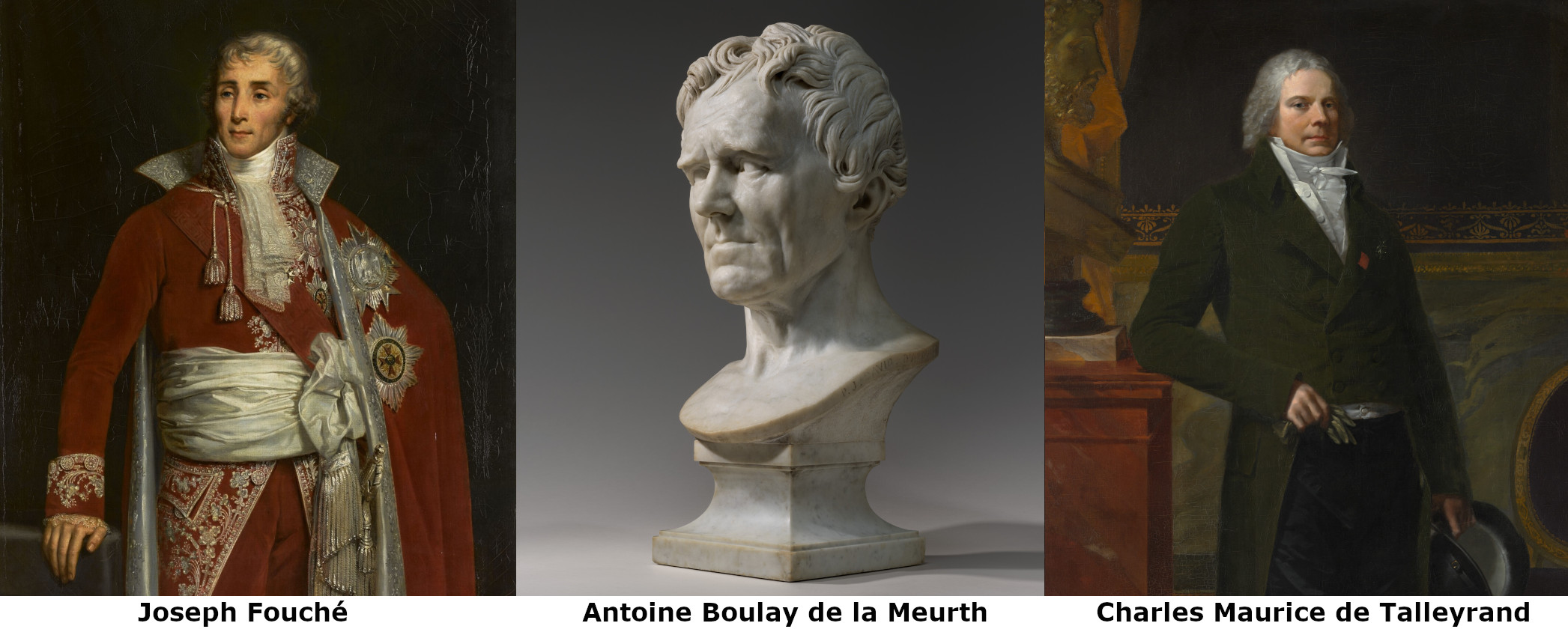
This remark has been attributed to the diplomat Charles Maurice de Talleyrand-Périgord, the police chief Joseph Fouché, the magistrate Antoine Boulay de la Meurthe, and the military leader Napoleon Bonaparte. Would you please explore this topic?
Reply from Quote Investigator: The earliest match found by QI appeared in 1807 within the periodical “L’Ambigu: ou Variétés Littéraires et Politiques” (“The Ambiguous: or Literary and Political Varieties”) which was edited by the French journalist Jean-Gabriel Peltier and published in London. An article attributed the saying to Antoine Boulay de la Meurthe. Below is an excerpt in French followed by an English translation. Boldface added to excerpts by QI:1
… on ne peut se dispenser de citer ici un mot froidement atroce de Boulay (de la Meurthe) conseiller d’état, à qui quelqu’un disait : je pense que la mort du Duc d’Enghien est un crime inutile. C’est bien plus qu’un crime, s’écria Boulay, c’est une faute !
… we cannot refrain from quoting here a coldly atrocious remark made by Boulay (de la Meurthe), a Councilor of State, to whom someone said: “I believe that the death of the Duke of Enghien is a pointless crime.” “It is far more than a crime,” exclaimed Boulay; “it is a blunder!”
Based on the citation above, Antoine Boulay de la Meurthe is the most likely creator of this saying. Joseph Fouché is the second most likely creator. Fouché received credit by 1813. Talleyrand received credit in 1822, and Napoleon received credit in 1844.
Below are details for additional selected citations in chronological order.
A match appeared in the memoirs of the French novelist Germaine de Staël which were written between 1810 and 1813. De Staël died in 1817, and her memoirs were published posthumously by her son. She wrote about the death of the Duke of Enghien, and she attributed the saying to Joseph Fouché. Boldface added to excerpts by QI:2
Fouché lui-même blâmait cette action ; il avait dit ce mot si caractéristique du régime actuel : « C’est pis qu’un crime ; c’est une faute. » Il ya bien des pensées renfermées dans cette phrase ; mais heureusement qu’on peut la retourner avec vérité, en affirmant que la plus grande des fautes, c’est le crime.
Here is one possible rendering into English:
Fouché himself condemned the act; he had uttered that remark so characteristic of the current regime: “It is worse than a crime; it is a blunder.” There are many thoughts encapsulated within this phrase; yet, fortunately, one can truthfully reverse it by asserting that the greatest of blunders is crime itself.
Another match appeared in a journal entry written by Emmanuel, comte de Las Cases dated April 1816 in the work “Mémorial de Sainte-Hélène” (“Memorial of Saint Helena”).
Las Cases accompanied Napoleon Bonaparte during the ex-Emperor’s exile on the island of St. Helena between 1815 and 1821. Las Cases functioned as Napoleon’s informal secretary, and he recorded conversations. Las Cases tentatively credited the saying to Joseph Fouché while criticizing his character. Boldface added to excerpts by QI:3
On connaît de lui le mot qu’il a dit, ou qu’on lui a prêté, sur l’affaire du duc d’Enghien : « C’est plus qu’un crime, c’est une faute. » De pareils traits peignent plus le caractère d’un homme que des volumes entiers. L’Empereur connaissait bien Fouché et n’en a jamais été la dupe.
Here is one possible rendering into English:
He is known for the remark—whether he actually uttered it or it was merely attributed to him—regarding the affair of the Duc d’Enghien: “It is more than a crime; it is a blunder.” Such epigrams reveal a man’s character more vividly than entire volumes. The Emperor knew Fouché well and was never taken in by him.
A match in English appeared in the London periodical “The Correspondent” in 1817. The saying was not presented as a quotation; instead, the words emerged from a dialog between an unnamed person and Joseph Fouché:4
You have all doubtless heard of the expression of FOUCHÉ, when some one, in his presence, expressing a due horror of the execrable murder of the Duke D’ENGHIEN, called it a crime. “It is worse,” said he, “it is a blunder.”
Also, in 1817 a text attributed to Napoleon Bonaparte was published under the title “Manuscrit venu de Sainte-Hélène, d’une Manière Inconnue” (“Manuscript from Saint Helena, Received in an Unknown Manner”). The publisher expressed uncertainty about the manuscript:
Whether it be really written by Buonaparte or by some confidential friend is a matter that must be left entirely to conjecture …
The text included a version of the saying credited to an anonymous wit. Here is the original French followed by an English translation:5
Un homme de beaucoup d’esprit, et qui doit s’y connaître, a dit de cet attentat que c’était plus qu’un crime, que c’était une faute. N’en déplaise à ce personnage, c’était un crime, et ce n’était pas une faute. Je sais fort bien la valeur des mots.
A man of great wit—and one who ought to know—once said of this outrage that it was more than a crime: it was a blunder. With all due respect to that gentleman, it was a crime, and it was not a blunder. I know full well the value of words.
In January 1822 “The Literary and Scientific Repository” of New York published an article titled “The Late Emperor of France” which attributed the saying to Fouché:6
The seizure and condemnation of the Duc D’Enghien, however, who was shot by order of Bonaparte, was an act of guilt of a different character, which could not be defended on the ground of policy or duty, and which wanted even the plea of necessity to palliate its atrocity. In the words of Fouché, it was not only a crime, but a blunder.
Also, in 1822 the book “Reminiscences of Charles Butler, Esq of Lincoln’s-Inn” was published. A footnote attributed the saying to Talleyrand:7
Mentioning the murder of the duke d’Enghien by the order of Buonaparte, Talleyrand is reported to have said, “C’était plus qu’un crime, ç’était une faute:”—”it was worse than a crime, it was a blunder.” We believe that such an expression was never uttered by an Englishman, and that it would be heard by no Englishman without disgust.
The book “Mémorial de Sainte-Hélène” by Emmanuel, comte de Las Cases was first published in 1823. This work contained the 1816 entry about Fouché which was mentioned previously. An English translation was also published in 1823. The phrasing of the saying differed from the version which is now common. The 1823 translator used the word “fault” instead of “blunder”:8
The remark which he made, or which is attributed to him in the affair of the Duke d’Enghien, is well known; “It is more than a crime, it is a fault,” said he. Such traits as these paint the character of a man better than whole volumes. The Emperor knew Fouché well, and never became his dupe.
Fouché took direct credit for the remark in his memoirs which were published in 1824. Fouché mentioned the statement within his discussion about the death of the Duke of Enghien:9
L’indignation que j’avais prévue éclata de la manière la plus sanglante. Je ne fus pas celui qui osa s’exprimer avec le moins de ménagement sur cet attentat contre le droit des nations et de l’humanité. « C’est plus qu’un crime, dis-je, c’est une faute! » paroles que je rapporte, parce qu’elles ont été répétées et attribuées à d’autres.
Here is one possible translation into English:
The indignation I had foreseen erupted in the most violent manner. I was not the person who hesitated to express himself with the least restraint respecting this violence against the law of nations and of humanity. “It is more than a crime,” I said; “it is a blunder!” words I recount here because they have been repeated and attributed to others.
In 1825 an English translation was published which used the phrase “political fault” instead of “blunder”:10
Indignation, which I had foreseen, broke out in the most sanguinary manner. I was not the person who hesitated to express himself with the least restraint respecting this violence against the rights of nations and humanity. “It is more than a crime,” I said, “it is a political fault;” words which I record because they have been repeated and attributed to others.
In 1827 the prominent Scottish author Sir Walter Scott published “The Life of Napoleon Buonaparte: Emperor of the French”. Scott credited Fouché with an instance of the saying:11
In the well-known words of Fouché, the duke’s execution was worse than a moral crime—it was a political blunder. It had this consequence most unfortunate for Buonaparte, that it seemed to stamp his character as bloody and unforgiving …
In 1828 “The London Magazine” credited Talleyrand with an instance:12
Hence poverty, as Talleyrand said of the execution of the Duc d’Enghien, is worse than a crime—it is a blunder.
In 1844 transcendentalist Ralph Waldo Emerson published the essay ” Experience”. Emerson incorrectly attributed the saying Napoleon:13
For there is no crime to the intellect. That is antinomian or hypernomian, and judges law as well as fact. “It is worse than a crime, it is a blunder,” said Napoleon, speaking the language of the intellect.
In 1865 the London humor magazine “Punch” published the following warning:14
It was Fouché, not Talleyrand, who said, C’est pire qu’un crime, c’est une faute. Mind this, you fellows, when you begin your smart leading articles.
In 1870 the collection “Nouveaux Lundis” (“New Mondays”) edited by Charles Augustin Sainte-Beuve contained a piece about Talleyrand which included the saying. The accompanying footnote attributed the statement to Antoine Boulay de la Meurthe. Here is the French followed by an English translation:15
« C’est pire qu’un crime, c’est une faute (1) »
(1) On a attribué ce mot à Fouché, et il lui ressemble en effet. Ces mots historiques voyagent jusqu’à ce qu’ils aient trouvé, pour les endosser, le nom auquel ils conviennent le mieux. On m’assure que le mot a été dit en réalité par Boulay (de la Meurthe). Dudon, qui était alors auditeur au Conseil d’État, certifiait l’avoir entendu de sa bouche.
“It is worse than a crime; it is a blunder” (1)
(1) This remark has been attributed to Fouché, and indeed, it is quite in character for him. Such historic sayings tend to travel about until they find—to claim them as their own—the name to which they are best suited. I am assured, however, that the remark was actually made by Boulay (de la Meurthe). Dudon, who was at the time an auditor at the Council of State, vouched for having heard it from his very lips.
In 1875 “Beautiful Thoughts from French and Italian Authors” compiled by Craufurd Tait Ramage credited Talleyrand:16
C’est pir qu’un crime, c’est un bêtise.
It is worse than a crime, it is a blunder.
This is a saying of Talleyrand.
In conclusion, Antoine Boulay de la Meurthe is the most likely creator of this expression. He received credit in 1807. Joseph Fouché is the next most likely creator. He received credit from Germaine de Staël by 1813. Fouché was also given credit by Emmanuel, comte de Las Cases by 1816. Further, Fouché himself claimed credit in his 1824 memoir. Talleyrand received credit in 1822, but QI has found no evidence that he ever claimed credit.
Image Notes: Image Notes: Portrait of Joseph Fouché, Duke of Otranto by Claude-Marie Dubufe based on a work by René Théodore Berthon. Portrait of Charles Maurice de Talleyrand Périgord circa 1817 by Pierre-Paul Prud’hon. Sculpture of Comte Antoine Boulay de la Meurthe by Pierre-Jean David d’Angers. Images have been cropped and resized. The portraits were accessed via Wikipedia. The picture of the sculpture was accessed via the U.S. National Gallery of Art.
Acknowledgements: Great thanks to Daniel Gackle, Plan Maestro, Jane Thurber, Karthik Sankaran, and an anonymous person whose inquiries led QI to formulate this question and perform this exploration. Also, thanks to previous researchers including Ralph Keyes and Fred R. Shapiro. In addition, thanks to Talos_XLIV for reporting two typos.
Update History: On May 7, 2026, the 1807 citation was added to the article, and the conclusion was updated.
- Date: Le 30 Mars, 1807 (March 30, 1807), L’Ambigu: ou Variétés Littéraires et Politiques (The Ambiguous: or, Literary and Political Varieties), Number CXLIV (144), Chapitre Premier: Napoléon (Chapter One: Napoleon), Quote Page 604 and 605, Edited and published by M. Peltier (Jean-Gabriel Peltier), London. (Google Books Full View) link ↩︎
- 1821, Dix Années D’Exil (Ten Years’ Exile), Fragmens d’un ouvrage inédit composé dans les années 1810 a 1813, (Fragments from an unpublished work composed between 1810 and 1813) by Germaine de Staël, Chapitre 15: Assassinat du duc d’Enghien (Assassination of the Duke d’Enghien), Quote Page 74, Auguste Wahlen et Compagnie, Bruxelles. (Google Books Full View) link ↩︎
- 1824 (Originally published in 1823), Mémorial de Sainte-Hélène ou Journal ou se Trouve Consigné, Jour par Jour, ce qu’a dit et fait Napoléon Durant dix-huit mois; (or Journal in which is Recorded, Day by Day, what Napoleon said and did during eighteen months), Par Le Comte de Las Cases (By the Count de Las Cases), Tome Troisième (Volume Three), Date: Avril 1816 (April 1816), Quote Page 82, Dépôt du Mémorial, Rue du Bac, Paris; Bossange Frères, rue de Seine, Paris. (Internet Archive) link ↩︎
- 1817, The Correspondent: Consisting of Letters, Moral, Political, and Literary Between Eminent Writers in France and England, Number 1, Section: Introduction, Quote Page xiii, Longman, Hurst, Rees, Orme, and Brown, London. (Google Books Full View) link ↩︎
- 1817, Manuscrit venu de Sainte-Hélène, d’une Manière Inconnue Suivi de La protestation de l’impératrice Marie-Louise, Quote Page 35, De L’Imprimerie de H. Remy, Bruxelles, (Brussels, Belgium). (Google Books Full View) link ↩︎
- 1822 January, The Literary and Scientific Repository, and Critical Review, Volume 4, Number 7, Article 7: The Late Emperor of France, Quote Page 109, Wiley and Halsted and C. S. Van Winkle, New York. (Google Books Full View) link ↩︎
- 1822, Reminiscences of Charles Butler, Esq of Lincoln’s-Inn, Third Edition, Section: XII: On Parliamentary Eloquence, Chapter 3: Mr. Fox and Mr. Pitt, Quote Page 172, John Murray, London. (Google Books Full View) link ↩︎
- 1823, Le Mémorial de Sainte-Hélène, Journal of the Private Life and Conversations of the Emperor Napoleon at Saint Helena by The Count de Las Cases, My Residence with The Emperor Napoleon at St. Helena, Volume 2, Part the Third, Date: April 1816, Quote Page 38, Printed for Henry Colburn and Company, London. (Google Books Full View) link ↩︎
- 1825 (First published in 1824), Mémoires de Joseph Fouché, Duc d’Otrante, Ministre de la Police Générale, Tome Premier (Volume 1), Quote Page 199, P. J. de Mat, A la librairie Française at étrangère, Bruxelles, (Brussels, Belgium). (Google Books Full View) link ↩︎
- 1825, The Memoirs of Joseph Fouché, Duke of Otranto, Minister of the General Police of France, Volume 1 of 2, Translated from French to English, Quote Page 265, Printed for Charles Knight, London. (Google Books Full View) link ↩︎
- 1827, The Life of Napoleon Buonaparte: Emperor of the French by Walter Scott, Volume 2 of 3, Chapter 5, Quote Page 49, J. & J. Harper, New York. (Google Books Full View) link ↩︎
- 1828 May, The London Magazine, The Leading Profession, Start Page 252, Quote Page 253, Henry Hooper at the Office of London Magazine, London. (Google Books Full View) link ↩︎
- 1844, Essays: Second Series by Ralph Waldo Emerson, Essay 2: Experience, Start Page 49, Quote Page 86, James Munroe and Company, Boston, Massachusetts. (Google Books Full View) link ↩︎
- 1865 December 16, Punch, Or the London Charivari, Punch’s Table Talk, Quote Page 241, Published at the Office of Punch, London. (Google Books Full View) link ↩︎
- 1870, Nouveaux Lundis par C.-A. Sainte-Beuve, Volume 12, Essai sur Talleyrand par Sir Henry Lytton Bulwer (Ancien Ambassadeur), Date: Mardi 26 janvier 1869, Traduit de l’anglais par M. George Perrot, Start Page 31, Quote Page 52, Michel Lévy Frères, Libraires Éditeurs, Paris. (Google Books Full View) link ↩︎
- 1875, Beautiful Thoughts from French and Italian Authors, Compiled by Craufurd Tait Ramage, Second Edition, Section: Epigrammatic Sayings, Quote Page 387, Edward Howell, Liverpool, England. (Google Books Full View) link ↩︎