Ernest Hemingway? Lionel Trilling? Ladislaus Boros? Larry Williams? Apocryphal?
Question for Quote Investigator: U.S. novelist Ernest Hemingway has been credited with the following fatalistic remark:
All true stories end in death.
I have been unable to find this precise statement in Hemingway’s oeuvre. Apparently, he employed a different phrasing. Would you please help me find the correct statement together with a citation?
Reply from Quote Investigator: In 1932 Ernest Hemingway published “Death in the Afternoon” which examined Spanish bullfighting. Hemingway discussed the mating of bulls and cows. He suggested that a bull which refused to mate with multiple cows would be sent to the bullring which meant death. A woman suggested that this topic was sad. Boldface added to excerpts by QI:1
I find that a sad story, sir.
Madame, all stories, if continued far enough, end in death, and he is no true-story teller who would keep that from you. Especially do all stories of monogamy end in death, and your man who is monogamous while he often lives most happily, dies in the most lonely fashion. There is no lonelier man in death, except the suicide, than that man who has lived many years with a good wife and then outlived her. If two people love each other there can be no happy end to it.
Over time, Hemingway’s quotation has been streamlined to yield the concise version. Here is an overview of this saying together with variants, dates, and attributions:
1932: Madame, all stories, if continued far enough, end in death (Ernest Hemingway)
1954: All stories end in death (Attributed to Ernest Hemingway)
1965: The best love-stories end in death (Ladislaus Boros — translated from German to English)
1966: All stories end in death (Attributed to Ernest Hemingway)
1967: All great love stories end in death (Lionel Trilling)
1971 Nov: Every true story ends in death (Attributed to Ernest Hemingway)
1971 Dec: All true stories end in death (Attributed to Ernest Hemingway)
2001: All true stories end in death (Attributed to Ernest Hemingway)
Below are details for selected citations in chronological order.
In October 1932 “The New Yorker” magazine published a review of Hemingway’s “Death in the Afternoon” which included the quotation:2
“Madam, all stories, if continued far enough, end in death, and he is no true story-teller who would keep that from you. . . . If two people love each other there can be no happy end to it.” I take it that this is the clearest statement yet heard of Mr. Hemingway’s artistic point of view.
In 1954 “Newsweek” magazine printed a short version of the saying while crediting Hemingway:3
All his life, Ernest Hemingway has thought of death, for “Papa” is a storyteller, and, he says, “all stories end in death.” All his life, Ernest Hemingway has looked into the face of death; he finds it ugly, yet he cannot tear his gaze from it. Time and time again, death has touched him, but lightly; death never could hold “Papa” in its embrace.
In 1962 Hungarian theologian Ladislaus Boros published “Mysterium Mortis” in German. An English translation appeared in 1965 under the title “The Moment of Truth” which included the following passage:4
Love and death have, therefore, a common root. The best love-stories end in death, and this is no accident. Love is, of course, and remains the triumph over death, but that is not because it abolishes death, but because it is itself death. Only in death is the total surrender that is love’s possible, for only in death can we be exposed completely and without reserve.
In 1966 Abraham Lass edited and published “A Student’s Guide to 50 American Novels”. A section of this reference book which examined Hemingway’s novel “A Farewell to Arms” included a version of the saying:5
The novel is rich in symbols. For example, the rain that opens and closes the book symbolizes death as well as life. What Frederic learns, then, is that a “code” hero must accept the truth that all stories end in death. That truth understood, life has moments of beauty and significance well worth the living.
In 1967 U.S. literary critic Lionel Trilling published “The Experience of Literature: A Reader with Commentaries” which contained a discussion of the poem “Ode to a Nightingale” by John Keats. Trilling commented on death, pleasure, and love:6
It is not uncommon for poetry to represent death as a positive and pleasurable experience. Death and dying seem naturally to associate themselves with love—the words are used to express the ultimate degree of erotic pleasure, and all great love stories end in death, as if this were the sign and validation of the lovers’ passion.
In November 1971 the “Chicago Tribune” of Illinois published a review of the television movie “Brian’s Song”. The article printed the narrator’s introduction to the movie which ended with the following:7
“Ernest Hemingway said that every true story ends in death. Well: this is a true story.”
In 1971 “The Commercial Appeal” newspaper of Memphis, Tennessee printed a review of the television movie “Brian’s Song”. The reviewer, Larry Williams, stated that the movie began with a different version of the quotation attributed to Hemingway:8
They quoted Ernest Hemingway in the prologue, “All true stories end in death.” And this was a true story. Brian Piccolo died of cancer at the age of 26. He went out with that rare gift which sustained his life: The ability to kid himself and his foe. It was the mark of his life to be loose and happy and yet at the same time to be competitive and courageous.
In 1979 the journal “College English” printed an article by John Woodcock which included an instance attributed Hemingway:9
Modern literature, however, has tended to follow some form of Hemingway’s dictum that all true stories end in death. One need not feel that death is ignoble to respond to its symbolic role as destroyer of human illusions.
In 1982 “The Mississippi Quarterly” published a piece by William Rodney Allen which contained the following:10
Hemingway wrote in Death in the Afternoon that all true stories end in death.
In 2001 a sports journalist at “The Hartford Courant” in Connecticut wrote the following:11
Ernest Hemingway once warned that all true stories end in death. His, of course, did.
In conclusion, Ernest Hemingway deserves credit for the remark he wrote “Death in the Afternoon” in 1932. A shortened version attributed to Hemingway has evolved over time. Ladislaus Boros and Lionel Trilling penned related remarks about love stories.
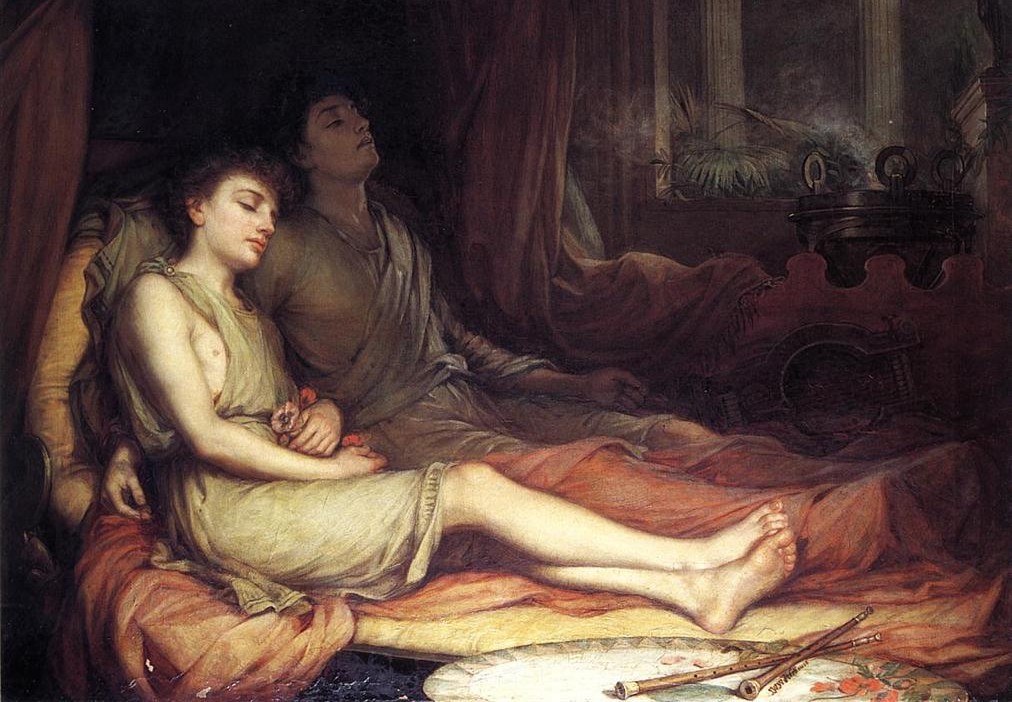
Image Notes: Image of “Sleep and His Half Brother Death” by English painter John William Waterhouse circa 1874. The image has been cropped and resized.
Acknowledgement: Great thanks to Mark Hughes Cobb whose inquiry led QI to formulate this question and perform this exploration. Cobb presented the concise version of the saying, and he also pointed to the correct quotation in “Death in the Afternoon”.
- 1932 Copyright, Death in the Afternoon by Ernest Hemingway, Chapter 11, Quote Page 122, P. F. Collier & Son Corporation, New York. (Verified with scans) ↩︎
- 1932 October 1, The New Yorker, Books: Bullfighters (Review by R.M.C of Ernest Hemingway’s “Death in the Afternoon”) Start Page 61, Quote Page 62, Column 2, F-R Publishing Corporation, New York. (Verified with scans) ↩︎
- 1954 February 1, Newsweek, Volume 43, Number 5, Only His Heroes Die, Quote Page 19, Column 1, Weekly Publications Inc., Dayton, Ohio. (Verified with scans) ↩︎
- 1962 Copyright, The Moment of Truth: Mysterium Mortis by Ladislaus Boros, (1965 English translation of Mysterium Mortis: Der Mensch in der letzten Entscheidung), Chapter 2: The Philosophical Basis for the Hypothesis of a Final Decision, Quote Page 47, Burns & Oates, London. (Verified with scans) ↩︎
- 1966, A Student’s Guide to 50 American Novels, Edited by Abraham Lass, Chapter: Analysis of Ernest Hemingway’s A Farewell to Arms, Start Page 166, Quote Page 171, Washington Square Press Inc., New York. (Verified with scans) ↩︎
- 1967, The Experience of Literature: A Reader with Commentaries by Lionel Trilling, Chapter: Ode to a Nightingale by John Keats (1795-1821), Commentary by Lionel Trilling, Start Page 892, Quote Page 896, Doubleday & Company, Garden City, New York. (Verified with scans) ↩︎
- 1971 November 27, Chicago Tribune, Section: TV Week, Friendship and Courage on the Gridiron, Narrator’s introduction to “Brian’s Song”, Quote Page 3, Column 1, Chicago, Illinois. (Newspapers_com) link ↩︎
- 1971 December 1, The Commercial Appeal, ‘Brian’s Song’ Hits Notes of Courage by Larry Williams, Quote Page 33, Column 1, Memphis, Tennessee. (Newspapers_com) link ↩︎
- 1979 March, College English, Volume 40, Number 7, The Literary View of Politics by John Woodcock, Start Page 772, Quote Page 779, The National Council of Teachers of English, Urbana, Illinois. (Verified with scans) ↩︎
- 1982-83 Winter, The Mississippi Quarterly: The Journal of Southern Culture, Volume 36, Number 1, All the Names of Death: Walker Percy and Hemingway by William Rodney Allen (University of Mississippi), Start Page 3, Quote Page 18, Mississippi State University, Mississippi State, Mississippi. (Verified with scans) ↩︎
- 2001 February 25, The Hartford Courant, Stellar Performance by Huskies Lost in Pomp by Matt Eagan (Courant Staff Writer), Quote Page E5, Column 1, Hartford, Connecticut. (Newspapers_com) link ↩︎