Albert Einstein? George Bernard Shaw? Stuart Chase? S. I. Hayakawa? Robert Anton Wilson? Minot Judson Savage? Donald Kennedy? Percy Williams Bridgman? Anonymous?
Question for Quote Investigator: We are often admonished to use common sense, but a wit once pointed out the drawback of relying on this simple guideline:
Common sense is what tells you the world is flat.
This expression has been attributed to physicist Albert Einstein, playwright George Bernard Shaw, English professor S. I. Hayakawa, economist Stuart Chase, writer Robert Anton Wilson, and others. I am skeptical because I have not seen a solid citation. Would you please explore this topic.
Reply from Quote Investigator: QI has found no substantive evidence supporting the attribution to Albert Enstein who died in 1955. Einstein received credit many years later in 1990.
This notion can be expressed in many ways which makes it hard to trace. Here is an overview with examples, dates, and attributions.
1866: Common sense … led into grave errors. Such doctrines as … the world is flat (Anonymous)
1872: Common sense … convinces us that the world is flat, and that the sun, moon, and stars are our satellites (Anonymous)
1884: Common-sense teaches us, even to-day, that the world is flat (Minot Judson Savage)
1923: Common sense says the world is flat: science says it is spherical (Harry Roberts)
1924: In the Middle Ages people believed that the earth was flat, for which they had at least the evidence of their senses (George Bernard Shaw)
1940: Good common sense makes it plain that the earth is flat and stands still (Edward Kasner and James Newman)
1948: Common sense tells us that the world is flat, that the sun goes around the earth, that heavy bodies always fall faster than light bodies (Stuart Chase)
1949: Common sense … defined … as that which tells you that the world is flat (Attributed to Stuart Chase by S. I. Hayakawa)
1957: Common sense is what tells you the world is flat (Attributed to Stuart Chase by K. C. Ingram)
1962: Common sense as the faculty which tells us the world is flat (Attributed to Stuart Chase by Robert T. Oliver)
1966: Common sense is what tells you the world is flat (Attributed to an anonymous wag by Robert A Golde)
1974: Common sense is what tells you that the world is flat (Principia Discordia)
1979: Common sense also tells us that the world is flat (Donald Kennedy)
1990: Common sense tells us the earth is flat (Attributed to Albert Einstein by Robert Anton Wilson)
1997: Common sense is that which tells us that the world is flat (Attributed to George Bernard Shaw by Adam Przeworski and Fernando Limongi)
1998: Common sense is something that tells us the world is flat (Attributed to Percy Bridgman by Stephen Booth)
2000: Common sense is what tells you that the world is flat (Anonymous)
Below are details for selected citations in chronological order.
In 1866 “The Suburban Magazine” of London, England printed an article without a byline titled “Common Sense” which highlighted the dangers of relying on common sense:1
It must not, however, be forgotten while dwelling on the praises of common sense, that men actuated by its principles, and adhering to its conditions, according to their lights, have been led into grave errors. Such doctrines as, that the sun goes round the earth, and not the earth round the sun—that the world is flat, and similar scientific absurdities, have been maintained by those who, in times past, adhered to what they saw and believed to be true, and denied all assertions to the contrary.
In 1872 “The Morning Advertiser” of London printed the following passage without a byline:2
Common sense, in this uncommon sense, convinces us that the world is flat, and that the sun, moon, and stars are our satellites, which get up in the East and go down again In the West every twenty-four hours; and an infinite deal more stuff of this kind which Science has demonstrated to be false and absurd.
In 1884 Unitarian minister Minot Judson Savage published the book “Beliefs About Man” which contained a concise version of the saying:3
… as Huxley has said, common-sense is only another name for “common ignorance.” It needs to be supplemented, now and again, by a little sense that is not so common. Common-sense teaches us, even to-day, that the world is flat. It taught that for thousands of years, and it took a great while to argue into the common-sense of the crowd the belief which is now established beyond question.
In 1923 Dr. Harry Roberts published an article in “The Western Daily Press” of Bristol, England which contained the following:4
Common sense says the world is flat: science says it is spherical. Common sense came to the natural conclusion that the sun moved round the earth: science found that the earth moved round the sun; and got its ambassador executed for saying so.
In 1924 George Bernard Shaw published the play “Saint Joan”, and he wrote the following in the preface. Shaw’s comments did not match the saying under examination, but they were thematically related:5
In the Middle Ages people believed that the earth was flat, for which they had at least the evidence of their senses: we believe it to be round, not because as many as one per cent of us could give the physical reasons for so quaint a belief, but because modern science has convinced us that nothing that is obvious is true, and that everything that is magical, improbable, extraordinary, gigantic, microscopic, heartless, or outrageous is scientific.
In 1940 Edward Kasner and James Newman published “Mathematics and the Imagination” which contained the following:6
Good common sense makes it plain that the earth is flat and stands still, that the Chinese and the Antipodeans walk about suspended by their feet like chandeliers …
In 1948 Stuart Chase published “The Proper Study of Mankind: An Inquiry into the Science of Human Relations” which contained the following:7
Common sense tells us that the world is flat, that the sun goes around the earth, that heavy bodies always fall faster than light bodies. The practical man, that paragon of common sense, was once defined by Disraeli as “one who repeats the errors of his forefathers.”
In 1949 S. I. Hayakawa published “Language in Thought and Action”, and Hayakawa credited a version of the saying to Stuart Chase:8
Citizens of a modern society need, therefore, more than ordinary “common sense” — which was recently defined by Stuart Chase as that which tells you that the world is flat. They need to be scientifically aware of the powers and limitations of symbols, especially words, if they are to guard against being driven into complete bewilderment by the complexity of their semantic environment.
In 1957 K. C. Ingram published “Talk That Gets Results: Key To Success and Harmony with Others”. Ingram credited the saying to Chase:9
If scientists did not think of the novel and the unusual we would have few of the great inventions that have revolutionized our everyday life during recent times. As Stuart Chase noted, ‘Common sense is what tells you the world is flat.’ Franklin’s idea about electricity was screwball.
In 1962 Robert T. Oliver published “The Healthy Mind in Communion and Communication” which credited another version of the saying to Chase:10
STUART CHASE has described common sense as the faculty which “tells us the world is flat.”
In 1966 Robert A Golde published “Thinking With Figures in Business” which provided an anonymous attribution for the saying:11
As some wag noted, “Common sense is what tells you the world is flat!” Furthermore, each discipline seems to develop its own kind of common sense. What is obvious to a doctor is not at all obvious to a businessman, and what is perfectly clear to a businessman may be incomprehensible to an engineer.
In 1974 the periodical “Green Egg” printed a review of the book “Principia Discordia”. The review reprinted several sayings from the book:12
It contains many inspirational and uplifting epigrams such as: “Bullshit makes the flowers grow and that’s beautiful.” “When in doubt, fuck it. When not in doubt…get in doubt.” “Common sense is what tells you that the world is flat.” “It is my firm belief that it is a mistake to hold firm beliefs.”
In 1979 “The Sacramento Union” of California printed the following which credited the saying to a government official:13
… Food and Drug Administration chief Donald Kennedy warns that even though common sense suggests the tiny chemical traces are harmless, “common sense also tells us that the world is flat.”
In 1990 Robert Anton Wilson published “Quantum Psychology: How Brain Software Programs You and Your World”. Wilson attributed the saying to Einstein:14
That’s why Einstein had to remind us, “Common sense tells us the earth is flat.”
In 1997 Adam Przeworski and Fernando Limongi published an article in the journal “World Politics: A Quarterly Journal of International Relations”, and the authors attributed the saying to George Bernard Shaw:15
Yet common sense would indicate that in order to strengthen democracy we should strengthen democracy, not support dictatorships. And, even if G. B. Shaw warned that “common sense is that which tells us that the world is flat,” the lesson of our analysis is that this time it is the best guide.
In 1998 Stephen Booth published “Precious Nonsense”, and he attributed the saying to physicist Percy Williams Bridgman:16
Common sense is wrong. After all, as the physicist Percy Bridgman observed more than half a century ago, common sense is something that tells us the world is flat.
In 2000 Vincent Fu published the compilation “Quote This!!!” which contained the following entry:17
Common sense is what tells you that the world is flat.
-Anonymous
In conclusion, the saying evolved over time. The originator remains anonymous. Different phrasings have distinct nuances. Minot Judson Savage employed a concise instance in 1884.
The attribution to Albert Enstein is unsupported. Einstein received credit in 1990 which was many years after his death. The attribution to George Bernard Shaw is unsupported. Shaw received credit in 1997 which was many years after his death. Also, Shaw wrote a thematically related remark in 1924. Stuart Chase employed an instance in 1948, but the saying was already in circulation.
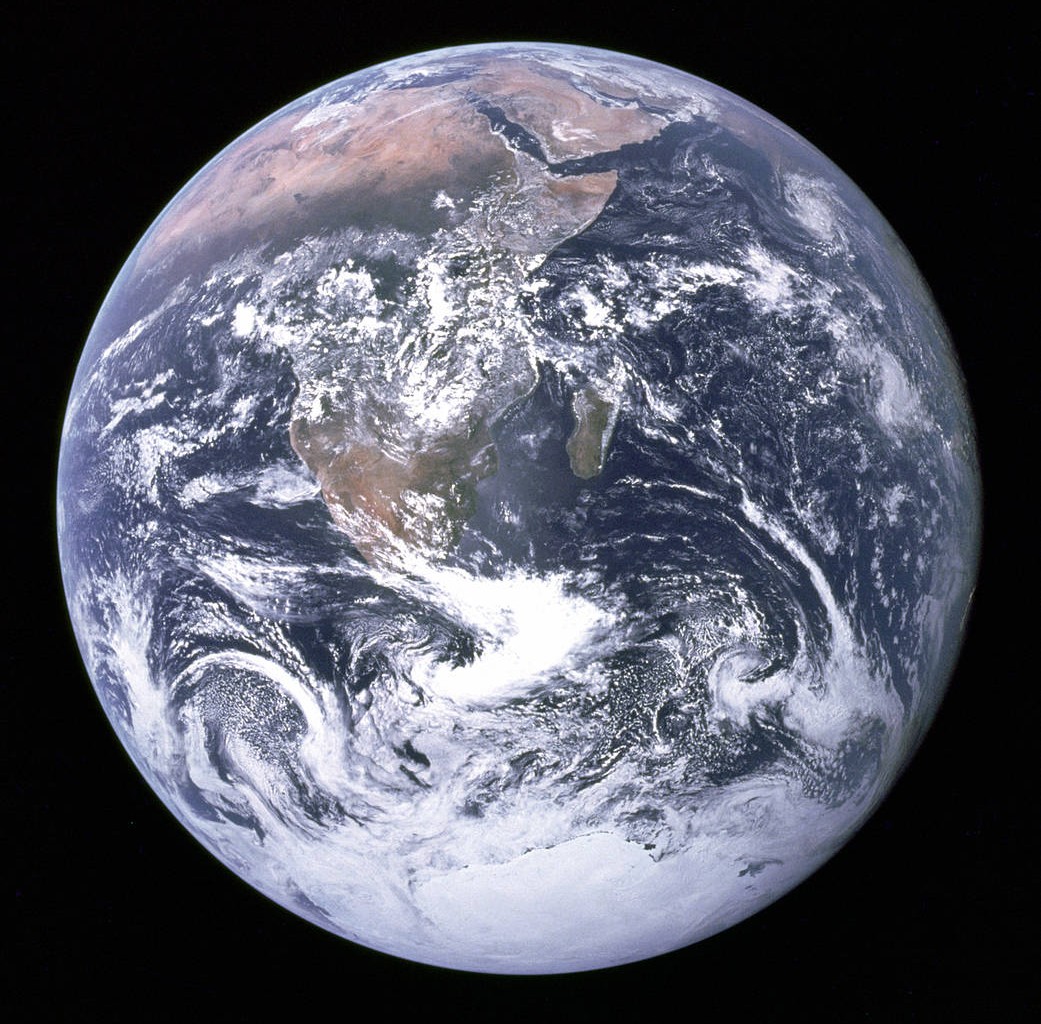
Image Notes: Earth as seen by the Apollo 17 crew. Image obtained from the official website nasa.gov.
Acknowledgement: Great thanks to John Simpson whose inquiry led QI to formulate this question and perform this exploration. Simpson mentioned the attributions to Albert Einstein, Stuart Chase, and S. I. Hayakawa. Also, thanks to Ian Ellis of “Today in Science History” who mentioned the 1949 citation in which Hayakawa credited Chase. In addition, thanks the volunteer editors of Wikiquote and Wikipedia who mentioned the same citation.
- 1866 September, The Suburban Magazine, Volume 1, Number 1, Common Sense, Start Page 13, Quote Page 14, Column 2, Published at the Office of The Suburban Magazine, London. (Google Books Full View) link ↩︎
- 1872 August 17, The Morning Advertiser, (Untitled article), Quote Page 4, Column 3, London, England. (British Newspaper Archive) ↩︎
- 1884, Beliefs About Man by M. J. Savage (Minot Judson Savage), Chapter 6: Is Man Free?, Quote Page 56, George H. Ellis, Boston, Massachusetts. (Google Books Full View) link ↩︎
- 1923 October 13, The Western Daily Press, Science and Common Sense by Dr. Harry Roberts, Quote Page 10, Column 6, Bristol, England. (British Newspaper Archive) ↩︎
- 1924 Copyright, Saint Joan: A Chronicle Play in Six Scenes and an Epilogue by Bernard Shaw (George Bernard Shaw), Section: Preface, Quote Page lxx and lxxi, Brentano’s, New York. (Google Books Full View) link ↩︎
- 1940, Mathematics and the Imagination by Edward Kasner and James Newman, Chapter 3: Pie, Quote Page 65, Simon and Schuster, New York. (Verified with scans) ↩︎
- 1948 Copyright, The Proper Study of Mankind: An Inquiry into the Science of Human Relations by Stuart Chase, Chapter 1: Is Man a Part of Nature?, Quote Page 10, Harper & Brothers, New York. (Verified with scans) ↩︎
- 1949, Language in Thought and Action by S. I. Hayakawa (Samuel Ichiye Hayakawa), Written in consultation with Basil H. Pillard (Antioch College), Book One: The Functions of Language, Chapter 2: Symbols, Quote Page 31, Harcourt, Brace and Company, New York. (Verified with scans) ↩︎
- 1957 Copyright, Talk That Gets Results: Key To Success and Harmony with Others by K. C. Ingram, Chapter 5: Why Be So Sure We’re Right? Quote Page 61, McGraw-Hill Bok Company, New York. (Verified with scans) ↩︎
- 1962 Copyright, The Healthy Mind in Communion and Communication by Robert T. Oliver (Head, Department of Speech, The Pennsylvania State University) and Dominick A. Barbara (Certified Practicing Psychoanalyst), Part 1 by Robert T. Oliver, Chapter 1: Purposive Thinking, Section: References, Quote Page 39, Charles C. Thomas Publisher, Springfield, Illinois. (Verified with scans) ↩︎
- 1966 Copyright, Thinking With Figures in Business: Techniques for Improving Your Number Sense by Robert A Golde (Golde Management Services), Chapter 1: The Need for Number Sense, Quote Page 7, Addison-Wesley Publishing Company, Reading, Massachusetts. (Verified with scans) ↩︎
- 1974 August, Green Egg, Volume 7, Number 64, (Book Review by Morning G’Zell of “Principia Discordia”), Quote Page 20, Column 1, Church of All Worlds, St. Louis, Missouri. (Verified with scans) ↩︎
- 1979 February 18, The Sacramento Union, Cancer suspect food additives in for another round of debates by Elizabeth Wehr, Quote Page F5, Column 3 and 4, Sacramento, California. (Newspapers_com) link ↩︎
- 1990, Quantum Psychology: How Brain Software Programs You and Your World by Robert Anton Wilson, Chapter 21: Wigner’s Friend, or Whodunit, Quote Page 174, New Falcon Publications, Phoenix, Arizona. (Verified with scans) ↩︎
- 1997 January, World Politics: A Quarterly Journal of International Relations, Volume 49, Number 2, Modernization: Theories and Facts by Adam Przeworski and Fernando Limongi, Quote Page 177 and 178, Published by Johns Hopkins University Press, Baltimore, Maryland. (Verified with scans) ↩︎
- 1998, Precious Nonsense: The Gettysburg Address, Ben Jonson’s Epitaphs on His Children, and Twelfth Hight by Stephen Booth, Chapter: Introduction, Quote Page 21, University of California Press, Berkeley, California. (Verified with scans) ↩︎
- 2000 Copyright, “Quote This!!!”: Mainstream Quotes as Answers to Life’s Questions and Current Issues, Compiled by Vincent Fu, Chapter 7: A Little Enlightenment, Quote Page 90, Ho Logos Group, Cypress, California. (Verified with scans) ↩︎