John James Audubon? Joseph Cornell? Patricia Holt? Jack Barclay? Birdwatcher’s Proverb? Jack Kornfield? Anonymous?
Question for Quote Investigator: Much of our knowledge is obtained indirectly through reference books and instruction manuals. Yet, direct observation provides a more accurate guide. Here is pertinent saying from the domain of ornithology:
When the bird and the book disagree, always believe the bird.
This statement has been attributed to the prominent artist and naturalist John James Audubon, but I have not seen a solid citation, and I am skeptical. Would you please explore the provenance of this expression?
Reply from Quote Investigator: QI has not found any substantive evidence supporting the ascription to John James Audubon who died in 1851.
The earliest match found by QI appeared in the 1987 book “Listening to Nature: How to Deepen Your Awareness of Nature” by Joseph Cornell. The saying appeared as an epigram for section fifteen. Boldface added to excerpts by QI:1
“When the bird and the book disagree, always believe the bird.”
—Birdwatcher’s Proverb
Thus, Joseph Cornell helped to popularize this saying, but the originator remains anonymous.
Below are additional selected citations in chronological order.
In October 1987 “Listening to Nature” was reviewed by Patricia Holt in “The San Francisco Examiner”. The saying was memorable enough to be reprinted:2
In an excerpt, Cornell shows how a simple bird call (“pssh . . . pssh . . . pssh”), repeated in sets, can attract many birds to within a few feet of the caller. If that doesn’t work, he says, remember the old birdwatcher’s proverb: “When the bird and the book disagree, always believe the bird.”
In 1990 Tom Parker compiled a collection of sayings and published them under the title “Never Trust a Calm Dog and Other Rules of Thumb”. Parker presented a slightly different version of the saying together with an attribution:3
WATCHING BIRDS When the bird and the bird book disagree, believe the bird. Jack Barclay, biologist, pilot, flight instructor, Santa Cruz, California
In 1996 a newspaper in Albert Lea, Minnesota published a set of miscellaneous sayings which included these three items:4
Don’t wish for an easier life. Become a stronger person.
Good intentions are common, good deeds are rare.
When the bird and the bird book disagree, always believe the bird.
In 2000 psychologist and meditation teacher Jack Kornfield published “After the Ecstasy, the Laundry: How the Heart Grows Wise on the Spiritual Path”. The saying appeared as a chapter epigraph with an attribution to Audubon:5
When the bird and the book disagree, always believe the bird.
JAMES AUDUBON
In 2006 the compilation “Wisdom for the Soul: Five Millennia of Prescriptions for Spiritual Healing” contained the following entry:6
When the bird and the book disagree, always believe the bird.
~ John James Audubon, 1785-1851 ~
In conclusion, the earliest citation in 1987 stated that the saying was a birdwatcher’s proverb. Thus, the originator remains anonymous. John James Audubon died in 1851, and he implausibly received credit in 2000.
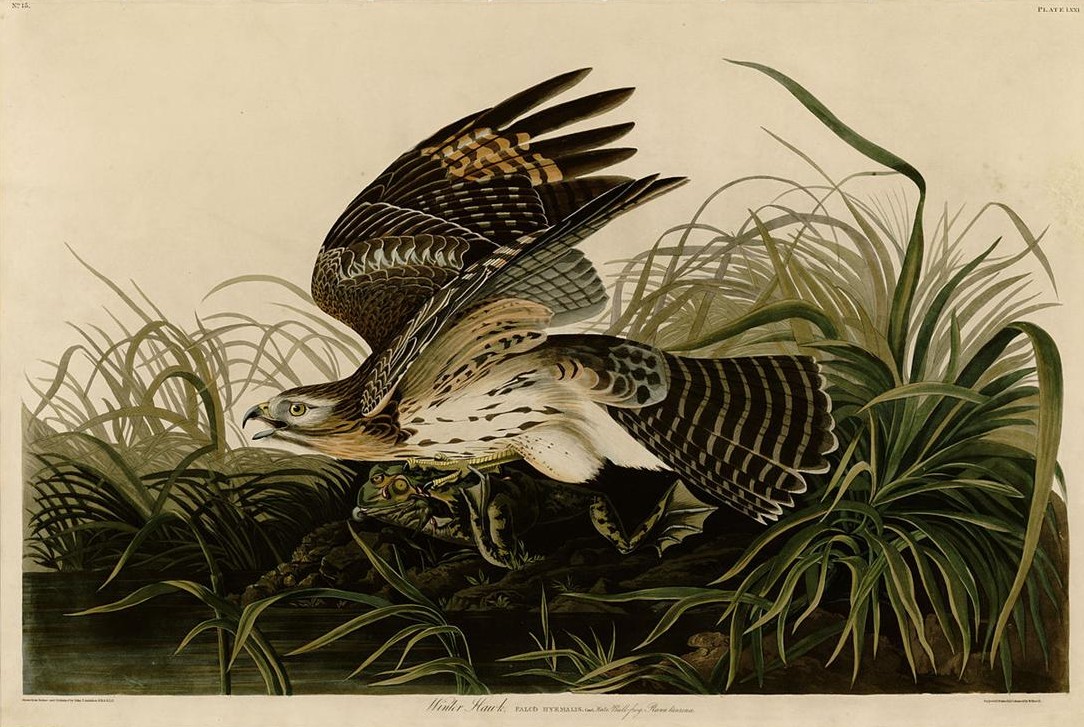
Image Notes: Illustration of a Winter Hawk from John James Audubon; plate 71 in the series Birds of America 1827-1838.
Acknowledgement: Great thanks to James Callan whose inquiry led QI to formulate this question and perform this exploration. Callan mentioned that he found the saying in Jack Kornfield’s book.
- 1987 Copyright, Listening to Nature: How to Deepen Your Awareness of Nature by Joseph Cornell, Section 15, (Section epigram), Quote Page 45, Dawn Publications, Nevada City, California. (Verified with scans) ↩︎
- 1987 October 4, The San Francisco Examiner, Section: Review, ‘Big Daddy’ and Little Birds by Patricia Holt, Quote Page 2, Column 2, San Francisco, California. (Newspapers_com) link ↩︎
- 1990, Never Trust a Calm Dog and Other Rules of Thumb, Compiled by Tom Parker, Topic: Birds, Quote Page 12, Harper Perennial: A Division of Harper Collins Publishers, New York. (Verified with scans) ↩︎
- 1996 March 31, Albert Lea Tribune, There’s nothing so forlorn as a robin in the snow by Allen Batt, Quote Page 4C, Column 5, Albert Lea, Minnesota. (Newspapers_com) link ↩︎
- 2000 Copyright, After the Ecstasy, the Laundry: How the Heart Grows Wise on the Spiritual Path by Jack Kornfield, Introduction, (Chapter epigraph), Quote Page xiii, Bantam Books: A Division of Random House, New York. (Verified with scans) ↩︎
- 2006, Wisdom for the Soul: Five Millennia of Prescriptions for Spiritual Healing, Compiled and Edited by Larry Chang, Section: Experience, Quote Page 284, Column 2, Gnosophia Publishers, Washington, D.C. (Verified with scans) ↩︎