Arthur D. Little Consulting Firm? JoAnne Yates? John H. Dessauer? Ian H. Gordon? Horace Becker? JoAnne Yates? Apocryphal?
Question for Quote Investigator: Predicting the demand for an innovative product is remarkably difficult. Apparently, the company that invented the photocopier hired a prestigious consulting firm to estimate future sales. The result was a statement like the following:
The total market for photocopiers is at most five thousand units.
I do not know the exact phrasing of the statement. Also, I do not know the precise number of units. Would you please explore this topic?
Reply from Quote Investigator: Chemical engineer John H. Dessauer helped develop xerography and worked for the Haloid Company, which later became Xerox Corporation. In his 1971 book, “My Years with Xerox: The Billions Nobody Wanted,” Dessauer discussed a survey that sought to forecast demand for photocopiers. Boldface added to excerpts by QI:1
Haloid was still sponsoring a series of market surveys, for which it retained reputable New York firms. One of them, after questioning vast numbers of businessmen, reported that we could not look forward to placing more than five thousand copiers in American offices! It presented all sorts of evidence to bolster its dire warning. If its estimate was accurate, there was no hope whatever of recovering our investment in xerography. We might as well forget producing a copier and accept our loss.
Below are additional selected citations in chronological order.
The 1976 book “An Introduction to Contemporary Business” contained the following passage:2
Haloid hired large, reputable, New York marketing research agencies to conduct a series of market surveys. One survey questioned a large number of businessmen about the potential market for such a copier. Their projection: not more than 5000 copiers could be used in American offices. If this estimate were correct, Haloid could never even recover its original investment in Chet Carlson’s idea.
In 1987 JoAnne Yates published a book chapter titled “From Hand Copy to Xerox Copy: The Effects of Duplicating Technology on Organizational Communication in American Firms in the 19th and 20th Centuries”. Yates contacted an official at Xerox Corporation who stated that the survey was conducted by Arthur D. Little, a management consulting firm located in Boston, Massachusetts. QI does not know why previous citations suggested that the survey was conducted by a New York company:3
Ironically, as Dessauer (1971) has shown, Xerox brought the 914 to market despite gloomy market projections. In fact, according to one executive involved in the initial production of the 914, a market research study performed by Arthur D. Little showed a total potential market of only 5,000 copiers (Horace Becker, telephone interview, Sept. 30, 1985). That study, however, was based on a major misperception of the Xerox machine’s role in the copying market—that it would simply absorb some of the carbon copying market.
In 1993 “Judgment Calls: High-Stakes Decisions in a Risky World” by John C. Mowen included the following passage:4
The first commercial sales of a copier did not occur until 1951. In 1953, a research firm estimated that no more than five thousand copiers would be placed in American offices.
In 2002 “Competitor Targeting: Winning the Battle for Market and Customer Share” printed the following version of the tale:5
Kodak ignored its neighbor and under its very nose emerged a major corporation, which Haloid renamed as Xerox. Not only did Kodak miss out but IBM made a similar mistake. In the late 1950s, a consulting firm helped IBM to decide whether or not to acquire Xerox. It said that the world market for copiers would never exceed 5,000 units.
In conclusion, there is substantive evidence that a consulting firm in the 1950s estimated that the total demand for photocopiers in the U.S. was only 5,000 units. That claim appeared in a 1971 book by John H. Dessauer who was the director of research at Haloid. Dessauer helped Xerox become a billion-dollar company. The claim was also supported by Xerox executive Horace Becker according to a 1987 book chapter by JoAnne Yates.
Acknowledgement: Great thanks to Dave Wilton whose comment led QI to formulate this question and perform this exploration. Wilton heard that the Battelle Memorial Institute performed a study that projected a very low demand for photocopiers.
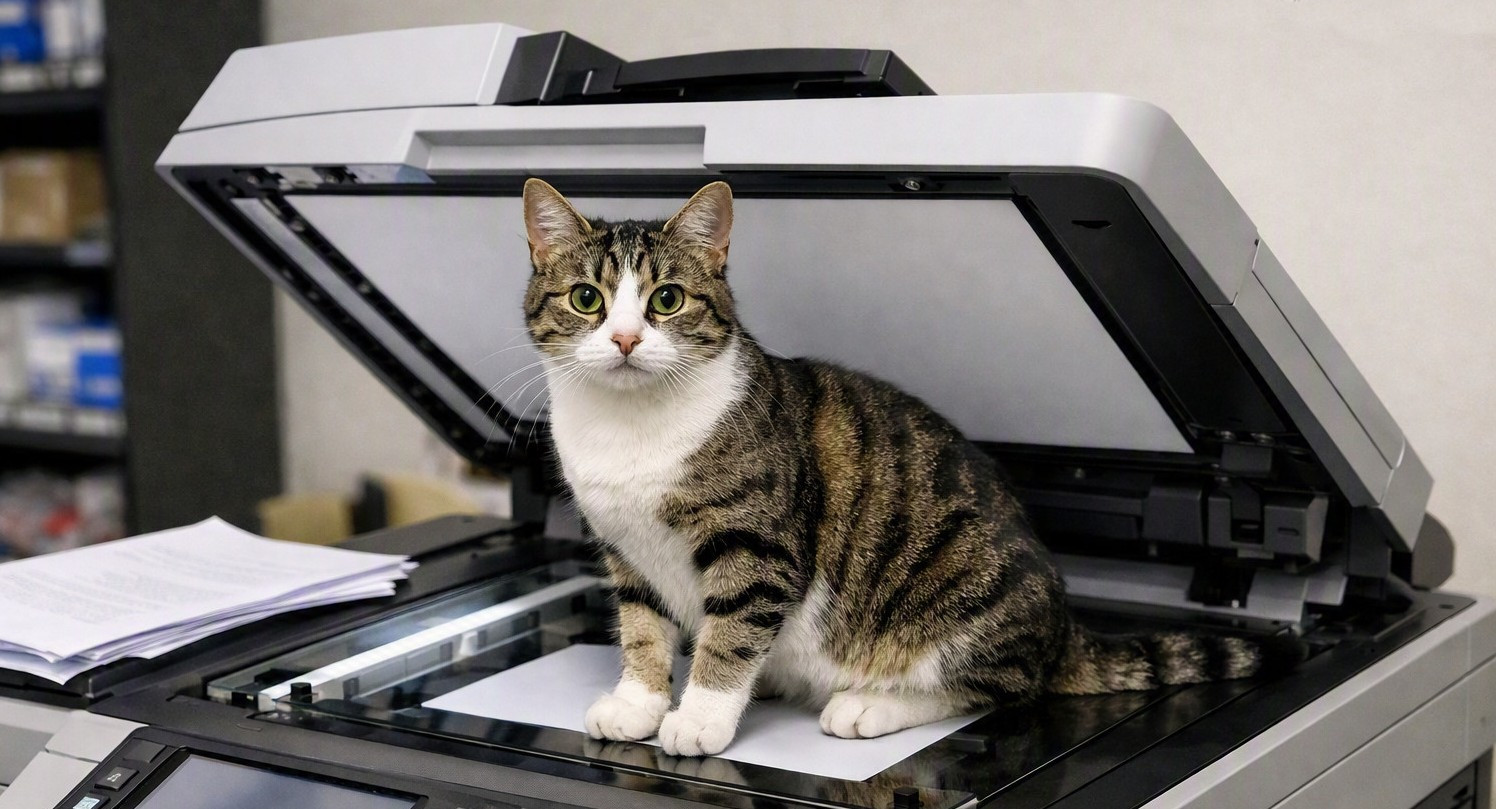
Image Notes: Public domain illustration of a cat sitting on a photocopier. The image has been cropped.
- 1971, My Years with Xerox: The Billions Nobody Wanted by John H. Dessauer, Chapter 3, Quote Page 89, Doubleday & Company, Garden City, New York. (Verified with scans) ↩︎
- 1976 Copyright, An Introduction to Contemporary Business by William Rudelius, W. Bruce Erickson, and William J. Bakula Jr., Second Edition, Chapter 1: American Business: An Overview, Quote Page 7, Harcourt Brace Jovanovich Inc., New York. (Verified with scans) ↩︎
- 1987 Copyright, Organization — Communication: Emerging Perspectives II, Edited by Lee Thayer (University of Wisconsin, Parkside), Chapter 5: From Hand Copy to Xerox Copy: The Effects of Duplicating Technology on Organizational Communication in American Firms in the 19th and 20th Centuries by JoAnne Yates, Start Page 82, Quote Page 100, Ablex Publishing Corporation, Norwood, New Jersey. (Verified with scans) ↩︎
- 1993 Copyright, Judgment Calls: High-Stakes Decisions in a Risky World by John C. Mowen, Chapter 1: On the Nature of Judgment Calls, Quote Page 21, Simon & Schuster, New York. (Verified with scans) ↩︎
- 2002, Competitor Targeting: Winning the Battle for Market and Customer Share by Ian H. Gordon, Chapter 2: The Competitive Imperative, Quote Page 57, John Wiley & Sons Canada Limited, Etobicoke, Ontario. (Verified with scans) ↩︎