Christopher Hitchens? Brian Crane? Susie Blair? Brian K. Lebowitz? P. G. Wodehouse? Pickles? Muffin the Cat? Roscoe the Dog? Anonymous?
Question for Quote Investigator: The attitudes of dogs and cats differ substantially according to a popular humorous analysis. A dog which receives food, water, care, and affection concludes: “My benefactor is a god”. A cat which receives food, water, care, and affection concludes: “I am a god”.
This notion has been credited to British political commentator Christopher Hitchens, U.S. cartoonist Brian Crane, and others. Would you please explore the provenance of this comical observation?
Reply from Quote Investigator: This notion can be expressed in many ways; hence, it is difficult to trace. The earliest full match located by QI appeared in “Reader’s Digest” magazine in May 1994. Boldface added to excerpts by QI:1
With a dog, you feed him, you give him plenty of affection, you take him for walks and he thinks, “Wow, this guy must be a god.” With a cat, however, you feed him, you love him, you care for him and he thinks, “Wow, I must be a god.”
—Contributed by Brian K. Lebowitz
QI tentatively credits Lebowitz as originator although it remains possible that Lebowitz was sharing a joke he acquired from someone else.
Below are additional selected citations in chronological order.
The humble attitude of canines towards godhood has long been observed. For example, in 1930 the Cambridge Festival2 in England staged “Tobias and the Angel” by the Scottish playwright James Bridie which contained the following remark by a character:3
RAPHAEL. What a way to behave before your dog! You are a god to your dog. What must he think of you? You will make an atheist of him.
In 1933 a character in a book by English humorist P. G. Wodehouse spoke about the arrogant attitude of felines:4
“The real objection to the great majority of cats is their insufferable air of superiority. Cats, as a class, have never completely got over the snootiness caused by the fact that in Ancient Egypt they were worshipped as gods. This makes them too prone to set themselves up as critics and censors of the frail and erring human beings whose lot they share.”
A separate QI article titled “Quip Origin: In Ancient Times Cats Were Worshipped As Gods; They Have Not Forgotten This” is available here.
In 1934 the book “Training the Dog” by Will Judy contained the following passage:5
To your dog, you are a god; you are the greatest and most important personage on the face of the earth; your command is strict law to him regardless of what others may say. If you and I could be as good and as noble and as mighty as our dogs think we are, we would be half gods on earth.
In May 1994 “Reader’s Digest” magazine printed the full version of the joke which had been contributed by Brian K. Lebowitz as mentioned near the beginning of this article.
In June 1994 a senior writer for Cox Newspapers named Joe Murray printed an instance received from a correspondent:6
On the subject of deity and animals, Susie Blair … writes to share a quote that she clipped:
“With a dog, you feed him, you give him plenty of affection, you take him for walks and he thinks, ‘Wow, this guy must be a God.’ With a cat, you feed him, you love him, and care for him and he thinks, ‘Wow, I must be a God.'”
In 1996 a version of the joke appeared in a four-panel syndicated comic strip called “Pickles” featuring a retired couple, Earl and Opal Pickles, and their pets by U.S. cartoonist Brian Crane.7
In the first panel of the comic strip the dog Roscoe noted that he was fed and cared for every day by Opal Pickles. In the second panel Roscoe concluded: “SHE MUST BE A GOD”. In the third panel the cat Muffin noted that she was fed and cared for every day by Opal Pickles. In the fourth panel Muffin concluded: “I MUST BE A GOD”.
In 2000 the book “My Soul Thirsts: An Invitation to Intimacy with God” by Steve Korch included a description of the cartoon discussed above. Thus, the joke achieved further distribution. The description began with the following words:8
Two primary perspectives on life were captured in the cartoon strip Pickles. Picture it with me. The first frame opens with a frumpy old woman dressed in a bowling shirt, Bermuda shorts, and slippers calling her dog to dinner, “Chow time, Roscoe.”
In 2005 a “Dictionary of Proverbs” published in New Delhi, India included the following instance of the joke without attribution:9
A dog thinks: Hey, these people I live with feed me, love me, provide me with a nice warm, dry house, pet me, and take good care of me. They must be Gods! A cat thinks: Hey, these people I live with feed me, love me, provide me with a nice warm, dry house, pet me. and take good care of me. I must be a God!
In 2007 Christopher Hitchens published a collection titled “The Portable Atheist: Essential Readings for the Nonbeliever”. Hitchens wrote the introduction to the book, and he presented the following instance:10
If we stay with animal analogies for a moment, owners of dogs will have noticed that, if you provide them with food and water and shelter and affection, they will think you are god. Whereas owners of cats are compelled to realize that, if you provide them with food and water and shelter and affection, they draw the conclusion that they are god.
In 2008 “God’s Mechanics: How Scientists and Engineers Make Sense of Religion” by Guy Consolmagno included the following instance:11
The difference between a dog and a cat, so the story goes, is that if you feed a dog, the dog thinks that you are God; but if you feed a cat, the cat thinks that he is God. The joke, besides being a commentary on dogs and cats, is also a commentary on God.
In 2011 the joke appeared in the collection “The Quotable Hitchens: from Alcohol to Zionism” with a citation pointing to “The Portable Atheist”.12
In conclusion. The earliest instance located by QI appeared in May 1994 within “Reader’s Digest”. The joke was submitted to the periodical by Brian K. Lebowitz, and he is currently the leading candidate for creator. Brian Crane employed the joke in his comic strip “Pickles” in 1996 after it had entered circulation. Christopher Hitchens employed the joke in 2007 after it was widely circulating.
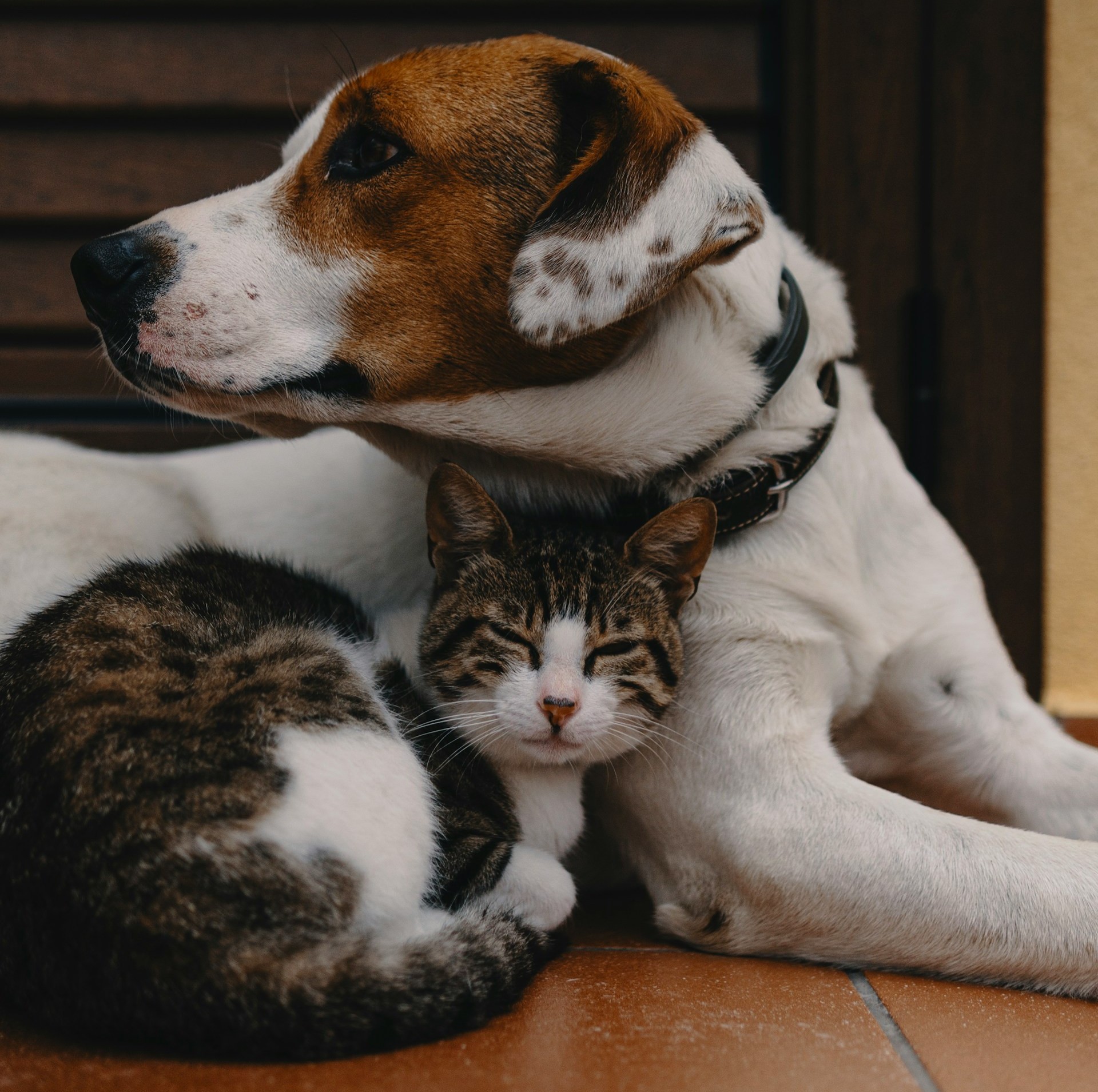
Image Notes: Picture of a dog and a cat from Alec Favale at Unsplash. The image has been cropped and resized.
Acknowledgement: Great thanks to Craig Good whose inquiry led QI to formulate this question and perform this exploration. Thanks also to Jonathan N. Stea who initiated a discussion thread on this topic and noted the attribution to Christopher Hitchens. Further thanks to the other participants in the discussion thread.
- 1994 May, Reader’s Digest, Volume 144, Number 865, Pet Theory, Quote Page 92, The Reader’s Digest Association, Pleasantville, New York. (Verified with scans) ↩︎
- 1930 November 22, The Daily Telegraph, A Play from the Apocrypha: Story of “Tobias and the Angel”, Quote Page 8, Column 4, London, England. (Newspapers_com) ↩︎
- 1961 (First published 1931), Tobias and the Angel by James Bridie, Act 2, Scene 1, Quote Page 48, Constable and Company, New York. (Verified with scans) ↩︎
- 1933, Mulliner Nights by P. G. Wodehouse, Chapter 2: The Story of Webster, Start Page 41, Quote Page 43, Herbert Jenkins Limited, London. (Verified with scans; Internet Archive) ↩︎
- 1934, Training the Dog: Complete instructions suitable for all breeds and all purposes, including field and outdoor work by Will Judy, Quote Page X (10), Judy Publishing Company, Chicago, Illinois. (Verified with scans) ↩︎
- 1994 June 2, The North Platte Telegraph, Writers read and readers write by Joe Murray, Quote Page 6, Column 5, North Platte, Nebraska. (Newspapers_com) ↩︎
- 1996 September 27, Norwich Bulletin, Comic Strip: Pickles by Brian Crane, Quote Page C5, Column 1, Norwich, Connecticut. (Newspapers_com) ↩︎
- 2000 Copyright, My Soul Thirsts: An Invitation to Intimacy with God by Steve Korch, Chapter 9: Intimate I-sight (becoming real in an unreal world), Quote Page 121, Judson Press, Valley Forge, Pennsylvania. (Verified with scans) ↩︎
- 2005, Dictionary of Proverbs, Compiled by Grenville Kleiser, Quote Page 3, A.P.H. Publishing Corporation, New Delhi. (Google Books Preview) ↩︎
- 2007, The Portable Atheist: Essential Readings for the Nonbeliever, Selected by Christopher Hitchens, Section: Introduction by Christopher Hitchens, Quote Page xvi, Da Capo Press: A Member of the Perseus Books Group, New York. (Verified with scans) ↩︎
- 2008, God’s Mechanics: How Scientists and Engineers Make Sense of Religion by Guy Consolmagno, Chapter 6: The Dangers of Organized Religion, Quote Page 82, Jossey-Bass: A Wiley Imprint, San Francisco, California. (Verified with scans) ↩︎
- 2011 Copyright, The Quotable Hitchens: from Alcohol to Zionism by Christopher Hitchens, Edited by Windsor Mann, Topic: Religion, Quote Page 238, Da Capo Press: A Member of the Perseus Books Group, New York. (Verified with scans) ↩︎