Lewis Carroll? Cheshire Cat? Caterpillar? Harry S. Albert? R. Elizabeth Jones? Manmatha Nath Chatterjee? Henry Miller? Theodore Levitt? Anonymous?
Question for Quote Investigator: Choosing goals in life is difficult but essential. The following absurdist proverb is pertinent:
If you don’t know where you’re going, any road will take you there.
This statement has been credited to the famous English author Lewis Carroll, but I do not think this precise phrase appears in any of his works. Would you please explore this topic?
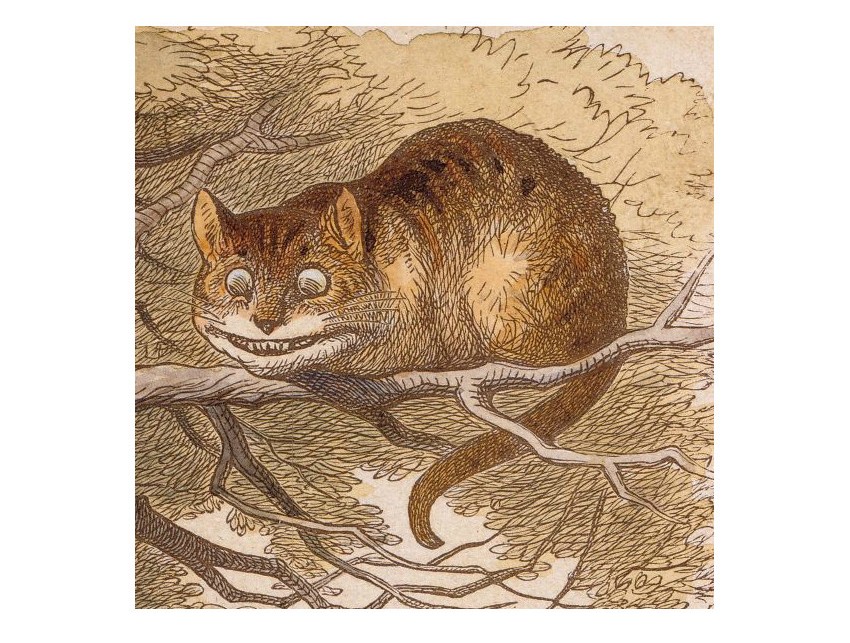
Reply from Quote Investigator: In 1865 Lewis Carroll published “Alice’s Adventures in Wonderland” which contained a scene with Alice and the Cheshire cat. Boldface added to excerpts by QI:1
“Cheshire Puss,” she began, rather timidly, as she did not at all know whether it would like the name: however, it only grinned a little wider. “Come, it’s pleased so far,” thought Alice, and she went on, “Would you tell me, please, which way I ought to go from here?”
“That depends a good deal on where you want to get to,” said the Cat.
“I don’t much care where—” said Alice.
“Then it doesn’t matter which way you walk,” said the Cat.
“—so long as I get somewhere,” Alice added as an explanation.
“Oh, you’re sure to do that,” said the Cat, “if you only walk long enough.”
QI believes that the proverb evolved from this scene in Lewis Carroll’s book. Here is an overview with dates showing a sampling of the variety of expressions and attributions:
1865: “That depends a good deal on where you want to get to” “I don’t much care where — ” “Then it doesn’t matter which way you walk” (Lewis Carroll)
1900 Jul: “That depends a good deal where you want to get to” “I don’t much care — ” “Then it doesn’t matter which way you go” (Attributed to Lewis Carroll)
1910 Dec: If you don’t care where you are going, it can not matter much which way you go (Attributed to a Caterpillar character)
1913 Dec: It doesn’t matter which way you go, if you don’t much care where you are going to (Attributed to the Cheshire cat of Lewis Carroll)
1941 Oct: When a man does not know where he is going, any road will take him to his destination (Harry S. Albert)
1941 Dec: When a man does not know where he is going, any road will take him to his destination (Attributed to Algo Henderson)
1942 Apr: If one does not know where he is going, any road will take him there (Manmatha Nath Chatterjee)
1942 Jun: If you don’t know where you are headed, any road will lead to your destination (Attributed to Anonymous)
1944 Oct: If you do not know where you are going, any road will get you there (Labeled an Oriental Proverb by R. Elizabeth Jones)
1945 Jun: If you do not know where you are going any road will take you there (Labeled an Ancient Saying by Manmatha Nath Chatterjee)
1958 Apr: If you don’t know where you are going, any road will take you there (Attributed to the Talmud by Daniel Bell)
1960 Jul: Unless he knows where he is going, any road will take him there (Theodore Levitt)
1969: If you don’t know where you’re going, any road will do (Attributed to Anonymous by John Argenti)
1977: Unless you know where you are going, any road will take you there (Attributed to Theodore Levitt)
1980: If you don’t know where you are going, every road will get you there (Attributed to Chips Bohlen by Henry Kissinger)
1990: If you don’t know where you are going, any road will take you there (Attributed to the Talmud by Martin Gardner)
2002: If you don’t know where you’re going, any road will take you there (George Harrison)
A separate Quote Investigator article about an inverted saying is also available. The following title is a clickable link: Proverb Origin: If You’re Not Sure Where You’re Going, You’re Liable to End Up Someplace Else
Below are details for selected citations in chronological order.
In 1900 “The Educational Times” of London printed a slightly altered version of the dialog between Alice and the Cheshire cat. The word “where” was omitted, and the word “walk” was changed to “go”:2
‘Cheshire Puss,’ she began, rather timidly, as she did not at all know whether it would like the name, ‘will you please tell me which way I ought to go from here?”
‘That depends a good deal where you want to get to,” said the Cat.
‘I don’t much care—’ said Alice.
‘Then it doesn’t matter which way you go,’ said the Cat.
‘—so long as I get somewhere,’ Alice added as an explanation.
‘Oh! you’re sure to do that,’ said the Cat, ‘if you only walk long enough.’
In 1910 “The Railroad Telegrapher” journal of St Louis Missouri printed a story titled “A Golden Link” by the pseudonym Ellerslie. A caterpillar character received credit for a version of the proverb. QI conjectures that the author confused Lewis Carroll’s hookah-smoking caterpillar character with Carroll’s Cheshire cat character:3
“Although, as the caterpillar said, if you don’t care where you are going, it can not matter much which way you go,” laughed Ethel Lincoln.
In 1913 the journal “Country Life in America” of New York attributed a version of the proverb to Lewis Carroll’s Cheshire cat:4
“As the Cheshire cat said to Alice,” he explained, “it doesn’t matter which way you go, if you don’t much care where you are going to, and we don’t, do we?”
In October 1941 a newspaper in Paterson, New Jersey reported that Harry S. Albert, the executive director of the Young Men’s and Young Women’s Hebrew Associations, employed an instance of the proverb:5
Director Albert’s report reads: “When a man does not know where he is going, any road will take him to his destination. In times of crisis, more than at other times, it is necessary for all of us to know our destination.
In December 1941 an article in “The Michigan Librarian” of Ann Arbor attributed the proverb to Algo Henderson who was the president of Antioch College at that time:6
The president of Antioch College said recently, “When a man does not know where he is going, any road will take him to his destination. In times of crisis, possibly more than at other times, it is necessary for all travelers on a road to know the destination.”
In April 1942 Professor of Education Manmatha Nath Chatterjee of Antioch College published a piece in the journal “Social Science” which included an instance of the proverb:7
If one does not know where he is going, any road will take him there. What is it that we learn, and for what purpose? Certificates, and also diplomas have a market value, but do they convey any definite idea of the candidate other than that he has had so many years in school and college?
In June 1942 the journal “National Parent-Teacher” printed an article which presented an anonymous instance of the proverb:8
Some one has said, “If you don’t know where you are headed, any road will lead to your destination.” Hopkins P.T.A. did know where it was headed, and it arrived, through other folks’ help, with flying colors. It’s ingenuity that counts!
In 1944 a newspaper in Montpelier, Vermont reported on a speech by R. Elizabeth Jones who was the national secretary of the Young Women’s Christian Association. Jones. Jones employed the saying which was called an old Asian proverb:9
Quoting an old oriental proverb, “If you do not know where you are going, any road will get you there.” She said, that this is the attitude being taken by many in regard to the complexities of modern-day life.
In 1945 Manmatha Nath Chatterjee published an article in “The Humanist”, and he called the proverb an ancient Hindu saying:10
The Hindus remember the ancient saying, “If you do not know where you are going any road will take you there.” The routine of life had been laid out and also the goal toward which the fulfillment of the routine was likely to lead one. The four castes must go side by side.
In 1954 Manmatha Nath Chatterjee published “Out of Confusion”. The introduction was written by Harry Elmer Barnes who stated that Chatterjee employed the proverb:11
Professor Chatterjee quotes an old fable to the effect that “If you do not know where you are going, any road will lead you there.” This seems to be the dilemma of the world today. He seeks to correct this fundamental mistake by formulating a sound goal for mankind and indicating with precision the paths that may lead us there.
In 1957 the prominent author Henry Miller published the memoir “Big Sur and the Oranges of Hieronymus Bosch”. Miller mentioned the adage while crediting Chatterjee in a footnote:12
“If you do not know where you are going, any road will take you there.”*
*Out of Confusion, by M. N. Chatterjee (Yellow Springs, Ohio: Antioch Press, 1954).
In 1958 U.S. sociologist Daniel Bell attributed the proverb to a religious text:13
Now that we have investigated many roads, are there some which can lead us to reality better than others? (Says a passage in the Talmud: “If you don’t know where you are going, any road will take you there.”)
In 1960 economist Theodore Levitt published an article in “Harvard Business Review” discussing executive leadership which included an instance:14
This is a first requisite of leadership, for unless he knows where he is going, any road will take him there. If any road is okay, the chief executive might as well pack his attaché case and go fishing.
In 1969 the book “Corporate Planning: A Practical Guide” by John Argenti included the proverb, but it was enclosed in quotation marks which signaled an anonymous attribution:15
If they do not know what the company is really trying to do they will never know how to do it. ‘If you don’t know where you’re going, any road will do.’
But matters are worse than this. Not only have many companies no clear idea of what they want, they are also unable to plan efficiently.
In 1974 the “Globe-Gazette” of Mason City, Iowa printed a version of the dialog between Alice and the Cheshire cat together with an instance of the proverb:16
A child’s fairytale sometimes holds a lesson for us all. In Lewis Carroll’s book, “Alice in Wonderland,” Alice is lost in the woods. In her wandering, she comes upon the Cheshire Cat and asks, “Would you tell me, please, which way I ought to go from here?”
“That depends a great deal on where you want to get to,” says the cat.
“I don’t much care where,” replies Alice.
“Then it doesn’t matter which way you go,” replies the cat.If you don’t know where you are going, any road will take you there. But, if you don’t know where you are going, you are also lost.
In 1977 “Forbes” magazine attributed the proverb to Theodore Levitt who wrote the “Harvard Business Review” article mentioned previously:17
Unless you know where you are going, any road will take you there. Theodore Levitt
In 1980 Henry Kissinger delivered an address in London, and he mentioned the adage which he attributed to a diplomat:18
All this talk about ‘probing’ has something of the quality that one of our great Foreign Service officers, Chips Bohlen, used to sum up in the sentence: ‘If you don’t know where you are going, every road will get you there.’
In 1990 Martin Gardner, an authority on Lewis Carroll, published “More Annotated Alice”, the follow-up to “The Annotated Alice”. Gardner printed the following in the sidebar next to the discussion between Alice and the Cheshire cat:19
I am told there is a passage in the Talmud that says: “If you don’t know where you are going, any road will take you there.”
The musician George Harrison died in 2001. His posthumous album “Brainwashed” was released in 2002 with the song “Any Road” which featured the following lines in the lyrics:20
If you don’t know where you’re going,
Any road will take you there
In conclusion, QI believes that the proverb evolved from the dialog between Alice and the Cheshire cat in Lewis Carroll’s book “Alice’s Adventures in Wonderland”. The 1910 and 1913 citations illuminate this evolution. QI has not yet found evidence supporting an ancient origin for the saying although that possibility has been mentioned in multiple citations. Harry S. Albert, R. Elizabeth Jones, and Manmatha Nath Chatterjee helped to popularize the proverb but did not create it.
Image Notes: Illustration of the Cheshire Cat by John Tenniel. The image has been cropped and resized.
Acknowledgements: Great thanks to Mark Burstein, Susan Fitzgerald, and Keith Inman whose inquiries led QI to formulate this question and perform this exploration. Thanks to Peter Morris who found the important 1910 citation. Many thanks to “The Dictionary of Modern Proverbs” compiled by Charles Clay Doyle, Wolfgang Mieder, and Fred R. Shapiro which contains a helpful entry for this proverb which begins with a 1942 citation. Also, thanks to Jonathan Lighter who explored this topic and located several valuable citations. In addition, thanks to Nigel Rees who mentioned the George Harrison song “Any Road” in his April 2021 newsletter.
- 1865, Alice’s Adventures in Wonderland by Lewis Carroll, Chapter 6: Pig and Pepper, Quote Page 89 and 90, Macmillan and Company, London. (Indiana University Digital Library) link ↩︎
- 1900 July 2, The Educational Times, Secondary Inspection, (At the Evening Meeting of the College of Preceptors, held on Wednesday June 13, Dr Wormell in the chair, R.P. Scott, Esq., M.A., LL.D., read the following paper on “The Inspection of Secondary Schools: of what tests ought it to consist?), Start Page 281, Quote Page 282, Francis Hodgson, London. (Google Books Full View) link ↩︎
- 1910 December, The Railroad Telegrapher, Volume 27, Number 12, A Golden Link by Ellerslie, Quote Page 1898, Column 1, Published by the Order of Railroad Telegraphers, St Louis Missouri. (Google Books Full View) link ↩︎
- 1913 December, Country Life in America, Volume 25, Number 2, The Idyl of Twin Fires by Walter Prichard Eaton, Chapter 1: I Buy a Farm on Sight, Start Page 57, Quote Page 58, Column 1, Doubleday, Page & Company, Garden City, New York. (Google Books Full View) link ↩︎
- 1941 October 28, Paterson Evening News, Civilians Exhorted to Help Sustain Morale of Soldiers, Quote Page 11A, Column 3, Paterson, New Jersey. (Newspapers_com) ↩︎
- 1941 December, The Michigan Librarian, Volume 7, Number 4, Editorial: Where Are We Going by C. Irene Hayner (President of Michigan Library Association), Start Page 2, Quote Page 2, Michigan Library Association, Ann Arbor, Michigan. (Verified with scans) ↩︎
- 1942 April, Social Science, Volume 17, Number 2, Measurement in Education by M. N. Chatterjee (Professor of Education, Antioch College), Quote Page 164, Column 2, Published by Pi Gamma Mu, International Honor Society in Social Sciences. (JSTOR) link ↩︎
- 1942 June, National Parent-Teacher, Volume 36, Number 10, PTA Frontiers, New Hampshire: A Townful of Drama by Daisy D. Williamson, Quote Page 47, National Parent-Teacher Inc., Chicago, Illinois. (Verified with scans) ↩︎
- 1944 October 28, Montpelier Evening Argus, Secretary of Young Women Christian Ass’n Addresses VJC Students at Chapel, Quote Page 5, Column 2, Montpelier, Vermont. (Newspapers_com) link ↩︎
- 1945 June, The Humanist, Volume 5, Number 2, India and World Peace: A Hindu View by M. N. Chatterjee, Start Page 77, Quote page 82, American Humanist Association, Schenectady, New York. (Verified with microfilm) ↩︎
- 1954 Copyright, Out of Confusion by Manmatha Nath Chatterjee, Section: Introduction by Harry Elmer Barnes, Quote Page xiv, The Antioch Press, Yellow Springs, Ohio. (Verified with scans) ↩︎
- 1957 Copyright, Big Sur and the Oranges of Hieronymus Bosch by Henry Miller, Part Two: Peace and Solitude: A Potpourri, Chapter 15, Quote Page 249, New Directions Publishing Corporation, New York. (Verified with scans) ↩︎
- 1958 April, World Politics, Volume 10, Number 3, Ten Theories in Search of Reality: The Prediction of Soviet Behavior in the Social Sciences by Daniel Bell, Quote Page 358, Published by The Johns Hopkins University, Baltimore, Maryland. (JSTOR) link ↩︎
- 1960 July-August, Harvard Business Review, Volume 38, Number 4, Marketing Myopia by Theodore Levitt, Start Page 45, Quote Page 56, Column 2, Graduate School of Business Administration, Harvard University, Boston, Massachusetts. (Verified with scans) ↩︎
- 1969, Corporate Planning: A Practical Guide by John Argenti, Chapter 3: The Need for Corporate Planning, Quote Page 25, Dow Jones-Irwin Inc., Homewood, Illinois. (Verified with scans) ↩︎
- 1974 March 30, Globe-Gazette, Supplement Section: Hawkeye Bancorporation Annual Report 1973, Professional Management Gets Predicted Results, Quote Page 1, Column 6, Mason City, Iowa. (Newspapers_com) ↩︎
- 1977 October 15, Forbes, Thoughts on the Business of Life, Quote Page 186, Column 1, Forbes Inc., New York. (Verified with scans) ↩︎
- 1980 June 22, The Observer, Western dreams and realities by Dr. Henry Kissinger, Quote Page 12, Column 7, London, England. (Newspapers_com) ↩︎
- 1990, More Annotated Alice: Alice’s Adventures in Wonderland and Through the Looking-Glass and What Alice Found There by Lewis Carroll, With Notes by Martin Gardner, Chapter 6: Pig and Pepper, Note 6, Quote Page 78, Random House, New York. (Verified with scans) ↩︎
- YouTube video, Title: George Harrison – Any Road & Lyrics, Uploaded on Mar 26, 2012, Uploaded by: Sevy SevyM, (Quotation starts at 0 minutes 36 seconds of 3 minutes 51 seconds) (Accessed on youtube.com on March 9, 2026) link ↩︎