Mark Twain? C. E. M. Joad? Apocryphal?
Question for Quote Investigator: New authors often receive lavish praise from friends, acquaintances, and relatives, but the plaudits contain suspiciously few details. A famous writer once said:
People don’t really read your books; they only say they do to keep you from feeling bad.
This statement has been credited to humorist Mark Twain. Is this attribution correct? Would you please help me to find a citation?
Reply from Quote Investigator: Mark Twain was a steamboat pilot on the Mississippi River in his twenties. He developed a deep respect for the genius of inventor Robert Fulton who designed the first commercially successful steamboat.
In 1906 Twain received a request to deliver a lecture for the benefit of the Robert Fulton Memorial Association. The request came from General Frederick D. Grant. During their exchange of letters, Twain discussed his strategy for engaging the audience. Boldface added to excerpts by QI:
“Well, that is my idea, as I have said; first excite the audience with a spoonful of information about Fulton, and then quiet them down with a barrel of illustrations drawn by memory from my books—and if you don’t say anything the house will think they never heard it before, because people don’t really read your books; they only say they do to keep you from feeling bad.
Twain’s letter achieved wide circulation when it was printed in major newspapers such as “The New York Times”1 and “The Chicago Tribune”2 in 1906.
Below are additional selected citations in chronological order.
Mark Twain died in 1910. A two-volume collection of Twain’s letters was published in 1917. The letter to Frederick D. Grant appeared in the second volume.3
In 1934 “The London Mercury” published an article by C. E. M. Joad who was an English philosopher and broadcasting personality. Joad described visiting a bookstore in the U.S. and encountering a book buyer who did not read his books:4
… “Well, I think you ought to know, Mr. Joad, that we don’t really read your books. What we want is your autograph, and it happens that this big book of yours exactly fits my colour scheme of interior decoration” — these things cannot be satirized; they can only be recorded.
In 1978 Paul Fatout edited and published the collection “Mark Twain Speaks for Himself” which included Twain’s letter to Grant.5
In conclusion, Mark Twain deserves credit for this quotation. He wrote it in a letter to General Frederick D. Grant in 1906.
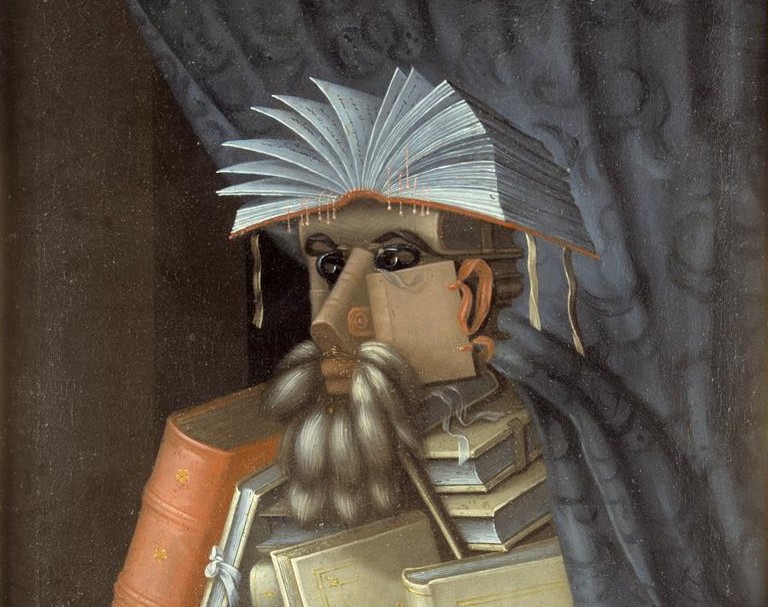
Image Notes: Detail from the painting The Librarian by Giuseppe Arcimboldo circa 1566. The image has been cropped and resized.
Acknowledgement: Great thanks to the anonymous person whose message led QI to formulate this question and perform this exploration.
- 1906 April 15, The New York Times, Mark Twain Tells How To Manage Audiences, Quote Page 9, Column 3, New York, New York. (ProQuest) ↩︎
- 1906 April 15, The Chicago Sunday Tribune, Twain Talk For Pay? No, Quote Page 3, Column 2, Chicago, Illinois. (ProQuest) ↩︎
- 1917, Mark Twain’s Letters, Arranged with Comment by Albert Bigelow Paine, Volume 2 of 2, Chapter 45: Letters 1906 to Various Persons, Letter to: General Grant, Letter from: S. L. Clemens, Start Page 791, Quote Page 792, Harper & Brothers Publishers, New York. (Google Books Full View) link ↩︎
- 1934 December, The London Mercury, Volume 31, Number 182, A Philosopher Looks at America by C. E. M. Joad, Start Page 159, Quote Page 159, London, England. (Verified with scans) ↩︎
- 1978 (1981 Reprint), Mark Twain Speaks for Himself, Edited by Paul Fatout, Mark Twain Tells How To Manage Audiences, New York Times, April 15, 1906, Quote Page 214, Purdue University Press, West Lafayette, Indiana. (Verified with scans) ↩︎