Joseph P. Kennedy Sr.? Bernard Baruch? Joseph F. Dinneen? Apocryphal?
Question for Quote Investigator: Prescient investors pulled their money out of the U.S. stock market shortly before the crash of 1929. According to a Wall Street legend, a financier who received a stock tip from a shoeshine boy experienced the following epiphany:
When a shoeshine boy knows as much as I do about the stock market it’s time for me to get out.
I do not know the exact phrasing of this quotation, and this tale might be apocryphal. The story has been attributed to U.S. businessman Joseph P. Kennedy Sr. and U.S. financier Bernard Baruch. Would you please explore this topic?
Reply from Quote Investigator: The earliest match known to QI appeared in the 1959 book “The Kennedy Family” by journalist Joseph F. Dinneen. The book asserted that Joseph P. Kennedy Sr. started removing his money from the U.S. stock market in August 1929.
Kennedy did not fully explain his behavior at that time. The stock market catastrophically crashed in October 1929. Time passed, and a newsperson inquired about Kennedy’s foresight:1
“How did that come about, Joe?” a reporter asked him years later.
“Very simply,” he said. “I dropped in at a shoeshine parlor on Wall Street. The boy who shined my shoes did not know me. He wasn’t fishing for information or looking for a market tip. He was the average wage earner or salaried employee playing the market like everybody else in that day. He looked up at me as he snapped the cloth over my shoes and told me what was going to happen to various stocks and offerings on the market that day.
“I listened as I looked down at him, and when I left the place I thought: ‘When a time comes that a shoeshine boy knows as much as I do about what is going on in the stock market, tells me so and is entirely correct, there is something the matter either with me or with the market and it’s time for me to get out,’ and I did.”
The author Joseph F. Dinneen was a long-time reporter for “The Boston Globe” of Massachusetts. Dinneen did not indicate when Kennedy delivered his explanation. Also, Dinneen did not specify the name of the reporter to whom Kennedy spoke. Perhaps it was Dinneen himself. The thirty-year delay between the crash and the publication of Dinneen’s book was substantial.
Below are additional selected citations in chronological order.
Shining shoes was not a prestigious occupation, but the knowledge acquired through small talk could be significant. In 1928 “The Lumber Trade Journal” of New Orleans, Louisiana printed the following:2
H. B. Johnson, of the Mansfield Hardwood Lumber Company, Shreveport, said his company was not breaking its neck producing, as rains had been heavy. He thought a bootblack knows as much about what the market is going to be, as anyone else.
In 1959 Joseph F. Dinneen published “The Kennedy Family” which contained the stock market anecdote as mentioned previously.
In October 1959, the popular financial journalist Sylvia Porter wrote about the type of people who lost money during the great crash of 1929. Porter included “the shoeshine boy”:3
He was the chauffeur who picked up a stock tip as he drove his boss downtown, and the shoeshine boy on the corner of Wall Street who begged for pay in the form of the name of a stock instead of cash . . . He symbolized the young married man who risked the $50 of precious rent money to buy $500 of stock on the thinnest of margins, and the widow who plunged with every penny of her insurance money into unknown stocks.
In 1960 Bernard Baruch published the second volume of his memoirs titled “Baruch: The Public Years”. He discussed the collapse of the Florida land speculation bubble in 1926 which he viewed as a harbinger of wider financial difficulties. In 1928 Baruch began to liquidate his stock holdings and to put his money into bonds together with a cash reserve. Baruch feared that the stock market would fall. He discussed the manic social climate before the great crash:4
In every bank and brokerage house, in business places, on street corners, and in elevators and restaurants—wherever people met—one could hear the familiar phrases “what I heard” and “the tip I got.” Token margin requirements enabled anybody to test his luck in the market.
Taxi drivers told you what to buy. The shoeshine boy could give you a summary of the day’s financial news as he worked with rag and polish. An old beggar, who regularly patrolled the street in front of my office, now gave me tips—and, I suppose, spent the money I and others gave him in the market. My cook had a brokerage account, and followed the ticker closely.
Thus, Baruch mentioned a shoeshine boy in his memoirs, but his withdrawal from the stock market was not triggered by an interaction with a shoeshine boy.
In October 1960 “The Saturday Evening Post” of Philadelphia, Pennsylvania printed a piece titled “Bernard Baruch’s Own Story” which consisted of an excerpt from the memoir “Baruch: The Public Years”. The passage given above was included.5
Joseph P. Kennedy Sr. died in November 1969. The “Boston Evening Globe” printed a piece which included the tale of the shoeshine boy:6
Kennedy was known as a loner in the bull market of the 1920s but, with what later was regarded uncanny insight, he got out of the market in the Summer of 1929 just before the “Black Friday” crash.
When Globe reporter Joseph F. Dineen Sr. asked him why he got out, a few years later, he gave this reply:
“Very simply. I dropped into a shoeshine parlor on Wall Street. The boy who shined my shoes did not know me …”
In 1996 “Fortune” magazine published an article which mentioned the shoeshine boy tale:7
Joe Kennedy, a famous rich guy in his day, exited the stock market in timely fashion after a shoeshine boy gave him some stock tips. He figured that when the shoeshine boys have tips, the market is too popular for its own good, a theory also advanced by Bernard Baruch, another vested interest who described the scene before the big Crash:
“Taxi drivers told you what to buy. The shoeshine boy could give you a summary of the day’s financial news as he worked with rag and polish. An old beggar who regularly patrolled the street in front of my office now gave me tips and, I suppose, spent the money I and others gave him in the market. My cook had a brokerage account and followed the ticker closely. Her paper profits were quickly blown away in the gale of 1929.”
Also, in 1996 Ronald Kessler published a harshly critical book titled “The Sins of the Father: Joseph P. Kennedy and the Dynasty He Founded”. Kessler was skeptical about the shoeshine boy anecdote:8
Joe later said that he had figured out that the market was overheated because Pat Bologna, who had a shoeshine stand at 60 Wall Street and later 70 Pine Street, was in the market with relatively large sums and had lots of inside tips.
“When the time comes that a shoeshine boy knows as much as I do about what is going on in the stock market … it’s time for me to get out,” he later said. “Only fools hold out for top dollar.”
But the story of the shoeshine boy was baloney. Joe told the story to show how astute he was. In fact, it was Currier—the same man Joe would soon double-cross—who had saved him from disaster by warning him to get out of the market.
In conclusion, the shoeshine boy anecdote appeared in the 1959 book “The Kennedy Family” by Joseph F. Dinneen. The tale was told by Joseph P. Kennedy Sr. to an unnamed reporter. The thirty-year delay reduced the credibility of the colorful account, but QI has seen no alternative behavioral explanation from Kennedy himself. The negative 1996 portrait of Kennedy by Ronald Kessler suggested that lawyer Guy Currier told Kennedy to sell.
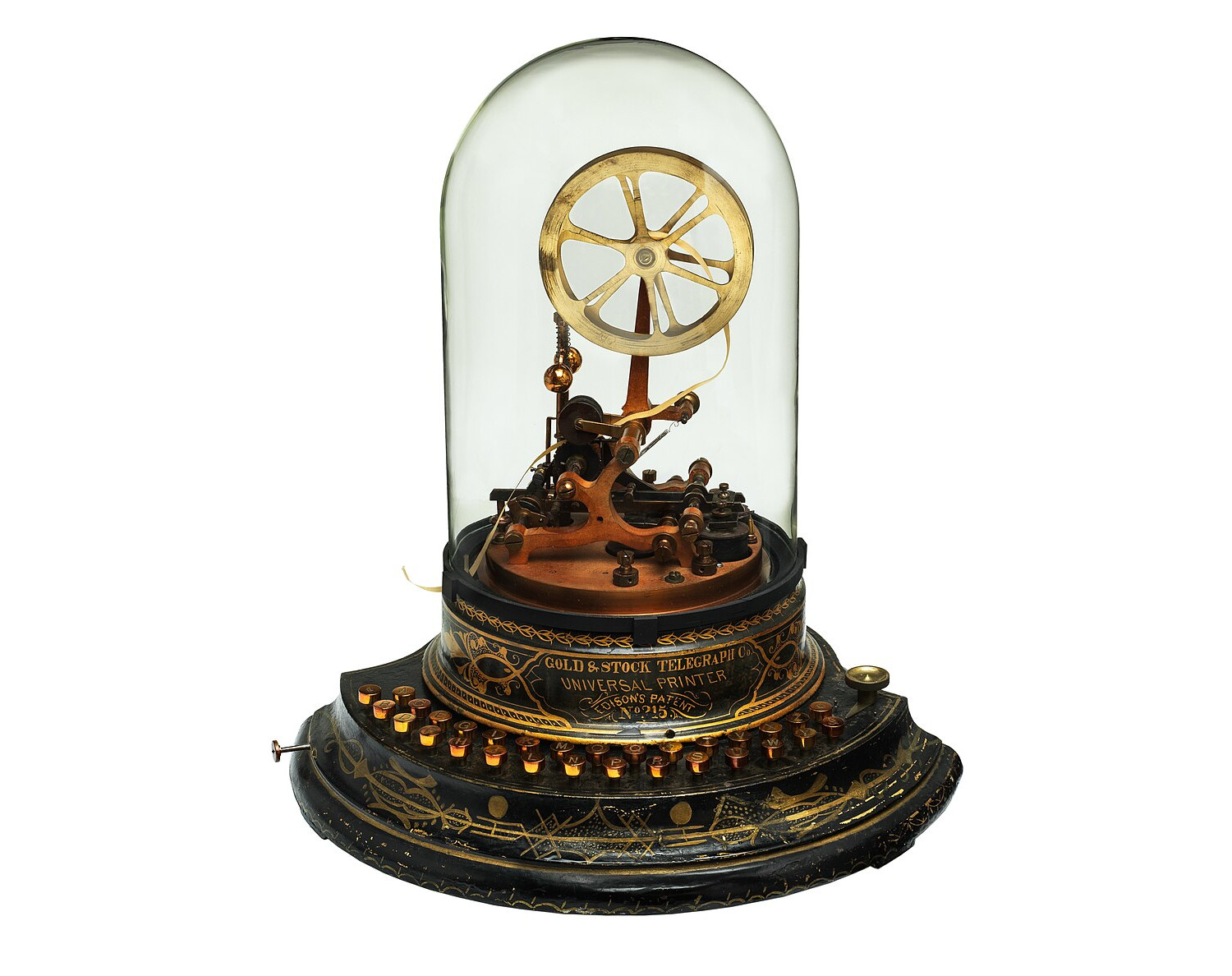
Image Notes: Public domain picture of a stock ticker by photographer Jaclyn Nash of the Smithsonian Institution.
Acknowledgement: Great thanks to Jay Weiser whose inquiry led QI to formulate this question and perform this exploration. Weiser mentioned the “Fortune” magazine article and the attributions to Joseph P. Kennedy Sr. and Bernard Baruch. Also, thanks to researcher Barry Popik who examined this topic and found pertinent citations beginning in 1965.
- 1959 Copyright, The Kennedy Family by Joseph F. Dinneen, Chapter 3, Quote Page 34 and 35, Little, Brown and Company, Boston, Massachusetts. (Verified with scans) ↩︎
- 1928 August 1, The Lumber Trade Journal, Two Hardwood Clubs Hold Meeting at Monroe, Quote Page 20, Column 2, New Orleans, Louisiana. (Google Books Full View) link ↩︎
- 1959 October 7, The Arizona Daily Star, New Investor by Sylvia Porter, Quote Page 14B, Column 3, Tucson, Arizona. (Newspapers_com) ↩︎
- 1960 Copyright, Baruch: The Public Years by Bernard M. Baruch, Chapter 13: The Great Crash, Quote Page 220, Holt, Rinehart and Winston, New York. (Verified with scans) ↩︎
- 1960 October 1, The Saturday Evening Post, Volume 233, Number 14, Bernard Baruch’s Own Story by Bernard M. Baruch, Part One: The 1929 Crash, Start Page 19, Quote Page 21, Column 1, The Curtis Publishing Company, Philadelphia, Pennsylvania. (Verified with scans) ↩︎
- 1969 November 18, Boston Evening Globe, Joseph P. Kennedy: The father of destiny’s children, Quote Page 19, Column 4, Boston, Massachusetts. (Newspapers_com) link ↩︎
- 1996 April 15, Fortune, Volume 133, Number 7, When the shoeshine boys talk STOCKS by John Rothchild, Start Page 99, Quote Page 99, Column 1, Time Inc., New York. (Verified with scans) ↩︎
- 1996 Copyright, The Sins of the Father: Joseph P. Kennedy and the Dynasty He Founded by Ronald Kessler, Chapter 7: Crash, Quote Page 82, Warner Books Inc., New York. (Verified with scans) ↩︎