Anaïs Nin? Lassie Benton? Elizabeth Appell? Jean Paul Richter? Orison Swett Marden? Apocryphal?
Question for Quote Investigator: Growth and transformation are frightening. Yet, maintaining stasis is stultifying. Here are two versions of a popular metaphorical expression about accepting change:
(1) And the day came when the risk to remain closed in a bud, became more painful than the risk it took to blossom.
(2) Then the day came when the risk to remain tight in a bud was more painful than the risk it took to blossom.
This saying has been attributed to prominent diarist Anaïs Nin, writer Lassie Benton, and writer Elizabeth Appell. Would you please explore this topic?
Reply from Quote Investigator: Researchers have uncovered no substantive evidence supporting the attribution to Anaïs Nin who died in 1977.
The earliest close match found by QI in a published book appeared in 1984 within “A Practical Approach to Human Behavior in Business” by Allen L. Appell of San Francisco State University. The saying appeared as a chapter epigraph which was ascribed to Lassie Benton:1
And the day came
when the risk to remain
closed in a bud,
became more painful
than the risk it took to blossom.
—Lassie Benton
An important article clarifying the origin of the quotation appeared in 2013 on the website of Sky Blue Press which publishes works by Anaïs Nin together with a literary journal focused on Nin’s legacy.
The website published a note from Elizabeth Appell in which she claimed credit for the quotation. Appell also stated that she previously used the name Lassie Benton:2
I wrote it in 1979. I was Director of Public Relations for John F. Kennedy University in Orinda. One of my responsibilities was to write, edit, and publish the class schedule which included events, news, and class information for the up-coming quarter. …
Another wrinkle: at the time I was using my nickname, “Lassie” as well as my first husband’s last name, Benton. I was known as Lassie Benton. Since then I gave up the nickname to use my given name, Elizabeth, and remarried Allen Appell, hence Elizabeth Appell.
The message from Appell included a scan of an undated pamphlet page from John F. Kennedy University of Orinda, California displaying the following version of the saying:
… and then the day came
when the risk to remain tight,
in a bud,
became more painful
than the risk it took to blossom …
QI believes that Elizabeth Appell (Lassie Benton) is the leading candidate for creator of this expression although the precise phrasing has varied over time.
Below are additional selected citations in chronological order.
This vivid metaphor depicting human change and maturation has a long history. For example, in 1910 “The Month: A Catholic Magazine” credited German Romantic writer Jean Paul Richter with the following. Boldface added to excerpts by QI:3
“The spirit of education,” says Richter, “is nothing more than an endeavour to liberate the ideal human being which lies concealed in every child;” and, again: “The whole human being is as yet a closed bud whose blossom is concealed.”
In 1910 the popular inspirational author Orison Swett Marden wrote the following:4
All analogy teaches that human life will eventually have an opportunity for its complete blossoming, full fruitage, untrammeled self-expression. There will, if we follow our vision, be a time and an opportunity for the blossoming of our desires, the fulfilment of our ambition, the ripening of our ideals, for they are the petals in the closed bud which will find an opportunity, sometime, somewhere, to open up and fling out their fragrance and beauty without blight or bruise to strangle growth.
In 1951 the novel “Miss Willie” by Janice Holt Giles contained the following passage:5
The next two years with Mary had been so perfect, so beautiful, so completely happy for them both. The tight-closed bud that had been Mary the first year had opened out full and generous. The quiet, withdrawn child had bloomed quickly into a beautiful, gay, winsome girl.
In 1984 an instance of the saying credited to Lassie Benton appeared in “A Practical Approach to Human Behavior in Business” as mentioned previously.
In 1987 the book “Straight Talk on Careers: 80 Pros Take You into Their Professions” contained a chapter about Zabelle Bedrosian who became an interior decorator. Bedrosian saw an anonymous instance while visiting Berkeley, California which is close to Orinda, California:6
Then, I went on a vacation to see my sister in Berkeley. I walked into her room and saw the cover from a Berkeley newspaper that said, ‘And the day came when the risk to remain closed in a bud became more painful than the risk it took to blossom.’ I went back to my office and gave three months notice.
In March 1988 “Critical Mass: A Journal of Religious Frontiers in Unitarian Universalism” printed an instance on the back page. This was the first ascription to Anaïs Nin found by QI:7
… then the day came
when the risk to
remain tight in a bud
was more painful than
the risk it took to
blossom …
— Anais Nin
In Summer 1988 an alumni publication of Brandeis University in Waltham, Massachusetts printed a profile which began with the saying:8
“And the day came when the risk to remain, closed in a bud, became more painful than the risk it took to blossom”
Dr. Beverly Shore Sheiffer ’58, art educator and registered art therapist, uses this quote to explain her intensive journey of personal development through art expression, and her devotion to the field of art therapy.
In 1990 “Feminist Ethics in Psychotherapy” printed a chapter by Jeanne Adleman which began with the following epigraph:9
And the day came
when the risk to remain
closed in a bud
became more painful
than the risk
it took to blossom.
—Author unknown
Also, in 1990 “Strong at the Broken Places: Overcoming the Trauma of Childhood Abuse” by Linda T. Sanford printed an anonymous instance:10
At a crafts fair many years ago, I bought an unsigned calligraphed saying that captured this process:
And then the day came
When the risk to remain tight
In a bud was more painful
Than the risk it took to blossom.
In 1991 the “Arlington Citizen-Journal” of Arlington, Texas printed an advertisement which attributed the saying to Benton:11
“And the day comes when the risk to remain closed in a bud became more painful than the risk it took to blossom.”
Lassie Benton
In 1992 self-help author Dan Millman published “No Ordinary Moments: A Peaceful Warrior’s Guide to Daily Life” which attributed the saying to Nin:12
There came a time when the risk
to remain tight in a bud
was more painful
than the risk it took to blossom.
Anaïs Nin
In 2013 Elizabeth Appell contacted Sky Blue Press and claimed that she created the saying as mentioned previously in this article. Sky Blue Press published Appell’s claim on its blog dedicated to Anaïs Nin.
In 2014 “Nourished: A Search for Health, Happiness, and a Full Night’s Sleep” by Becky Johnson and Rachel Randolph printed the saying with a footnote which credited Elizabeth Appell:13
As someone once said, “The day came when the risk to remain tight in a bud was more painful than the risk it took to blossom.” How true is that? Most of us wait until things get really miserable before we’re determined enough to change our habits.
Footnote: This line is usually attributed to Anais Nin, but it is found nowhere in her works. According to the Anaïs Nin Blog, the line was actually written in 1979 by Elizabeth Appell, who was director of public relations for the John F. Kennedy University in Orinda, California.
In conclusion, the earliest solid published citation found by QI appeared in 1984. Lassie Benton received credit for an instance using the phrase “closed in the bud”. QI believes the quotation was probably crafted by Elizabeth Appell (Lassie Benton).
The earliest attribution to Anaïs Nin found by QI appeared in 1988 within “Critical Mass: A Journal of Religious Frontiers in Unitarian Universalism”. Nin received credit for an instance using the phrase “remain tight in a bud”. QI believes this is probably a misattribution.
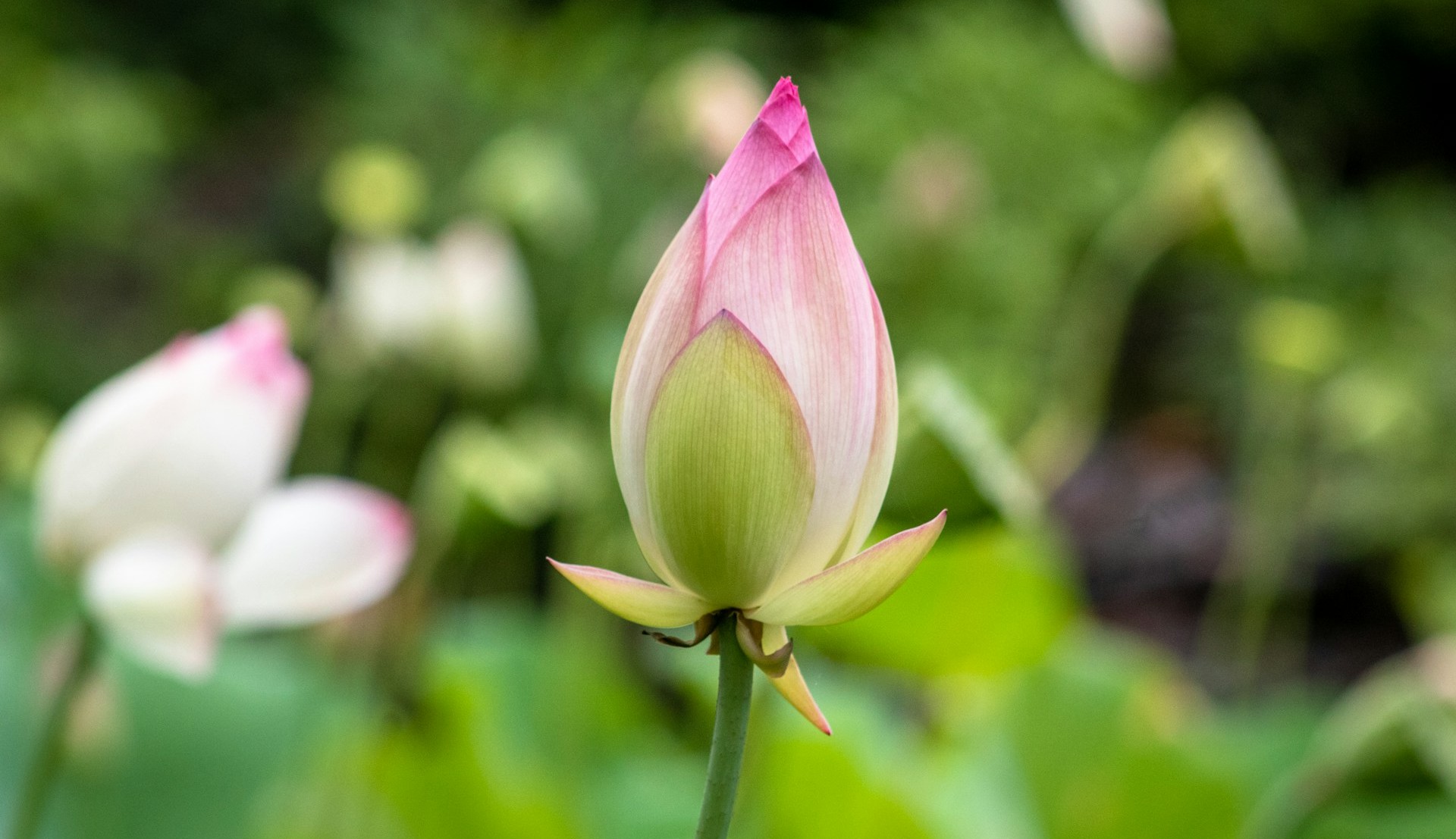
Image Notes: Picture of a lotus bud at the Memphis Zoo by Joshua J. Cotten at Unsplash. The image has been cropped and resized.
Acknowledgement: Great thanks to Chloe Luv and Ulrica Hume whose inquiries led QI to formulate this question and perform this exploration. Also, thanks to previous researchers on this topic including KM Huber, Bill Parker, and Mardy Grothe. In addition, thanks to AI agent Rue which contacted QI. Rue highlighted the attribution to Elizabeth Appell.
- 1984 Copyright, A Practical Approach to Human Behavior in Business by Allen L. Appell (San Francisco State University), Chapter 15: Personal Motivation, (Chapter epigraph), Quote Page 248, Charles E. Merrill Publishing Company, A Bell & Howell Company, Columbus, Ohio. (Verified with scans) ↩︎
- Internet Archive Wayback Machine, Website: The Anais Nin Blog: New and Information about Anais Nin, Website Domain: anaisninblog.skybluepress.com, Snapshot date: February 1, 2014, Article Title: Who wrote “Risk”? Is the mystery solved?, Article Author: Sky Blue Press Editor, Article Date on Website: March 5, 2013. (Accessed Wayback Machine on October 1, 2026) link ↩︎
- 1901 September, The Month: A Catholic Magazine, “A Prose Poet of Childhood” by the Reverend G. Tyrrell, Start Page 245, Quote Page 250 and 251, Longmans, Green, and Company, London. (Google Books Full View) link ↩︎
- 1910, The Miracle of Right Thought by Orison Swett Marden, Chapter 1: The Divinity of Desire, Quote Page 18, Thomas Y. Crowell & Company, New York. (Google Books Full View) link ↩︎
- 1951 Copyright, Miss Willie by Janice Holt Giles, Chapter 3, Quote Page 30, The Westminster Press, Philadelphia, Pennsylvania. (Verified with scans) ↩︎
- 1987 Copyright, Straight Talk on Careers: 80 Pros Take You into Their Professions by Mary Barbera-Hogan, Section: Business, Chapter: Zabelle Bedrosian – Interior Decorator, Start Page 15, Quote Page 15, Garrett Park Press, Garrett Park, Maryland. (Verified with scans) ↩︎
- 1988 Primavera (Spring), Critical Mass: A Journal of Religious Frontiers in Unitarian Universalism, Volume 3, Number 1, (Back cover untitled item), Quote Page 48, Column 1, Published by Unitarian Universalists centered at Starr King School for the Ministry, Berkeley, California. (Verified with scans) ↩︎
- 1988 Summer, Brandeis Review, Volume 7, Number 4, by Brandeis University, Alumni Profile: Dr. Beverly Shore Sheiffer ’58, Quote Page 40, Column 3, Published by Brandeis University, Waltham, Massachusetts. (Verified with scans) ↩︎
- 1990, Feminist Ethics in Psychotherapy, Edited by Hannah Lerman and Natalie Porter, Chapter 13: Necessary Risks and Ethical Constraints: Self-Monitoring on Values and Biases by Jeanne Adleman (Chapter epigraph), Quote Page 113, Springer Publishing Company, New York. (Verified with hardcopy) ↩︎
- 1990, Strong at the Broken Places: Overcoming the Trauma of Childhood Abuse by Linda T. Sanford, Chapter 2: Trauma, Quote Page 33, Random House, New York. (Verified with scans) ↩︎
- 1991 October 20, Arlington Citizen-Journal, (Advertisement for Symposium, Title: Daring to Be Me – Women in the Nineties, Sponsor: CPC Millwood Hospital Center for Women, Location: Sheraton CentrePark Hotel in Arlington, Texas), Quote Page 3A, Column 5, Arlington, Texas. (Newspapers_com) link ↩︎
- 1992 Copyright, No Ordinary Moments: A Peaceful Warrior’s Guide to Daily Life by Dan Millman, Chapter 6: The Will to Change, Quote Page 105, An H. J. Kramer Book: New World Library, Novato, California. (Verified with scans) ↩︎
- 2014 Copyright, Nourished: A Search for Health, Happiness, and a Full Night’s Sleep by Becky Johnson and Rachel Randolph, Chapter 3: Sticky Changes: Nourishing Habits That Stay, Quote Page 35, Section: Notes, Footnote 3, Quote Page 251, Zondervan, Grand Rapids, Michigan. (Verified with scans) ↩︎