André Gide? Leonardo da Vinci? Albert Camus? Carol Shields? Igor Stravinsky? Orson Welles? Apocryphal?
Question for Quote Investigator: A scrappy independent movie director who was given a massive budget created a pretentious flop. A poet who wrote brilliant iambic pentameter could only compose pedestrian free verse. A musician who spent countless hours in the studio finally released an unlistenable album. These examples illustrate a compelling maxim. Here are three versions:
(1) Art lives from constraints and dies from freedom.
(2) Art is born of constraint and dies of liberty.
(3) Art is born of constraint and dies of too much freedom.
This adage has been attributed to French author André Gide, Italian polymath Leonardo da Vinci, French philosopher Albert Camus, and others. Here are two extended versions of the saying:
(1) Art is born of constraint, lives on conflict, and dies of liberty.
(2) Art is born of constraint, thrives on struggle, dies of freedom.
Would you please explore this topic?
Reply from Quote Investigator: The earliest close match found by QI appeared in a speech titled “De L’Évolution du Théatre” (“On the Evolution of Theater”) delivered in Brussels by André Gide in 1904. The following passage in French is followed by an English translation. Boldface added to excerpts by QI:1
Le grand artiste est celui qu’exalte la gêne, à qui l’obstacle sert de tremplin. C’est au défaut même du marbre que Michel-Ange dut, raconte-t-on, d’inventer le geste ramassé du Moïse. C’est par le nombre restreint des voix dont il pouvait à la fois disposer sur la scène que, contraint, Eschyle dut d’inventer le silence de Prométhée lorsqu’on l’enchaîne au mont Caucase. La Grèce proscrivit celui qui ajouta une corde à la lyre. L’art naît de contrainte, vit de lutte, meurt de liberté.
The great artist is one whom constraint exalts, for whom an obstacle serves as a springboard. It was to a flaw in the very marble, so the story goes, that Michelangelo owed the invention of Moses’s compact, coiled posture. It was the limited number of voices available to him on stage that compelled Aeschylus to devise the silence of Prometheus as he was chained to Mount Caucasus. Greece banished the man who added a string to the lyre. Art is born of constraint, lives by struggle, and dies of freedom.
Below are additional selected citations in chronological order.
QI believes that the attribution to Leonardo da Vinci is incorrect. The error probably occurred because of remarks Leonardo made about physical force.
In 1902 “La Revue Blanche” (“The White Review”) published a book review that credited Leonardo with a partial match for the saying under examination:2
Le sujet, c’est la dispersion d’une âme que ne discipline ni la dure nécessité, ni le désir ferme et puissant. La moralité tient dans la sentence de Léonard: « La force naît par contrainte et meurt par liberté » …
Here is one possible translation into English:
The subject is the dissipation of a soul disciplined by neither harsh necessity nor firm, powerful desire. The moral lies in Leonardo’s dictum—“Force is born of constraint and dies of liberty” …
In 1911 “La Phalange: Revue Mensuelle” (“The Phalanx: Monthly Review”) printed a shortened version of the statement delivered by Gide in his 1904 speech. An English translation follows the original text:3
M. Copeau pense, comme André Gide, que l’art « vit de contrainte et meurt de liberté. »
Mr. Copeau believes, like André Gide, that art “lives on constraint and dies of freedom.”
In 1915 the Italian book “Leonardo Prosatore” (“Leonardo the Prose Writer”) contained a section about physical force which included the following line:4
Vive per violenza e more per libertà.
It lives by violence and dies for freedom.
In 1917 Canadian essayist and literary critic Marcel Dugas employed the saying while specifying an anonymous attribution:5
Il y a des intelligences qui échappent aux systèmes, aux lois, aux barrières. Leur personnalité excuse leur indépendance et souvenons-nous, suivant la parole fameuse, que “l’art vit de contrainte et meurt de liberté”.
There are minds that elude systems, laws, and barriers. Their personalities justify their independence, and let us recall the famous saying that “art lives on constraint and dies of freedom.”
In 1919 a piece in the Paris newspaper “L’Éclair” contained the following:6
Leur légèreté naîtra de leur puissance, leur liberté de leur discipline. Tout ici commente, et dans son sens le plus strict, le fameux théorème de Léonard de Vinci : « La force naît par contrainte, et meurt par liberté. »
Their lightness will spring from their power, their freedom from their discipline. Everything here—in the strictest sense—illustrates Leonardo da Vinci’s famous theorem: “Force is born of constraint and dies of freedom.”
In 1928 “Vanity Fair” magazine printed an English translation of André Gide’s 1904 speech under the title “Art and Artifice”:7
The great artist is the one who exalts his impediments, to whom obstacles serve as incentives. It is even said that Michael Angelo was led by a deficiency of the marble to invent the cramped posture of Moses. Owing to the limit in the number of voices that could be managed on the stage at one time, Aeschylus was constrained to invent the silence of Prometheus while being bound on the Caucasus. Greece banished the man who added a string to the lyre. Art is born of constraint, lives on conflict, and dies of liberty.
In 1929 “The Sackbut” journal printed a piece which contained an instance of the saying about strength instead of art:8
At the same time the author shows the rigorous self-discipline Ravel imposed upon his own daring; how, when quite young, the composer came to realize that strength gains in force by constraint, and dies of liberty; how boldly and simply he faced the problems his genius confronted him with, and set himself to the task of acquiring a sure technical canon rooted in the reality of his art.
In 1942 Russian composer Igor Stravinsky published “Poétique Musicale: Sous Forme de Six Leçons” (“Musical Poetics: In the Form of Six Lessons”) which contained the following:9
La force, dit Léonard de Vinci, naît par la contrainte et meurt par liberté.
Force, says Leonardo da Vinci, is born of constraint and dies of freedom.
In 1947 “Music & Letters: A Quarterly Publication” printed the following:10
Leonardo da Vinci said the same thing even more succinctly, and Stravinsky quotes his words: “Strength is born of constraint and dies of liberty”.
In 1947 the BBC broadcast a lecture in French by André Gide praising the French language. Interestingly, Gide credited a version of the saying to Leonardo. The following English translation of Gide’s lecture appeared in 1956:11
There is no opportunity here for giving way to haste, to vague inspiration; and any lyrical flight is controlled; reason intervenes ceaselessly, restraining. But I would like to quote here the words of Leonardo da Vinci: ‘Art is born of constraint and dies of liberty!’
In 1953 Justin O’Brien published “André Gide: A Critical Biography” which included an instance of the saying:12
From this Gide concludes: “Art is born of constraint, thrives on struggle, dies of freedom.”
In 1957 Albert Camus delivered a lecture at Uppsala University in Sweden. Camus employed the saying which he attributed to Gide:13
Il y a un mot de Gide que j’ai toujours approuvé bien qu’il puisse prêter à malentendu. « L’art vit de contrainte et meurt de liberté. » Cela est vrai. Mais il ne faut pas en tirer que l’art puisse être dirigé. L’art ne vit que des contraintes qu’il s’impose à lui-même : il meurt des autres. En revanche, s’il ne se contraint pas lui-même, le voilà qui délire et s’asservit à des ombres.
In 1961 a translation of Camus’ lecture by Justin O’Brien appeared in the collection “Resistance, Rebellion, and Death”:14
There is a remark of Gide that I have always approved although it may be easily misunderstood: “Art lives on constraint and dies of freedom.” That is true. But it must not be interpreted as meaning that art can be controlled. Art lives only on the constraints it imposes on itself; it dies of all others. Conversely, if it does not constrain itself, it indulges in ravings and becomes a slave to mere shadows.
In 1969 Herbert S. Gershman published “The Surrealist Revolution in France” which employed the saying. The accompanying footnote pointed to the 1904 speech by André Gide:15
… far from embracing the prudent maxim that art is born of constraint, thrives on struggle, and dies of liberty …
In 1971 an article titled “Towards a Cosmology” by René Poirier included an instance of the saying without attribution:16
However, cosmology, like art, lives by constraint and dies of too much freedom.
In 1979 the article “Photography and the World’s Body” by Roger Copeland contained the following instance:17
Without the inherent “limits” provided by a solid and knowable world, art runs the risk of drowning in a sea of subjectivity. (As Gide once observed, art is born of constraints and dies of too much freedom.)
In 1986 South African writer Breyten Breytenbach published a collection titled “End Papers” which contained an instance:18
Even quite recently Claude Lévi-Strauss asserted that we cannot express ourselves unless there are limitations. It was a reference to Gide’s well-known: ‘Art lives on restrictions (or obstacles) and dies from freedom.’
In 1990 ” The Economist” magazine printed an article about French cellist and composer Paul Tortelier who credited the expression to Leonardo:19
I was in Prague recently to play in a film about Dvorak. I had the impression that they have discovered freedom but don’t quite know what to do with it. Leonardo da Vinci said that art lives from constraints and dies from freedom.
In 1992 Canadian novelist Carol Shields published “The Republic of Love” which contained the following passage:20
She still has the Leonardo da Vinci quote taped over her desk, “Art lives from constraints and dies from freedom,” and she wonders if these words might apply equally to love.
The 1992 edition of “The Movie Business Book” contains a chapter written by the filmmaker Henry Jaglom who credited auteur Orson Welles with a thematically similar remark:21
Orson Welles once said to me at lunch, “The enemy of art is the absence of limitations.” Economically and creatively that’s the most important advice you can be given. You have limitations; you don’t have $1-million to blow up that bridge, so you have to create something else on film to produce the same effect.
A separate QI article explored the quotation ascribed to Orson Welles.
In conclusion, André Gide deserves credit for the three-part version of this quotation which he employed during a 1904 speech. Gide was influenced by a two-part remark from Leonardo da Vinci who was writing about force and not art. The two-part statement about art was derived from Gide’s three-part statement or from Leonardo’s two-part statement.
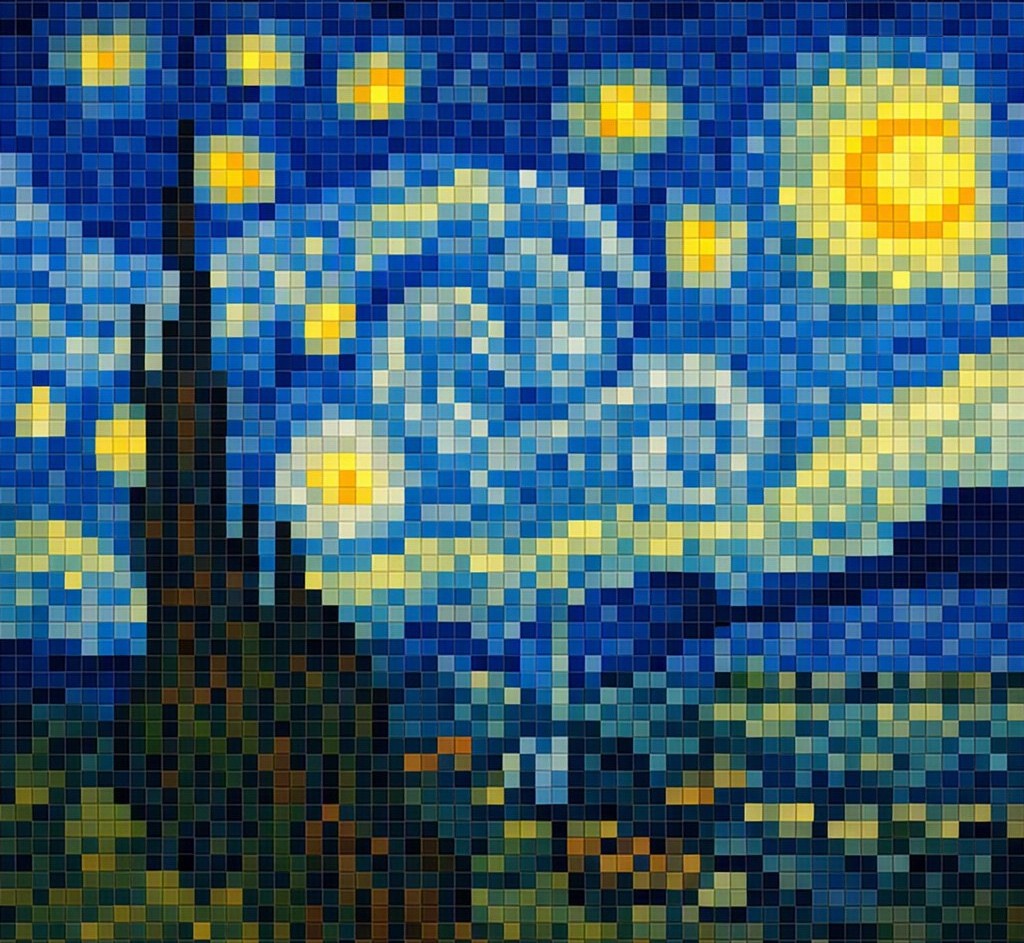
Image Notes: Mosaic version of The Starry Night by Vincent van Gogh. The image has been copped and resized.
Acknowledgement: Great thanks to Rick Freyer whose inquiry led QI to formulate this question and perform this exploration. Freyer noted that the saying had been attributed to André Gide, Leonardo da Vinci, and Michelangelo.
- 1904, Saül: Le Roi Candaule by André Gide, Deuxième Édition (Second Edition), De L’Évolution du Théatre (On the Evolution of Theater), Conférence Prononcée le 25 Mars 1904 a la « Libre Esthétique » De Bruxelles (Lecture Delivered on March 25, 1904 at the “Libre Esthétique” in Brussels), Quote Page xiii (8), Société du Mercure de France, Paris. (Google Books Full View) link ↩︎
- 1902 Juin 1, La Revue Blanche (The White Review), Volume 28, Number 216, Section: Les Livres (The Books), Book review of André Lebey: L’Age où l’on s’ennuie, Quote Page 228, Editions de la Revue, Paris. (Internet Archive at archive.org) link ↩︎
- 1911, La Phalange: Revue Mensuelle (The Phalanx: Monthly Review), Tome X Janvier-Juin (Volume 10 January–June), Le Mois Du Théatre (Theater Month) by Jean Royère, Start Page 366, Quote Page 367, Direction et Administration, Paris. (Google Books Full View) link ↩︎
- 1915, Leonardo Prosatore: Scelta Di Scritti Vinciani (Leonardo the Prose Writer: A Selection of Leonardo’s Writings) A Cura Di Giuseppina Fumagalli (Edited by Giuseppina Fumagalli), Chapter: La Natura: Gravità – Forza – Moto (Nature: Gravity – Force – Motion), Quote Page 80, Società Editrice Dante Alighieri, Di Albrighi, Segati & C., Milano-Roma-Napoli, Italy. (Internet Archive at archive.org) link ↩︎
- 1917, Versions: Louis Le Cardonnel, Charles Péguy by Marcel Dugas, Quote Page 20, Maison Francq, Montréal, Canada. (Internet Archive at archive.org) link ↩︎
- 1919 Octobre 10, L’Éclair : Journal Quotidien de Paris (Paris Daily Newspaper), Le Triomphe De L’Automobile: De La Voie Sacrée De Verdun Au Palais Des Champs-Élysées (The Triumph of the Automobile: From the Sacred Way of Verdun to the Champs-Élysées Palace) Quote Page 1, Column 2, Paris, France. (Gallica at gallica.bnf.fr) link ↩︎
- 1928 August, Vanity Fair, Volume 30, Number 6, Art and Artifice by André Gide, Start Page 33, Quote Page 33 and 85, Conde Nast Publications, Greenwich, Connecticut. (Google Books Full View) link ↩︎
- 1929 April, The Sackbut, Volume 9, Edited by Ursula Greville, Section: Book Reviews by Cedar Paul & Maurice Jacobson, (Book review by Cedar Paul of “Maurice Ravel et son oeuvre dramatique” by Roland Manuel), Quote Page 314, Published at 24 Berners Street, London. (Google Books Full View) link ↩︎
- 1942, Poétique Musicale: Sous Forme de Six Leçons (Musical Poetics: In the Form of Six Lessons) by Igor Strawinsky, Series: The Charles Eliot Norton Lectures for 1939-1940, Quatrième Leçon: Typologie Musicale (Fourth Lesson: Musical Typology), Start Page 46, Quote Page 51, Harvard University Press, Cambridge, Massachusetts. (Verified with scans) ↩︎
- 1947 January, Music & Letters: A Quarterly Publication, Volume 28, Number 1, Section: Review of Books, (Book review by R. H. M. of Igor Stravinsky’s “Poétique musicale”), Start Page 88, Quote Page 91, The Offices of Music & Letters, London. (Verified with scans) link ↩︎
- 1956, From the Third Programme, a Ten-years’ Anthology, (Celebrating ten years broadcasting by the BBC Third Programme), The French Language by André Gide, (First broadcast in French on July 6, 1947), Start Page 199, Quote Page 201, Nonesuch Press, London. (Verified with scans) ↩︎
- 1953, Portrait of André Gide: A Critical Biography by Justin O’Brien, Chapter 13: Daedalus, the Artifex, Quote Page 337, Alfred A. Knopf, New York. (Verified with scans) ↩︎
- 1958 Copyright, Discours de Suède (Speech from Sweden) by Albert Camus, Conférence du 14 décembre 1957, Note: Cette conférence, sous le titre L’ARTISTE ET SON TEMPS, a été prononcée dans le grand amphithéâtre de l’Université d’Upsal (Note: This lecture, titled “The Artist and His Time,” was delivered in the Great Hall of Uppsala University), Start Page 23, Quote Page 62, NRF Gallimard, Paris, France. (Verified with scans) ↩︎
- 1961 (1960 Copyright), Resistance, Rebellion, and Death by Albert Camus, Translated from the French by Justin O’Brien, Create Dangerously (Lecture given at the University of Uppsala in December 1957), Start Page 249, Quote Page 268, Alfred A. Knopf, New York. (Verified with scans) ↩︎
- 1969 Copyright, The Surrealist Revolution in France by Herbert S. Gershman, Chapter 3: The Early Literature of Surrealism, Quote Page 53, (Source listed in footnote 57 on page 198), The University of Michigan Press, Ann Arbor, Michigan. (Verified with scans) ↩︎
- 1971, Science and Synthesis: An International Colloquium organized by UNESCO on the Tenth Anniversary of the Death of Albert Einstein and Teilhard de Chardin, French contributions Translated by Barbara M. Crook, Towards a Cosmology by René Poirier, Start Page 103, Quote Page 104, Springer-Verlag, New York. (Verified with scans) ↩︎
- 1979 Spring, New Performance, Volume 1, Number 4, Photography and the World’s Body by Roger Copeland, Start Page 23, Quote Page 28, Oberlin Dance Collective Inc., c/o San Francisco Dance Management, San Francisco, California. (Verified with scans) ↩︎
- 1986 Copyright, End Papers: Essays, Letters, Articles of Faith, Workbook Notes by Breyten Breytenbach, Chapter: Burnt Bird: Berlin, Quote Page 111, Farrar, Straus and Giroux, New York. (Verified with scans) ↩︎
- 1990 August 25, The Economist, Volume 316, Number 7669, Saraband (Interview with Paul Tortelier), Start Page 75, Quote Page 76, Column 3, The Economist Newspaper NA Inc., New York. (Verified with scans) ↩︎
- 1992 February 13, The Globe and Mail, ‘I wanted to redeem the old love story’ by Val Ross (Publishing Reporter Toronto), Quote Page C1, Column 4, Toronto, Ontario, Canada. (Newspapers_com) link ↩︎
- 1992, The Movie Business Book, Edited by Jason E. Squire, Second Edition, “The Independent Filmmaker” by Henry Jaglom, Start Page 74, Quote Page 78, Fireside: Simon & Schuster, New York, (Verified with scans) ↩︎