Arthur Brisbane? Wray Hunt? John A. Broadus? Dorothy Maddox? Nellie K. Blissett? T. F. Thorp? George W. Paton? Anonymous?
Question for Quote Investigator: An old proverb asserts that every question has two sides. An extended proverb asserts that every question has three sides. The third side is the truthful or factual side. Here are three instances in this family:
(1) Every question has three sides: your side, my side, and the right side.
(2) There are three sides to every story: theirs, yours and the truth.
(3) In every dispute there are three sides — yours, mine, and the correct one.
This saying has been attributed to the famous newspaper editor Arthur Brisbane, but I have not seen a solid citation. Would you please explore the provenance of this saying?
Reply from Quote Investigator: This is a difficult topic to research because the members of this family can be expressed in many ways. The earliest strong match found by QI appeared in 1894 within “The Tamworth Herald” of Staffordshire, England. The Reverend Wray Hunt, Vicar of Trowell, spoke at a meeting of the Tamworth Cooperative Society. He argued that members of cooperatives should act as mediators. Boldface added to excepts by QI:1
They ought to be the mediators, and to occupy the proud position, to which so few could attain, of seeing that there were really three sides to the question — my side, your side, and the right side — (hear, hear). If they looked at it in that light they would arrive at a correct solution of the question — (applause).
Based on this citation, Wray Hunt is the leading candidate for originator of this family of sayings. However, this citation may be antedated by future researchers, and the attribution may shift. Arthur Brisbane did use this adage in 1934, but many versions were already in circulation.
Here is an overview showing selected published items together with dates and attributions:
1887 Feb 03: Partial match: There are always three sides to every question. First, the reasonable. Second, the plausible. Third, the damnable. (Anonymous)
1890 Nov 05: Partial match: There were three sides to every question, your side, your adversary’s side, and the legal side (Mr. Tomlinson)
1892 Feb 03: Partial match: There are three sides to every question; your side, my side and the inside. (Attributed to John A. Broadus)
1894 Mar 17: There were really three sides to the question — my side, your side, and the right side (Rev. Wray Hunt, Vicar of Trowell)
1897 Jun 22: Every question has three sides your side, my side, and the right side (Attributed to Anonymous)
1901 Jul 08: There are three sides to every question — his side, her side and the right side. (credited to Dorothy Maddox Magazine)
1901 Oct 19: Partial match: To every question there were three sides: my side, your side, and the inside. (Attributed to Rev Dr. Broadus)
1903 Aug 19: There are three sides to every question—your side, my side, and the right side (Attributed to Dr. Carlisle)
1906: Partial match: There are three sides to the matter, as I have told you—yours, the lady’s, and mine (Nellie K. Blissett)
1915 Feb 20: Partial match: There are three sides to every story — your side, his side, and the funny side (Anonymous)
1920 Nov 06: There’s always three sides to every question — my side, your side and the right side (Anonymous farmer in Virginia)
1921 Feb 06: Partial match: There are always three sides to a story. Your side and my side and the other side (Attributed to Dr. J. Whitcomb Brougher)
1921 Sep 08: There are three sides to every question: your side, the other fellow’s side, and Truth beyond that (Attributed to an unnamed deceased prominent Canadian journalist)
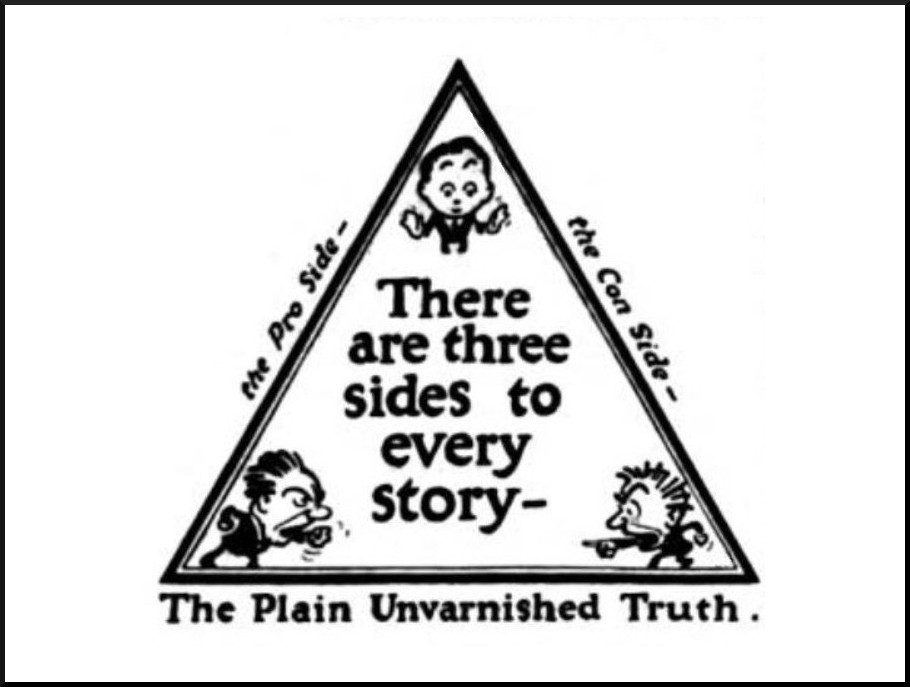
1921 Dec: There are three sides to every story — The Pro Side, The Con Side, The Plain Unvarnished Truth (Cartoon by an unnamed artist)
1923 Feb: There are three sides to most stories — “the other fellows, mine, and the Truth” (Anonymous)
1925 May 02: Yes, there may be three sides to the question, “your side, my side, and the truth” (Dr. T. F. Thorp)
1925 Dec: There are always two sides to a question and frequently three—yours, mine and the right side (L. E. Keller)
1926 Mar: In every dispute there are not two sides but three—yours, mine, and the correct one (George W. Paton)
1928 Aug 17: Almost every dispute has three sides—the other fellow’s side, your own side and the truth (Anonymous)
1934 Dec 13: There are three sides to every story—his, yours and the truth! (Arthur Brisbane)
1958 Mar 3: There are Three Sides to Every Story — Yours, Mine and The Facts (Sign in a drugstore in Calhoun, Georgia)
1968: Partial match: There are three sides to every argument: your side, the other person’s side, and to hell with it (Anonymous)
1986: Every story has three sides to it — yours, mine and the facts (Attributed to Foster Meharny Russell)
Below are details for selected citations in chronological order.
In 1887 a newspaper in St Johns, Arizona printed a letter to the editor from the pseudonymous “Pile Driver” who used a comical variant of the three-part saying:2
There are always three sides to every question. First, the reasonable. Second, the plausible. Third, the damnable. All three of these sides, have been pretty well represented in the county press, and tolerably well discussed in public places …
In 1890 “The Birkenhead News” of Merseyside, England published an article about a meeting of the Oxton Ward Conservative Club. A speaker named Mr. Tomlinson employed a variant of the expression using the phrase “legal side”:3
It was very difficult to give opinions on the burning questions of the Council, as there were three sides to every question, your side, your adversary’s side, and the legal side.
In 1892 “The Biblical Recorder” of Raleigh, North Carolina attributed a variant statement using the word “inside” to a religious figure:4
Dr. John A. Broadus says, there are three sides to every question; your side, my side and the inside.
A few days later a newspaper in Macon, Missouri credited the variant statement using “inside” to the same religious figure:5
Dr. John A. Broadus says: “There are three sides to every question — your side, my side, and the inside.”
In 1894 Reverend Wray Hunt spoke at a meeting in Tamworth, England, and he used the saying. This was the earliest strong match found by QI as mentioned at the beginning of this article:6
… there were really three sides to the question — my side, your side, and the right side …
In 1897 “The Progressive Farmer” of Raleigh, North Carolina printed the saying with an anonymous attribution:7
Somebody once used this very trite saying that “every question has three sides your side, my side, and the right side.” It any brother has a real, or imaginary, side adverse to the Agency it is well for the light to shine upon it.
In July 1901 a newspaper in Camden, New Jersey printed a variant while acknowledging the “Dorothy Maddox Magazette”:8
There are not only two, there are three sides to every question—his side, her side and the right side. P.S. — Each varies widely.
In October 1901 “The Churchman” periodical of New York attributed the variant with the word “inside” to Dr. Broadus:9
The Rev Dr. Broadus used to say that to every question there were three sides: my side, your side, and the inside. And this is true.
In 1903 the “Lancaster Enterprise” of South Carolina printed an article which attributed the saying with the phrase “right side” to Dr. Carlisle:10
Dr. Carlisle often says to the young man who asks for his advice on a subject: “Young man, remember; there are three sides to every question—your side, my side, and the right side.”
It would be well if parents and teachers could realize this great truth. There is the parent’s side, there is the teacher’s side; and, too often, there is a third side—the right side.
In 1906 the book titled “The Silver Key: A Romance of the Days of Charles II” by Nellie K. Blissett contained a variant:11
“I refuse it to you,” he said obstinately. “There are three sides to the matter, as I have told you—yours, the lady’s, and mine. It does not suit me that you should know who the lady was—that is all.
In 1915 “The Lake County Times” of Hammond, Indiana published an entertaining variant:12
There are three sides to every story—your side, his side, and the funny side. Try to ascertain all three in case of trouble—especially the third side and you’ll get along famously.
In 1920 “The Saturday Evening Post” of Philadelphia, Pennsylvania published a short item titled “More Than Two Sides” within an article titled “Sense and Nonsense”. A war correspondent and an unnamed farmer started to argue with one another. The famer used the adage with the phrase “right side”:13
At times the argument grew heated, the warmth abating with the farmer’s concluding remark.
“Well, you should know, Mr. James,” he said, “there’s always three sides to every question — my side, your side and the right side.”
In February 1921 “The Arizona Republican” of Phoenix, Arizona printed a variant with the phrase “other side”:14
“There are always,” said Dr. J. Whitcomb Brougher from his pulpit one Sunday, “three sides to a story. Your side and my side and the other side.” The more this statement is analyzed the truer it seems.
In September 1921 “The Toronto Daily Star” of Canada attributed a version using the word “truth” to an unnamed journalist:15
By picture and reliable news it endeavors to present all sides of every question of world-wide interest, federal, provincial and municipal, believing in the saying of a prominent Canadian journalist now dead and gone, that “there are three sides to every question: your side, the other fellow’s side, and Truth beyond that.”
In December 1921 a company periodical called “The Seaco Way” published a cartoon depicting a triangle. Each side of the triangle was labelled as follows. Also, see the illustration at the top of this article:16
There are three sides to every story — The Pro Side, The Con Side, The Plain Unvarnished Truth.
In February 1923 “The Seaco Way” printed another version of the saying with the word “truth”:17
It is still true that there are three sides to most stories—”the other fellows, mine, and the Truth.” The wise man gets at the third side by hearing the other two.
In May 1925 the “San Juan Mission News” of California printed an instance with “truth”:18
There are controversies and contentions and striving for the mastery; there are two sides to the question and all that; yes, there may be three sides to the question, “your side, my side, and the truth.”
In December 1925 a periodical for railway maintenance workers printed an instance with the phrase “right side”:19
It must be realized that there are always two sides to a question and frequently three—yours, mine and the right side.
In March 1926 George W. Paton delivered a speech in London that was excerpted in the periodical “Co-Partnership”. Paton was Chairman of Messrs. Bryant and May Ltd. Paton used a version of the saying with the phrase “correct one”:20
Mr. PATON suggested that the new spirit was a real spirit of Christian Brotherhood, which must permeate all offices and factories. We must instil the idea of “fair dealing” in all, remembering that in every dispute there are not two sides but three—yours, mine, and the correct one.
Shortly afterward in March 1926 “The Sun” newspaper of Orangeville, Ontario, Canada credited Paton with the version of the saying using “correct one”:21
There are always three sides to every dispute — yours, mine, and the correct one. — G. W. Paton.
In 1928 “The La Belle Star” newspaper of Missouri printed an instance without attribution:22
Almost every dispute has three sides—the other fellow’s side, your own side and the truth.
In 1934 the “Brooklyn Daily Eagle” of New York reported on a speech by prominent newspaper editor Arthur Brisbane during which he used an instance:23
Arthur Brisbane’s observation during his speech at the Broadway Cheese Club the other day, “There are three sides to every story—his, yours and the truth!”
In 1958 a newspaper reported on a sign located in Calhoun, Georgia:24
“There are Three Sides to Every Story — Yours, Mine and The Facts” and “Please Listen Distinctly,” seen on wall at Willie J. Owens’ drugstore in Calhoun.
In 1968 the compilation “20,000 Quips and Quotes” included an entry for a comical variant:25
There are three sides to every argument: your side, the other person’s side, and to hell with it.
In 1986 “The Fitzhenry & Whiteside Book of Quotations” included the following entry:26
Every story has three sides to it — yours, mine and the facts.
Foster Meharny Russell
In conclusion, in 1894 Wray Hunt used an instance of this saying with the phrase “right side”. This was the earliest match in this family; hence, Wray Hunt is currently the top candidate for creator. However, this is a complex topic, and future researchers may discover older matches.
Image Notes: Picture from the December 1921 issue of “The Seaco Way” depicting a triangle with labels on its three edges.
Acknowledgement: Great thanks to Mike Mozzaro whose inquiry led QI to formulate this question and perform this exploration. Also, thanks to the “Dictionary of Modern Proverbs” which included a pertinent entry containing the important citations beginning in 1903.
- 1894 March 17, The Tamworth Herald, Tamworth Industrial Co-operative Society, Address by Mr. Tom Mann, (Introductory words by Wray Hunt), Quote Page 8, Column 6, Tamworth, Staffordshire, England. (Newspapers_com) link ↩︎
- 1887 February 3, The St. Johns Herald, Good Reasons for Dividing the County, (Letter to the editor from Pile Driver), Quote Page 2, Column 2, St Johns, Arizona. (Newspapers_com) ↩︎
- 1890 November 5, The Birkenhead News, Oxton Ward Conservative Club, (Speaker: Mr. Tomlinson), Quote Page 2, Column 4, Birkenhead, Merseyside, England. (Newspapers_com) link ↩︎
- 1892 February 3, The Biblical Recorder, The Mission Question, Quote Page 3, Column 5, Raleigh, North Carolina. (Newspapers_com) ↩︎
- 1892 February 5, Macon Times, Gleanings and Glances by M. C. Tracy, Quote Page 1, Column 2, Macon, Missouri. (Newspapers_com) link ↩︎
- 1894 March 17, The Tamworth Herald, Tamworth Industrial Co-operative Society, Address by Mr. Tom Mann, Quote Page 8, Column 6, Tamworth, Staffordshire, England. (Newspapers_com) link ↩︎
- 1897 June 22, The Progressive Farmer, Letter title: The Other Side, Letter from: T. Ivey Esq., Hillsboro, North Carolina, Quote Page 4, Column 1, Raleigh, North Carolina. (Newspapers_com) ↩︎
- 1901 July 8, Camden Post-Telegram, Dorothyettes (From Dorothy Maddox Magazine), Quote Page 4, Column 6, Camden, New Jersey. (Newspapers_com) ↩︎
- 1901 October 19, The Churchman, Section: Letters to the Editor, Letter title: California and “Romanizing Tendencies”: A Few Facts and Some Comments Letter from: Geo. Thos. Dowling (Rector of Christ Episcopal church, Los Angeles), Quote Page 514, Column 2, The Churchman Company, New York. (Google Books Full View) link ↩︎
- 1903 August 19, Lancaster Enterprise, Parents and Teachers, Quote Page 8, Column 1, Lancaster, South Carolina. (Newspapers_com) ↩︎
- 1906, The Silver Key: A Romance of the Days of Charles II by Nellie K. Blissett, Chapter 5: The House in the Rue Gabrielle, Quote Page 71, The Smart Set Publishing Company, New York. (Google Books Full View) link ↩︎
- 1915 February 20, The Lake County Times, Random Things and Flings, Quote Page 4, Column 3, Hammond, Indiana. (Newspapers_com) ↩︎
- 1920 November 6, The Saturday Evening Post, Sense and Nonsense: More Than Two Sides, Quote Page 42, Column 3, The Curtis Publishing Company, Philadelphia, Pennsylvania. (Internet Archive) link ↩︎
- 1921 February 6, The Arizona Republican, Pastor Says There Are Three Sides to Every Story, Section 4, Quote Page 3, Column 6, Phoenix, Arizona. (Newspapers_com) ↩︎
- 1921 September 8, The Toronto Daily Star, Shop Talk, Quote Page 6, Column 7, Toronto, Ontario, Canada. (Newspapers_com) ↩︎
- 1921 December, The Seaco Way, Volume 13, Number 5, Consider All Three Sides, (Cartoon of a triangle with text), Quote Page 2, Note: The article stated that the cartoon appeared previously in the October 1919 issue of “The Seaco Way”; QI has been unable to access that issue, Seamans & Cobb Company, Boston, Massachusetts. (Google Books Full View) link ↩︎
- 1923 February, The Seaco Way, Volume 16, Number 1, Defective Detectives, Quote Page 3, Seamans & Cobb Company, Boston, Massachusetts. (Google Books Full View) link ↩︎
- 1925 May 2, San Juan Mission News, A Communication by Dr. T. F. Thorp, Quote Page 5, Column 4, San Juan, San Benito County, California. (Newspapers_com) ↩︎
- 1925 December, The Railway Maintenance of Way Employes Journal, Volume 34, Number 12, Can the Brotherhood of Maintenance of Way Employes and Management Co-operate? by L. E. Keller (Statistician), Start Page 6, Quote Page 8, Column 1, Official Organ of Brotherhood of Maintenance of Way Employes, Detroit, Michigan. (Google Books Full View) link ↩︎
- 1926 March, Co-Partnership, Volume 32, Number 371, L.C.A. Monthly Lunches, Quote Page 63, Column 1, The Organ of the Labour Co-Partnership Association, London. (Google Books Full View) link ↩︎
- 1926 March 18, The Sun, Recent London Observations, Quote Page 6, Column 6, Orangeville, Ontario, Canada. (Newspapers_com) ↩︎
- 1928 August 17, The La Belle Star, Hot Stuff, Quote Page 3, Column 6, La Belle, Missouri. (Newspapers_com) ↩︎
- 1934 December 13, Brooklyn Daily Eagle, Dr. Dafoe ‘Cuter Than Quints’ — Applause and Main Stem Salutes, With Art Arthur, Quote Page 30, Column 7, Brooklyn, New York. (Newspapers_com) ↩︎
- 1958 March 3, The Atlanta Constitution, You Go Longer Between Flats by Leo Aikman, Quote Page 4, Column 5, Atlanta, Georgia. (Newspapers_com) ↩︎
- 1968, 20,000 Quips and Quotes by Evan Esar, Subject: Point of View, Quote Page 610, Doubleday, Garden City, New York. (Verified with hardcopy) ↩︎
- 1986, The Fitzhenry & Whiteside Book of Quotations, Revised and Enlarged, Edited by Robert I. Fitzhenry, Section: Arguments and Quarrels, Quote Page 36, Fitzhenry & Whiteside Limited, Toronto. (Verified with hardcopy) ↩︎