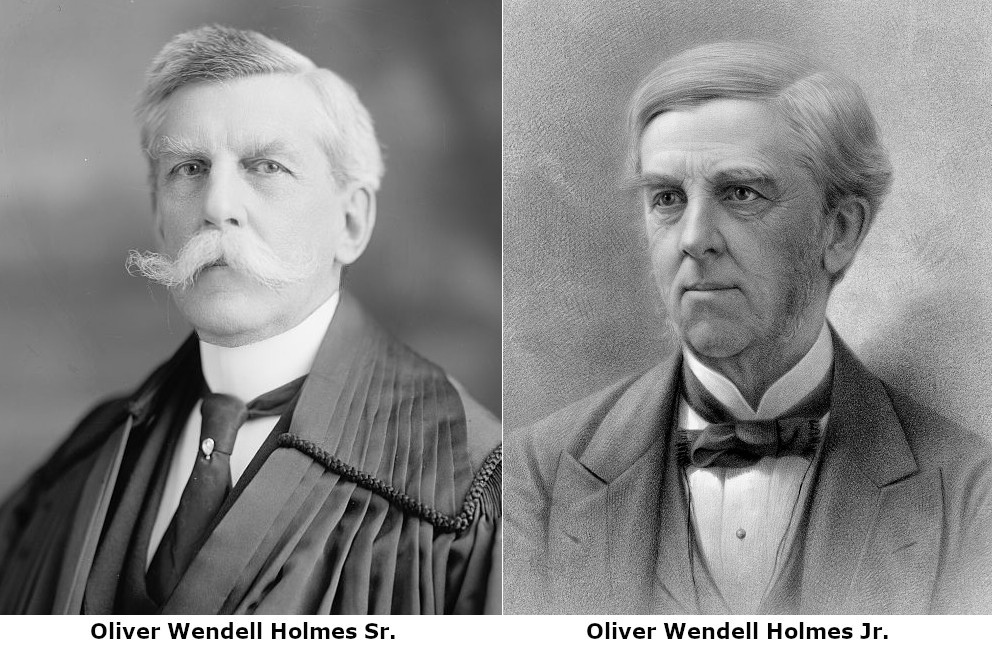
Oliver Wendell Holmes Sr.? Oliver Wendell Holmes Jr.? Clinton Cushing? Anonymous?
Question for Quote Investigator: Young people emerging from rigorous training are familiar with the rules of their professions, but it takes time and practical experience to recognize and adapt to the exceptions to these rules. A sage once said the following:
The young man knows the rules, but the old man knows the exceptions.
This remark has been credited to the influential U.S. physician Oliver Wendell Holmes Sr. and the prominent U.S. Supreme Court justice Oliver Wendell Holmes Jr. Would you please help me to find a citation to resolve this ambiguity?
Reply from Quote Investigator: In March 1871 Oliver Wendell Holmes Sr. delivered the valedictory address to the graduating class of the Bellevue Hospital Medical College in New York. The text of his speech was printed in “The New York Medical Journal” in April 1871. Boldface added to excerpts by QI:1
The young man knows the rules, but the old man knows the exceptions. The young man knows his patient, but the old man knows also his patient’s family, dead and alive, up and down for generations.
Oliver Wendell Holmes Sr. deserves credit for the expression under examination. During subsequent years the attribution specified was often ambiguous. In 1981 the statement was incorrectly credited to the famous jurist Oliver Wendell Holmes Jr.
Below are selected citations in chronological order.
Lewis Carroll? Cheshire Cat? Caterpillar?Harry S. Albert? R. Elizabeth Jones? Manmatha Nath Chatterjee? Henry Miller? Theodore Levitt? Anonymous?
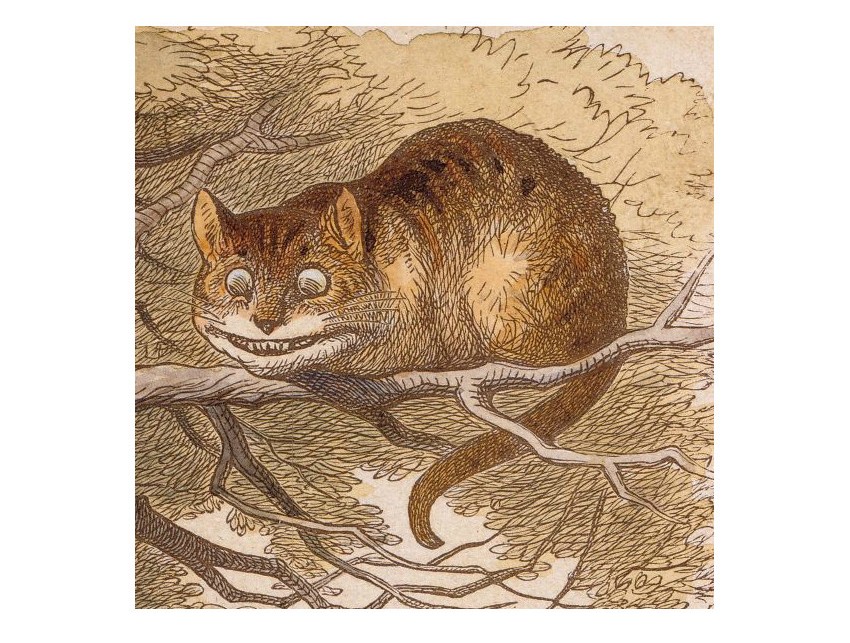
Illustration of the Cheshire Cat by John Tenniel
Question for Quote Investigator: Choosing goals in life is difficult but essential. The following absurdist proverb is pertinent:
If you don’t know where you’re going, any road will take you there.
This statement has been credited to the famous English author Lewis Carroll, but I do not think this precise phrase appears in any of his works. Would you please explore this topic?
Reply from Quote Investigator: In 1865 Lewis Carroll published “Alice’s Adventures in Wonderland” which contained a scene with Alice and the Cheshire cat. Boldface added to excerpts by QI:1
“Cheshire Puss,” she began, rather timidly, as she did not at all know whether it would like the name: however, it only grinned a little wider. “Come, it’s pleased so far,” thought Alice, and she went on, “Would you tell me, please, which way I ought to go from here?” “That depends a good deal on where you want to get to,” said the Cat. “I don’t much care where—” said Alice. “Then it doesn’t matter which way you walk,” said the Cat. “—so long as I get somewhere,” Alice added as an explanation. “Oh, you’re sure to do that,” said the Cat, “if you only walk long enough.”
QI believes that the proverb evolved from this scene in Lewis Carroll’s book. Here is an overview with dates showing a sampling of the variety of expressions and attributions:
1865: “That depends a good deal on where you want to get to” “I don’t much care where — ” “Then it doesn’t matter which way you walk” (Lewis Carroll)
1900 Jul: “That depends a good deal where you want to get to” “I don’t much care — ” “Then it doesn’t matter which way you go” (Attributed to Lewis Carroll)
1910 Dec: If you don’t care where you are going, it can not matter much which way you go (Attributed to a Caterpillar character)
1913 Dec: It doesn’t matter which way you go, if you don’t much care where you are going to (Attributed to the Cheshire cat of Lewis Carroll)
1941 Oct: When a man does not know where he is going, any road will take him to his destination (Harry S. Albert)
1941 Dec: When a man does not know where he is going, any road will take him to his destination (Attributed to Algo Henderson)
1942 Apr: If one does not know where he is going, any road will take him there (Manmatha Nath Chatterjee)
1942 Jun: If you don’t know where you are headed, any road will lead to your destination (Attributed to Anonymous)
1944 Oct: If you do not know where you are going, any road will get you there (Labeled an Oriental Proverb by R. Elizabeth Jones)
1945 Jun: If you do not know where you are going any road will take you there (Labeled an Ancient Saying by Manmatha Nath Chatterjee)
1958 Apr: If you don’t know where you are going, any road will take you there (Attributed to the Talmud by Daniel Bell)
1960 Jul: Unless he knows where he is going, any road will take him there (Theodore Levitt)
1969: If you don’t know where you’re going, any road will do (Attributed to Anonymous by John Argenti)
1977: Unless you know where you are going, any road will take you there (Attributed to Theodore Levitt)
1980: If you don’t know where you are going, every road will get you there (Attributed to Chips Bohlen by Henry Kissinger)
1990: If you don’t know where you are going, any road will take you there (Attributed to the Talmud by Martin Gardner)
2002: If you don’t know where you’re going, any road will take you there (George Harrison)
Howard H. Aiken? Kenneth E. Iverson? Gregory W. Welch? Robert Slater? Apocryphal?
Picture representing creativity from Unsplash
Question for Quote Investigator: A cynical comment about innovation states that it is not necessary to fear the theft of your ideas because people obstinately resist imaginative ideas. If your idea is original, you will have to ram it down people’s throats. This notion has been attributed to Howard H. Aiken who was the main designer of IBM’s Harvard Mark I, the first programmable computer in the U.S. Would you please help me to find a citation?
Reply from Quote Investigator: The Spring 1985 issue of “The Computer Museum Report” of Boston, Massachusetts contained an article titled “Howard Hathaway Aiken: The Life of a Computer Pioneer” by Gregory W. Welch which included a version of the quotation:1
… a comment that Aiken made to a student once betrays the attitude which earned him the enmity of some, and caused him to become disillusioned in later years: “Don’t worry about people stealing your idea,” he said. “If it’s original you will have to ram it down their throats.” This attitude represented what his critics claimed was Aiken’s condescending and superior air.
The footnote accompanying the quotation named “Iverson” as the source. This corresponded to computer scientist Kenneth E. Iverson who was Aiken’s student. The notes of the article listed the following document by Iverson which QI has not examined:
Kenneth E. Iverson, “Howard Aiken, Friend and Mentor,” April, 1973, Aiken Files, Folder: “Harry Mimno,” AOF.
The initialism AOF referred to the following archive:
AOF—Active files of Dr. Anthony Oettinger, Chairman, Program on Information Resources Policy, Harvard University, Aiken Computation Laboratories, 33 Oxford Street, Cambridge, Massachusetts.
Aiken died in March 1973. Hence, the document above was created by Iverson in the month after Aiken’s death. QI believes that the quotation is probably in this 1973 document. Alternatively, Gregory W. Welch heard the quotation directly from Iverson who credited Aiken.
Below are additional selected citations in chronological order.
Yogi Berra? Abigail Van Buren? Joe Garagiola? Laurence J. Peter? Robert F. Mager? Anonymous?
Picture of a map with a compass from Unsplash
Question for Quote Investigator: Selecting goals and targets is helpful. A collection of humorous sayings highlights the disadvantages of aimlessness. Here are three examples:
(1) If you don’t know where you are going you will never arrive.
(2) If you don’t know where you’re going, you’re going to wind up someplace else.
(3) You’ve got to be careful if you don’t know where you’re going because you might not get there.
Instances from this family have been credited to baseball player Yogi Berra, Canadian educator Laurence J. Peter, psychologist Robert F. Mager, and advice columnist Abigail Van Buren. Would you please explore this topic?
Reply from Quote Investigator: Here is an overview with dates showing the variety of expressions and attributions in this family:
65 AD Precursor: When a man does not know what harbour he is making for, no wind is the right wind (Seneca the Younger)
1907 Nov 25: If you don’t know where you are going you will never arrive (Attributed to Anonymous)
1962: If you’re not sure where you’re going, you’re liable to end up someplace else—and not even know it (Robert F. Mager)
1969: If you don’t know where you are going, you will probably end up somewhere else. (Laurence J. Peter and Raymond Hull)
1969 Jun 06: If you don’t know where you’re going, you’re going to wind up someplace else (Attributed to Yogi Berra)
1969 Jul 22: If you don’t know where you’re going, you’re gonna wind up somewhere else (Attributed to Yogi Berra)
1969 Aug 09: People who don’t know where they’re going usually wind up somewhere else (Abigail Van Buren)
1972 Jan 31: If you don’t know where you’re going, you might wind up some place else (Attributed to Yogi Berra)
1979 Nov: If you don’t know where you’re going, you won’t know when you get there (Attributed to Yogi Berra)
1980 Nov 14: If you don’t know where you’re going, how will you know when you get there? (Attributed to Yogi Berra)
1982 Aug 17: You’ve got to be very careful if you don’t know where you’re going, because you might not get there (Attributed to Yogi Berra)
1983 Dec 29: You’ve got to be careful because if you don’t know where you’re going, you might never get there (Attributed to Yogi Berra)
1998: You’ve got to be careful if you don’t know where you’re going ’cause you might not get there! (Yogi Berra)
Rudyard Kipling? Friedrich Nietzsche? Arthur Gordon? Anonymous?
Picture of a blue peacock amongst yellow rubber ducks from Unsplash
Question for Quote Investigator: The peer group exerts enormous pressure on the individual. Achieving and maintaining an independent viewpoint is arduous. An influential thinker stated the following:
The individual has always had to struggle to keep from being overwhelmed by the tribe.
The thinker believed that pursuing a personal path was worthwhile and said this:
No price is too high to pay for the privilege of owning yourself.
These statements have been attributed to the German philosopher Friedrich Nietzsche and the English author Rudyard Kipling. I have never seen a solid citation. Would you please explore this topic?
Reply from Quote Investigator: Rudyard Kipling died in 1936. In July 1959 “Reader’s Digest” magazine published an article by journalist Arthur Gordon titled “Interview With an Immortal”. Gordon stated that he interviewed Kipling at his home in June 1935. Gordon presented a quotation from Kipling about maintaining one’s identity. Boldface added to excerpts by QI:1
Looking back, I think he knew that in my innocence I was eager to love everything and please everybody, and he was trying to warn me not to lose my own identity in the process. Time after time he came back to this theme.
“The individual has always had to struggle to keep from being overwhelmed by the tribe. To be your own man is a hard business. If you try it, you’ll be lonely often, and sometimes frightened. But no price is too high to pay for the privilege of owning yourself.”
The accuracy of this quotation is dependent on Arthur Gordon’s veracity. Gordon became a respected editor who worked at “Good Housekeeping” and “Cosmopolitan” magazines. Gordon also authored fourteen books, and contributed pieces to “Reader’s Digest”, “Esquire”, “Collier’s”, “Saturday Evening Post”, and other periodicals.2
QI has found no substantive support for the attribution to Friedrich Nietzsche who died in 1900. Nietzsche implausibly received credit in 1996.
Below are additional selected citations in chronological order.
George Carlin? Jeremy Clarkson? Carol Mueller? Larry Tobin? Bill Hall? Cheryl Saban? Ben Rubin? Apocryphal?
Question for Quote Investigator: Electronic devices beep when reporting notifications. Trucks beep when they are backing up. Microwave ovens beep when food is ready. A wit commented on our modern soundscape. Here are three versions:
(1) Everything beeps now. (2) Now everything goes beep (3) Everything beeps in this society.
U.S. comedian George Carlin has received credit for this quip, but he is a quotation magnet. Many jokes have been erroneously attributed to him. Would you please explore this topic?
Reply from Quote Investigator: George Carlin did employ this quip in his 2001 book “Napalm & Silly Putty” which included a section called “Short Takes” with the following item. Boldface added to excepts by QI:1
Everything beeps now.
Thus, George Carlin helped to popularize this quip, yet it was already in circulation. For example, in 1984 columnist by Larry Tobin of “The Tomahawk Leader” in Wisconsin wrote the following:2
Remember how it used to be that people made such a big deal over the fear of “things that go bump in the night?” …
Well that must have happened so often with no gruesome result that people finally ignored it. Nothing goes “bump” anymore, so somebody decided to change the format. Now everything goes “BEEP!”
Here are additional selected citations in chronological order.
Question for Quote Investigator: When the first laser was built it received high praise, but the applications of the invention were unclear. A clever phrase described the situation. Here are two versions:
(1) A solution in search of a problem (2) A solution looking for a problem
Ultimately, many applications emerged. For example, lasers transmit data down optical fibers, and laser diodes read the data recorded on optical disks.
The phrase above has been applied to nuclear energy, computers, AI, bitcoin, and other technological developments. Would you please explore when this phrase emerged? Also, which technology originally inspired the coinage of this phrase?
Reply from Quote Investigator: The earliest strong match found by QI appeared in March 1951 within the “Journal of the Electrochemical Society”. Jerrold R. Zacharias published a review of a book which discussed the economics of nuclear power. The title of the review contained the phrase under examination:1
Nuclear Power — a solution in search of a problem
This title reflected Zacharias’s contention that the authors of the book had failed to find an economically advantageous use for nuclear power. Boldface added to excerpts by QI:
If this work were called “Economic Aspects of Cheap Heat,” it would be rightly named and beyond reproach. It seems to a nuclear physicist to be a fine work on industrial engineering, but it does not find the problem for which nuclear power is the solution.
Below are additional selected citations in chronological order.
Lorraine Hansberry? Stephen King? Helene Keyssar? Apocryphal?
Egg with a pink background from Unsplash
Question for Quote Investigator: I am trying to find the source of the following dialogue. The setting was a breakfast table. One person enthusiastically described a grand plan and said, “I have a dream” or “I want to fly”. The other person attenuated the emotional intensity by simply saying “Eat your eggs”.
This exchange has been attributed to playwright Lorraine Hansberry and horror author Stephen King. Would you please help me to find the precise dialogue together with a citation?
Reply from Quote Investigator: Lorraine Hansberry’s play “A Raisin in the Sun” was produced in New York in 1959. The character Walter ardently described a plan for opening a liquor store with two friends. Walter was hoping to obtain the seed money for this venture from a family member. But Ruth was skeptical, and she attempted to change the topic of conversation:1
RUTH Walter, leave me alone! (She raises her head and stares at him vigorously—then says, more quietly) Eat your eggs, they gonna be cold.
WALTER (Straightening up from her and looking off) That’s it. There you are. Man say to his woman: I got me a dream. His woman say: Eat your eggs. (Sadly, but gaining in power) Man say: I got to take hold of this here world, baby! And a woman will say: Eat your eggs and go to work. (Passionately now) Man say: I got to change my life, I’m choking to death, baby! And his woman say — (In utter anguish as he brings his fists down on his thighs) — Your eggs is getting cold!
Below are additional selected citations in chronological order.
Thomas Robert Dewar? Grafton Grabb? A Ragged Tramp? Anonymous?
Illustration of a wooden gavel from Unsplash
Question for Quote Investigator: Everyone faces trials, i.e., adversity. A humorous remark uses wordplay to tie together these hardships with the legal system:
Life is full of trials with an occasional conviction.
This quip has been attributed to Scottish whisky distiller Thomas Robert Dewar, but I have not seen a solid citation. Would you please explore this saying?
Reply from Quote Investigator: An anecdote published in the January 22, 1887 issue of the New York humor magazine “Judge” employed the same wordplay. Boldface added to excerpts by QI:1
NOT USED TO SYMPATHY. “Come in, my poor man,” said a benevolent lady to a ragged tramp, “and I will get you something to eat.” “Thanky, mum; don’t care if I do.” “I suppose,” continued the lady, setting a square meal before him,“your life has been full of trials?” “Yis, mum; an’ the wust of it wuz I allus got convicted.”
The final line used eye dialect to render the following phrase “Yes, mam; and the worst of it was I always got convicted”.
This joke evolved over time and was streamlined. In 1915 “Puck” magazine printed an instance without attribution which precisely matched the expression under examination. In 1926 Lord Dewar (Thomas Robert Dewar) used the line while delivering a speech, but the quip was already in circulation.
Below are details for selected citations in chronological order.
Samuel Goldwyn? Bill Keisler? Bobby Wayne? Vladimir Semyonov? Sam Levenson? Laurence J. Peter? Anonymous?
Picture of microphones from Unsplash
Question for Quote Investigator: The following astringent remark perfectly embodies the attitude of a high-handed boss who ignores feedback:
When I want your opinion, I’ll give it to you.
This line has been ascribed to movie mogul Samuel Goldwyn. The statement has also been attributed to the domineering partner of a marriage. Would you please trace this expression?
Reply from Quote Investigator: The earliest match found by QI appeared in “Coronet” magazine in February 1952. Boldface added to excepts by QI:1
In a New York restaurant, a woman was overheard to tell her henpecked husband: “Keep quiet. When I want your opinion I’ll give it to you!” —Bill Keisler
The item above was submitted to a section of “Coronet” called “Grin and Share It” by Bill Keisler. Strictly speaking, the creator of this line was an anonymous woman. The person who recognized its humour was Keisler.
Singer Bobby Wayne received credit for the joke in March 1952. Soviet administrator Vladimir Semyonov received credit in 1953. Samuel Goldwyn received credit in 1965.
Below are details for selected citations in chronological order.