Blaise Pascal? John Locke? Benjamin Franklin? Jean-Louis Guez de Balzac? Abraham Lincoln? Henry David Thoreau? Cicero? Mark Twain? Woodrow Wilson?
Question for Quote Investigator: I was planning to end a letter with the following remark:
If I had more time, I would have written a shorter letter.
But the number of different people credited with this comment is so numerous that an explanatory appendix would have been required, and the letter was already too long. Here is a partial list of attributions I have seen: Mark Twain, George Bernard Shaw, Voltaire, Blaise Pascal, Johann Wolfgang von Goethe, Winston Churchill, Abraham Lincoln, Pliny the Younger, Cato, Cicero, Bill Clinton, Jean-Louis Guez de Balzac, and Benjamin Franklin. Did anybody in this group really say it?
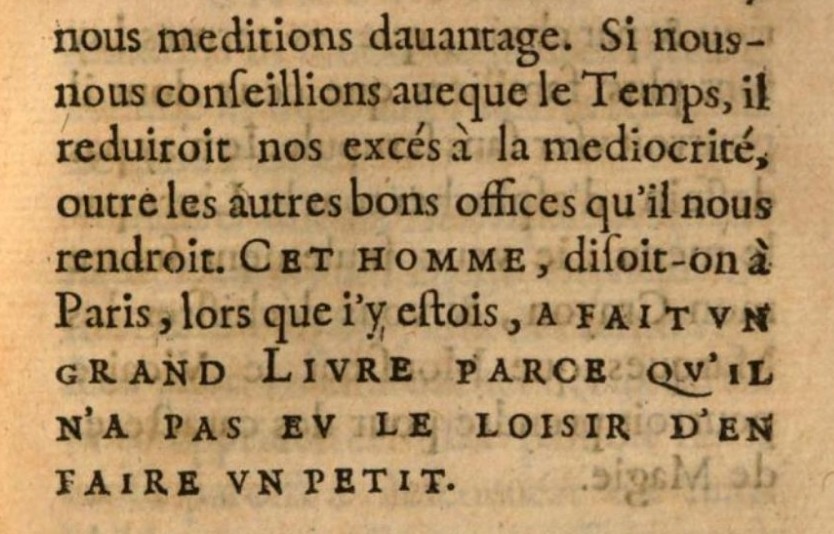
Reply from Quote Investigator: A large family of sayings expresses this idea. The first instance known to QI appeared in the 1652 book “Socrate Chrestien” (“The Christian Socrates”) by the French essayist Jean-Louis Guez de Balzac who credited the people of Paris with the saying. Thus, the earliest instance was anonymous. An English translation is followed by the original French and a book scan below. Boldface added to excerpts by QI:1
If we took counsel with Time, it would temper our excesses to moderation, in addition to the other good services it would render us. “THAT MAN,” people used to say in Paris when I was there, “WROTE A LONG BOOK BECAUSE HE DID NOT HAVE THE LEISURE TO WRITE A SHORT ONE.”
Si nous — nous conseillions aueque le Temps, il reduiroit nos excés à la mediocrité, outre les autres bons offices qu’il nous rendroit. CET HOMME, disoit-on à Paris, lors que i’y estois, A FAIT UN GRAND LIVRE PARCE QU’IL N’A PAS EU LE LOISIR D’EN FAIRE UN PETIT.
Note, Jean-Louis Guez de Balzac was not the same person as the French novelist and playwright Honoré de Balzac.
The second earliest instance known to QI appeared in a 1657 letter written by the French mathematician and philosopher Blaise Pascal. The statement appeared in a collection called “Lettres Provinciales” in the year 1657:2 3 4
Je n’ai fait celle-ci plus longue que parce que je n’ai pas eu le loisir de la faire plus courte.
Here is one possible modern-day translation of Pascal’s statement. Note that the term “one” refers to the letter itself.
I have made this one longer only because I did not have the leisure to make it shorter.
An English translation was created in 1658 and published in London. Here is an excerpt from that early rendition of the letter. The spelling differed in 1658, and the phrases “longer then” and “shorter then” occurred in this text instead of “longer than” and “shorter than”:5
My Letters were not wont to come so close one in the neck of another, nor yet to be so large. The short time I have had hath been the cause of both. I had not made this longer then the rest, but that I had not the leisure to make it shorter then it is.
This notion was quite memorable, and it was discussed in a French book about language. That work was translated and published in London in 1676 as “The Art of Speaking”:6
These Inventions require much wit, and application; and therefore it was, that Mons. Pascal (an Author very famous for his felicity in comprising much in few words) excused himself wittily for the extravagant length of one of his Letters, by saying, he had not time to make it shorter.
In 1688 a religious controversialist named George Tullie included a version of the witticism in an essay he wrote about the celibacy of the clergy:7
The Reader will I doubt too soon discover that so large an interval of time was not spent in writing this discourse; the very length of it will convince him, that the writer had not time enough to make a shorter.
Below are listed several variations of the expression as used by well known, lesser known, and unknown individuals. The philosopher John Locke, the statesman Benjamin Franklin, the transcendentalist Henry David Thoreau, and the President Woodrow Wilson all presented statements matching this theme and the details are provided.
Mark Twain who is often connected to this saying did not use it according to the best available research, but one of his tangentially related quotations is given later for your entertainment.
Here are additional selected citations in chronological order.
Continue reading “Quote Origin: If I Had More Time, I Would Have Written a Shorter Letter”