Coco Chanel? Marcel Haedrich? Apocryphal?
Question for Quote Investigator: Did the famous fashion designer and style arbiter Coco Chanel say that “nothing is ugly”? Would you please help me to find a citation showing the context?
Reply from Quote Investigator: Coco Chanel died in 1971, and in that same year Marcel Haedrich authored a biography in French titled “Coco Chanel Secrète”. The following year Haedrich’s work was translated by Charles Lam Markmann and published under the title “Coco Chanel: Her Life, Her Secrets”. A section called “She Said” printed a collection of remarks from Chanel including the following:1
Nothing is ugly as long as it is alive. Women tell me: “I have rather thick legs.” I ask them: “Do they support you? That’s what matters. The legs carry you, you don’t carry them. Stop thinking about it; that is not what will make you happy.”
Below are additional selected citations in chronological order.
The passage above appeared in 1971 as follows in the original French within “Coco Chanel Secrète”:2
Rien n’est laid, du moment que c’est vivant. Des femmes me disent : « J’ai des jambes un peu grosses… » Je leur demande : « Elles vous portent ? C’est l’essentiel. Les jambes vous portent, on ne les porte pas. N’y pensez plus, ce n’est pas cela qui rend heureux. »
In 1972 the English language edition of “Vogue” magazine published a piece under Haedrich’s byline titled “Chanel: What She Knew That You Should Know Now About Life, Love ,Taste, Fashion”. The quotation was included.3 Thus, Chanel’s comment achieved further circulation.
The 1977 reference “The Quotable Woman: 1800-1975” compiled by Elaine Partnow included this entry with a supporting citation:4
Coco Chanel (1883-1971)
Nothing is ugly as long as it is alive.
Quoted in Coco Chanel, Her Life, Her Secrets by Marcel Haedrich
In conclusion Coco Chanel deserves credit for this quotation based on the testimony of her biographer Marcel Haedrich.
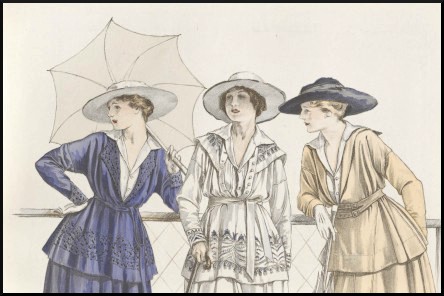
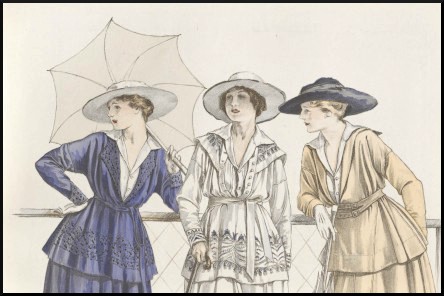
Image Notes: Illustration from “Les Élégances parisiennes” with publication date Juillet 1916. Image accessed via gallica.bnf.fr. Caption says: COSTUMES DE JERSEY: Modèles de Gabrielle Channel. (The correct spelling is Chanel). Image has been cropped and resized.
Update History: On March 27, 2025 the format of the bibliographical notes was updated.